Guides To The Unfree World, Ctd

by Patrick Appel

A reader writes:

That FP piece castigating Lonely Planet is horseshit. It ignores the practical reality of traveling in unfree countries: if you get caught with books that tell the truth about the regime, you can be thrown in jail.

I backpacked in Iran with a Lonely Planet guide. Sure, the account of the Islamic Revolution was a bit too even-handed for my liking, and the practical advice – don't so much as shake the hand of a member of the opposite sex, for example – didn't really get into how absurd it all was. But I went to Iran with no illusions about the theocratic repression there. (I didn't need LP to tell me.) That's the very reason I was glad my guidebook was less than frank about the evils of the system.

Debate the ethics of spending your travel money in a totalitarian country, sure. But give LP a pass on its seeming equivocation: its their way of protecting the traveler.

Another reader adds:

I'm writing my dissertation on Cuba and travel there pretty regularly. I've read the Lonely Planet history/politics section, and I completely agree that it's a long looooong ways from a good synthesis of scholarship. The point, however, is that what enables dictatorial regimes to hold power probably isn't the ideology of the tourists that visit them, it's the isolation these governments have been able to maintain. The author acknowledges as much. Travel helps!

But if you're going to go into a country like Cuba and have real conversations with people, it's way more important to have a sense 1) of the basic talking points that have framed the rule of a government that, until fairly recently had a decent level of support and 2) that people are not faceless victims thirsting for US intervention, however much they might thirst for better economic opportunities.

Poor Cubans do have amazing and unique cultures, and tourists should talk to them. By skewing left, these books put tourists in a better position to find things out for themselves. But maybe we could get congress to mandate a Donald Rumsfeld preface from here on out?

 

Will Obama’s Medicare Cuts Hurt Seniors?

Medicare_fees

by Patrick Appel

Avik Roy, who advises the Romney campaign, insists that the ACA's Medicare cuts will do damage:

Of the $716 billion in cuts, $415 billion come in the form of “updates to fee-for-service payment rates,” a euphemism for reducing Medicare’s payments to doctors and hospitals. But what happens when you reduce payments to doctors? Doctors stop being willing to see Medicare patients. And if you can’t actually get a doctor’s appointment, what does it really matter what your insurance plan covers on paper?

We already see this happening in the Medicaid program, where sick and injured children can’t get appointments to deal with urgent medical conditions, because Medicaid so severely underpays doctors relative to private insurers.

A valid point. But Roy goes too far here:

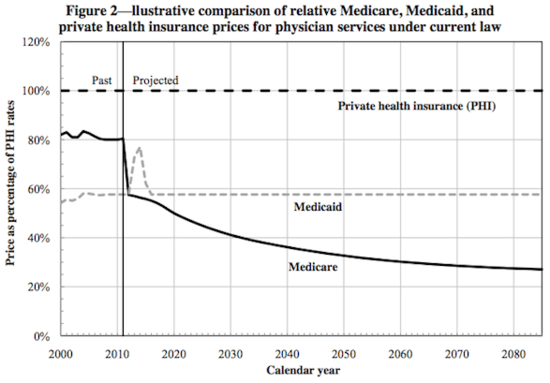
By the end of this decade, under Obamacare, Medicare reimbursement rates are set to fall below those of Medicaid.

Roy illustrates this point with the chart above, but, if you read the report (pdf) from where the chart comes, it becomes clear that the big cut in Medicare payments under current law mostly isn't due to Obamacare. From the report:

Medicare physician payment rates decline to 55 percent of private health insurance payment rates in 2013, due to the scheduled reduction in the Medicare physician fee schedule of more than 30 percent under the [Medicare Sustainable Growth Rate] formula in current law. (In practice, Congress is very likely to override this reduction, as it has consistently for 2003 through 2012.) 

This override is often referred to as the "doc fix." Obamacare's Medicare cuts will have real consequences. For instance, Sarah Kliff finds evidence that the cuts could lower healthcare quality for Medicare recipients. But Roy's accounting trick makes it difficult to trust him or his numbers.

Baseball’s Bipolar Day

GT_FELIXHERNANDEZMELKYCABRERA_20120816

by Chas Danner

Yesterday was a dramatic one for professional baseball. On one hand, one of the finest pitchers in the game, the Mariners' Felix Hernandez, did the hardest thing a pitcher can do: he pitched a perfect game. On the other hand, it was announced that the MVP of this year's All-Star Game, Giants outfielder Melky Cabrera, had become the second (seemingly) elite player in less than a year to test positive for a performance-enhancing drug, automatically earning him a fifty-game suspension.

Hernandez's accomplishment was only the 23rd perfect game in history, and, remarkably, the third of this season; Cabrera's accomplishment was to remind everyone that the steroid era, during which almost every achievement in the game was tainted, might never completely end. Last season, the National League MVP, Ryan Braun, also tested positive for PED use, and when paired with the Cabrera news, it clearly suggests that some ballplayers still don't care how damaging PED use is to the sport. The harsher penalties imposed since the steroid era haven't discouraged marquee players from cheating, and the Player's Union has traditionally been slow to allow more strenuous testing or stronger penalties (though it's worth noting that last year they did agree to blood testing for human growth hormone). ESPN's Buster Olney, says it's time for the players themselves to take responsibility for cleaning up the game, and the way they can agree to do that is to realize that PED use is not just cheating, it's theft. (Olney's column is sadly paywalled):

Melky Cabrera was like a bank robber who did everything right in his plan to steal tens of millions — right up until the moment his getaway car ran out of gas. With a little luck, it would've all worked out as planned, and Cabrera could've made $60 million, or $70 million or $80 million or more. It's unclear exactly what day Cabrera was asked for the urine sample that tested positive, but if the timing had been different, he might've slipped through the cracks before becoming a free agent this fall. And it's just the latest example that should scare the players' union into seeking tougher penalties for drug offenders.

Cabrera cheated his way from mediocre to elite, and thus into a position to be (over)paid accordingly. If Cabrera had landed a top-tier contract, he would have stolen significant market value from every other player who'd played the game fair, yet couldn't perform as well as he could. Olney believes the penalties must now be made intolerably severe, similar to those already in place for gambling offenses:

[Those testing positive should receive a] one-year ban for the first offense, and a lifetime ban for the second offense. Additionally, any player suspended for performance-enhancing drugs should have his contract voided, with the player remaining under the control of the team that signed him. And any player who tests positive in a given season should automatically be ineligible to play in the postseason that year, so they are not rewarded with a playoff share. … These would be an important means in assuring that cheating players would be face career-threatening risks, rather than a penalty that is light enough that the Melky Cabreras of the world would seek ways to beat the system — to rob the marketplace.

(Left photo: Starting pitcher Felix Hernandez #34 of the Seattle Mariners celebrates after throwing a perfect game against the Tampa Bay Rays at Safeco Field on August 15, 2012 in Seattle, Washington. By Otto Greule Jr/Getty Images; Right photo: Melky Cabrera #53 of the San Francisco Giants pauses at second base after doubling against the Colorado Rockies at Coors Field on August 3, 2012 in Denver, Colorado. By Doug Pensinger/Getty Images)

The Public’s Economic Knowledge

by Patrick Appel

Gabriel Lenz tests it. Among the results:

I asked about the number of recessions the US experienced in the last 50 years…The actual number of recessions the US has experienced in the last 50 years is about eight: one in 1960s, two in the 1970s, two in the 1980s, one in the 1990s, and two in the 2000s. However, about 70% answered between zero and five, and 26% picked between zero and two. Only about 20% chose the correct range, which was 6 to 10. This misperception may help us understand why voters throw out incumbent presidents during downturns. When the economy happens to experience a downturn in an election year—as it did in 1980 and 2008—they see it as an unusual event with ominous implications, not realizing that recessions regularly occur. As a result, they may more often vote against the incumbent party.

(Hat tip: Sides)

Your Little Purring Murderer

by Chas Danner

A new study has been bouncing around the web in which cameras were attached to pet cats so that their behavior (and kill-totals) away from home could be better understood. Deanna Pan goes over the numbers:

About 30 percent of the sampled cats were successful hunters and killed, on average, two animals a week. Almost half of their spoils were abandoned at the scene of the crime. Extrapolating from the data to include the millions of feral cats brutalizing native wildlife across the country, the American Bird Conservancy estimates that kitties are killing more than 4 billion animals annually. And that number's based on a conservative weekly kill rate, said Robert Johns, a spokesman for the conservancy. "We could be looking at 10, 15, 20 billion wildlife killed (per year)," Johns said.

Amanda Marcotte points out who's really at fault for the death toll:

Apologists for outdoor cats often shrug these numbers off by saying that since it's a cat's instinct to kill small animals, then this can all be chalked up to "nature" and not really a matter of human concern. But the only reason there are so many cats out there is because of people; we introduce them to new environments and sadly, we often let the reproduce rapidly without any check until they've completely overrun the place. Spay and neuter programs help, as do catch-and-release programs to sterilize feral cats who have no hope of living with people. Still, the bird death toll could be even more seriously reduced if people stopped letting their cats roam about unsupervised.

Indeed the study's authors also recommend just leaving your cat indoors. Marcotte summarizes her attitude:

I approach cat ownership in the spirit of the TV show Dexter: Accept that your cats have troublesome urges and learn to channel those urges productively.

(Video: Tibs by Sam Huntley, who had some issues with his feline actor)

A Body Of Texts

by Zoë Pollock

Allison K. Gibson weighs the pros ands cons of mentioning technology in fiction:

First, technology can be awkward to write about. The jargon is clumsy: download, reboot, global positioning device. It’s embarrassing, really. So I understand an author’s impulse to avoid littering pages of otherwise lyrical prose with the bleep-boop-beep of tech speak. For this reason, authors often forgo current technologies when they want their characters to communicate with one another, or to reveal important, plot-forwarding information. I get it. What could be less romantic than a text message?

Fiction allows for a certain level of restraint, after all, where the author need not include a protagonist’s every bathroom break or end each scene with the characters saying goodbye. Why then, if it’s common practice to avoid including other unglamorous functions of characters’ daily lives — like said bathroom break — is it necessary to show them texting and refreshing their inboxes? Think of it this way: in most cases, a bowel movement will not move the plot forward; an email will.

On that note, the author Will Self recently gave an interview raging against disembodied fiction:

In a way, it’s just as simple as nobody ever having a shit in a book whereas it seems to me that the condition of somebody’s digestion is of almost paramount importance to their mental state. So much fiction seems disembodied to me, and so connected with a kind of cultural and political establishment, in whose interest it is that we be disembodied—particularly in Anglo-Saxon culture which is so antipathetic to sexuality, sensuality, and bodily experience.

If you write a novel in which nobody has a shit, nobody pisses, farts, cuts themselves, nobody has an awful fugue where they are aware of their blood circulation or their swollen liver or the wheeze in their lungs or the spot on the line of their jaw—what are you saying about the world at that point? You’re saying that the important thing is nothing to do with embodiment. You’re saying that the important thing is that we’re not like animals, whereas of course we are animals.

The Secret Of The Dog Shake

by Patrick Appel

Alexis explores the physics and purpose of animal drying methods:

[T]hink about a dog's skin. You know how loose it is? I had previously thought the main purpose of loose dog skin was so that they would look funny on UpsideDownDogs.com. But it turns out there is another more important reason. Because the skin is loose, it can whip around farther and faster than the backbone can. The skin, to which the fur is attached, travels at three times the speed of the backbone, which, according to the math, generates nine times as much force on the water droplets, helping fling them off. That's the magic of the mammal shake. 

It All Comes Down To (Yawn) Monday Night

by Gwynn Guilford

David K. Randall explains how the rigid 8:30pm timing of Monday Night Football leaves teams vulnerable to their circadian rhythms, particularly in that "strength, flexibility, and reaction times surge in the early evening, when [they pull] the body out of the post-lunch funk":

The scheduling of Monday Night Football games presents a unique circadian problem, especially if a team from the West Coast is playing a team from the East Coast. Players on the West Coast team are playing at their equivalent of 5:30 p.m…, [while East Coast players'] bodies are past their natural performance peaks before the first quarter ends. By the fourth quarter, the team from the East Coast will be competing close to its equivalent of midnight. Their bodies will be subtly preparing for sleep by taking steps such as lowering the body temperature, slowing the reaction time, and increasing the amount of melatonin in their bloodstream. Athletes on the team from the West Coast, meanwhile, are still competing in the prime time of their circadian cycle.

The trend bears out historically, it seems – with surprisingly consistent odds:

The Stanford researchers dug through 25 years of Monday night NFL games and flagged every time a West Coast team played an East Coast team. Then, in an inspired move, they compared the final scores for each game with the point spread developed by bookmakers in Vegas. The results were stunning. The West Coast teams dominated their East Coast opponents no matter where they played. A West Coast team won 63 percent of the time, by an average of two touchdowns. The games were much closer when an East Coast team won, with an average margin of victory of only nine points. By picking the West Coast team every time, someone would have beaten the point spread 70 percent of the time.

Curating The Closet

GT_PRADA_MET_120808

by Zoë Pollock

The Met has been at the forefront of ushering the world of apparel under the wing of art:

Fashion exhibits like that on Alexander McQueen and Schiaparelli and Prada are now major attractions, not peripheral or trivial like the old costume exhibits, because of, rather than despite, the fact that they blur the boundary between high-brow and low, enduring and ephemeral, mind and body, vanity and philosophy, and art and commerce. They glory in the confusion, rather than try to hide or rationalize it.

The clothes that scream art are almost always unwearable, bordering on ugly. John Waters recently gave an amazing speech in honor of Comme des Garçons designer Rei Kawakubo at the Council of Fashion Designers of America:

I wear Comme des Garçons the same way Andy Warhol once wore $100,000 women’s necklaces underneath his Brooks Brothers turtlenecks — to be fashionable in secret. Only you know you spent money when you wear Rei’s creations. In fact, some of the more fashion-impaired public actually feels sorry for us! “That’s a shame about that coat,” an uninformed friend said to me once in a bar in Baltimore when I was wearing, well high fashion. “John Waters in his thrift-shop finest,” the press has written when, in fact, I was featuring a brand-new Comme des Garçons suit! Rei Kawakubo gives us undercover glamour. We know how great her clothes look, but others just think we’re poor.

Bonus link: the Beast recently launched a fashion blog.

(Photo: Visitors look at the “Schiaparelli and Prada: Impossible Conversations.” exhibition, organized by The Costume Institute of The Metropolitan Museum of Art. The exhibition, which will run from May 10 through August 19, 2012, features approximately 100 designs and 40 accessories by Elsa Schiaparelli (1890–1973) from the late 1920s to the early 1950s, and by Miuccia Prada from the late 1980s to the present, drawn from The Costume Institute’s collection and the Prada Archive, as well as other institutions and private collections. By Emmanuel Dunand/AFP/Getty Images.)

The Perils Of Cubicleville

by Patrick Appel

Annie Murphy Paul examines co-worker interactions:

The original promoters of open-plan offices … hoped that the setting would make co-workers available to help one another. That’s great for the help seeker; not so great for the help giver who has her own work to do. In a study released last month by a group of German and Swiss researchers, participants who requested help with a task performed better, while those who supplied assistance did worse. Frequently alternating between helping others and doing one’s own job imposes a heavy “cognitive load,” the scientists concluded, as the help givers are forced to repeatedly reacquaint themselves with the details of their own task. They recommend that workers set aside a block of time each day when they are not to be disturbed.