The Daily Wrap

Florida

by Gwynn Guilford

Congratulations, readers! Today on the Dish, you dissected the impact of Ryan's plan on seniors, and then roundly debunked Ryan's crossover appeal after conservative bloggers crowed about his victory in a Dem district. Out of the inbox and into the blogosphere, as Adam Sorensen pondered Romney's unclear monetary policy and dark money swept Sauron-like over the race, Romney laughed lamely.

Ben Smith recoiled at nasty campaign rhetoric, the Obama campaign dithered on releasing a Medicare ad and Silver predicted convention-bounce. Sam Wang crunched some provocative numbers on Ryan's implications for the Congressional races and Ryan's team dissembled on his tax-loss harvesting.

In healthcare, Aaron Carroll wished for a middle way and changes in reimbursement lowered ACA spending over time. Meanwhile, Wes Clark Jr. defended Sr. and Barney discussed DOMAdaemmerung.

Today's Ask Jesse Bering Anything touched upon masturbation, "pink boys" made gender expression even more complex and the Lebanese civil war changed bread-making. The Lonely Planet left-flanked itself into dictator-coddling, Alyssa Rosenberg trashed tabloids and news on the ineffectiveness of sunblock appalled. And while New Mexico enchanted – and Connecticut and Pennsylvania were haunted – the history of the Exxon Valdez resurfaced.

In more assorted commentary, Richard Brody explained why most adaptations suck and a new martial reality TV show rankled. "A show of hands" took on a creepier meaning, shopping evolved, children's books taught adult lessons and ticks caused hamburger-threatening allergies. FOTD here, MHB here and VFYW here.
Ad War Update: Dónde Está Paul Ryan?

by Chas Danner

Still no TV ads from the Obama campaign regarding the Romney/Ryan medicare stance, instead they put out this web video today, perhaps as a preview:

Meanwhile the DNC put out an anti-Romney/Ryan sing-along which is so terrible it barely deserves a link. From the other side the RNC goes on the offensive wielding the $716 million billion BS from yesterday's Romney ad, while the Romney campaign has a new Spanish language ad out attacking Obama (size and scope of the ad buy is currently unknown):

Justin Sink captions:

The ad opens with video of the president declaring, "Yes, we can," in Spanish, with onscreen text then responding back, "Can we?" As a montage of worried-looking Hispanic voters plays, onscreen text displays unfavorable statistics about the economy. Among the claims: more than 10 percent Hispanic unemployment and more than 2 million American Hispanics in poverty. "Can we allow for Democrats to continue fooling us?" a narrator says. "When Obama and his Democrat allies tell us, 'Yes, we can,' we've got to tell them we no longer can!"

Paul Ryan doesn't appear in the ad, and there might be a reason for that:

Mitt Romney is on track to lose the Latino vote by a wider margin than any Republican presidential candidate in over a decade, and strategists in both parties say he may have made a bad situation worse with his selection of Wisconsin Rep. Paul Ryan as his running mate. What’s clear is that Romney’s lagging fortunes among Hispanics are unlikely to receive any boost from choosing a vice presidential candidate who has voted in Congress against the DREAM Act and supports overhauling entitlement programs that are extremely popular among Latino voters.

In outside spending dark money news, Karl Rove's Super ("non-profit issues") PAC, Crossroads GPS, is dropping $4.7 million to attack six Democratic Senate candidates with TV ads like this one (a $1.33 milllion buy) targeting Senator Sherrod Brown (D-OH) again:

But Crossroads GPS is spending the most money in this particular run by hammering Tim Kaine with two ads in Virginia. As far as a Democratic response, the DSCC is out with this new web video which tries to shine a light on C-GPS's shadiness, and then asks for donations to help "fight back":

Ad War archive here.

No ID, No Vote, Ctd

by Chas Danner

The GOP's voter ID law in Pennsylvania, which combats non-existent in-person voter fraud, has been upheld:

Commonwealth Judge Robert Simpson said the individuals and civil rights groups challenging the law had not met the heavy burden of proving that it so clearly violated the state constitution that it should not be implemented. He said there was still time for those without proper ID to acquire it.

The case will likely now head to the (ideologically split) Pennsylvania Supreme Court. Last week Emily Badger took a look at the problem the law specifically creates for Philadelphia, where as many as 280K voters may need to get a law-approved ID before November:

Would-be voters [in Philadelphia] might have better access to the DMV, but they're less likely to have driver's licenses in the first place because it's so much easier to live in Philadelphia than in rural areas (or even the suburbs) without a car. … Herein lies the unique quandary in Philadelphia. It is a large, left-leaning city, with the public transportation system of an old Northeastern metro area built in the era before cars. But it happens, right now, to be located in a state with a Republican-controlled legislature. There are plenty of older cities in America where large numbers of people might not have driver's licenses. But most of those cities, as [the Brennan Center's senior counsel Keesha] Gaskins points out, are in solidly blue states where it’s highly unlikely that voter ID laws would pass in the first place. This is also true of places like Chicago, San Francisco, and Seattle.

In 2008, Obama took 83% of the vote in Philadelphia. Badger also writes how regardless of whether or not the law is overturned, it has already created a great deal of confusion, which may also suppress turnout. Weigel thinks the law will force a strategy change for GOTV groups:

[The judge] was convinced by [the state's] simple, effective tactic of proving that all 14 sob-story ACLU et al witnesses could find ways to vote. The most likely political response to this, I'd guess, will be a more-aggressive Democratic/NAACP/labor campaign to get absentee ballots in the hands of their trouble voters — especially in places like Philadelphia — and instruct these people on how to justify the need for the ballot.

The Hypochondriac’s Insight

by Zoë Pollock

Alexander Nazaryan considers it:

For example, my therapist tells me that to worry unceasingly about getting cancer is as irrational as worrying about getting hit by a bus on Flatbush Avenue. In fact, I am terrified of getting hit by a bus on Flatbush Avenue, and I think he is the madman for being so cavalier on the subject. Has he been out there recently? [Catherine Belling author of "A Condition of Doubt: The Meanings of Hypochondria"] says that hypochondria is "always ironic," by which she means that, despite all its convolutions, hypochondria is always right. You will get sick and die. The question is only when and how.

The Hull Story

by Gwynn Guilford

The 1989 Exxon Valdez oil spill, the worst until Deepwater Horizon in 2010, is still killing sea otters today. Shanta Barley sees the ecological upside:

In 1990, the United States passed the Oil Pollution Act (OPA): a powerful piece of legislation that required oil tankers in US waters to have double hulls. It also boosted the government's ability to respond to spills; provided up to US$1 billion to deal with individual accidents; increased penalties for oil companies responsible for spills; and required businesses to draw up exhaustive plans for handling spills.

Barley also recounts the ship's post-'89 history:

In 2007, the Valdez endured her most brutal makeover yet. She was converted into an ore carrier and renamed the Dong Fang Ocean, sailing under a Panamanian flag. Her luck had not changed. In 2010, she celebrated the 21st anniversary of the Exxon Valdez disaster by smashing into the cargo ship Aali in the Yellow Sea, amputating her own anchors and piercing the Aali's ballast tanks. And in 2011, by now known as the Oriental Nicety, she was sold for $16 million to an Indian demolition company, Priya Blue Industries.

Face Of The Day

GT_INDIA-CADET_120815

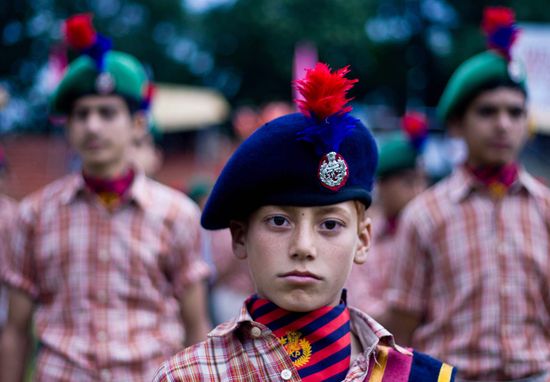
A member of National Cadet Corps (NCC) stands in formation during India's Independence Day celebrations on August 15, 2012 in Srinagar, the summer capital of Indian Administered Kashmir. All businesses, schools and shops were closed and traffic remained off the roads following a strike call given by Kashmiri separatist leaders against India's Independence Day celebrations in Kashmir. Meanwhile, India deployed large numbers of Indian police and paramilitary forces to prevent any incidents during the official celebrations. By Yawar Nazir/Getty Images.

– C.B.

Reality Television Goes To “War” Ctd

by Chris Bodenner

Wesley Clark Jr. writes the Dish to defend his dad from Ackerman:

Yes, he was first in his class at West Point and a Rhodes Scholar.  After being shot four times in Vietnam, he came home and was first in everything in his Army career, consistently building the strongest units at each post, designing many of the training programs at NTC that trained our Army prior to the first Gulf War.  He then negotiated the Dayton Peace accords.  He then led NATOs first war in Europe and stopped ethnic cleansing on the continent.

During the war, the British General, clearly an alcoholic, refused to seize the Pristina airfield after the Russians tried to enter and seize the province with an initial holding force from Bosnia.  The Russians, by the way, supported the Serbs in their ethnic cleansing campaign.  Rather than allow the Russians to grab the province, he had apaches land on the runway at the Pristina airport, blocking the 10,000 Russian troops being airlifted to it – the Russians were prevented from grabbing Kosovo and WW3 didn't start. Sniping Generals in the Pentagon like Shelton didn't win the war in Kosovo without losing a single American life and hold together a coalition of European nations that each wanted to feel like an equal partner – my father did.

After the war, he made a conscious decision not to sell guns and bombs like other retired generals, so he worked with an electric motor company.  After 9/11, he was the first retired officer to publicly speak out that invading Iraq would be a strategic mistake when that was a very unpopular opinion.   He was also extremely supportive of gay rights and agreed to be on the cover of The Advocate when he knew it would damage him politically in the primaries.

He now serves as either a consultant or board member for more than thirty companies, many of them green tech startups in wind, solar, biomass, biofuel, building materials and natural gas.  He is on a plane almost five days a week and works from 5am until 11pm.

He met Mark Burnett, who was a para in the Falklands War, and liked the idea of a show that would benefit vets.  It would mean a month not traveling every day, he could still work over the phone and computer and he would be close to his grandchildren and get to see them every weekend.  I suggested he do the show, because frankly, I thought he needed a month off and it would benefit a good cause.

He had a good time and was able to relax.   He enjoyed meeting the vets on the show and he thought the celebrities were nice and now he's back to being on planes every day, to include doing speeches for Obama and Democratic candidates because he's worried about the future of this country and how we deal with climate change and the changing strategic environment.

I just don't get the hate.

Children’s Books, Adult Lessons

Screen shot 2012-08-07 at 3.49.39 PM

by Zoë Pollock

Maria Konnikova provides a wonderful meditation on the philosophical lessons hidden in children’s books. In The Little Prince, she argues, “you find as clear a commentary on everything that’s wrong with modern life—and what can be done to fix it—as you would in the most biting social satire”:

Think back on those planets the boy visits on his trip to earth. Each inhabitant offers a profound lesson on how easily we can go wrong in our life choices. There’s the red-faced gentleman, who has “never smelled a flower…looked at a star… [or] loved anyone.” Why? He’s been too busy telling everyone that he’s a serious man–and acting the part. For, as we learn later on, he is a businessman. A businessman whose business is counting the stars, so that he might own them—but so preoccupied is he with the counting that he forgets to enjoy his wealth. … The little prince reminds us to have the proper perspective on the world around us: to be attentive and present, to know why we do what we do, to remain ever-curious, ever-inquisitive, ever-questioning, to remember the things that matter–and those that don’t. A child can’t realize the significance of the lesson, because it hasn’t yet been lost on him.

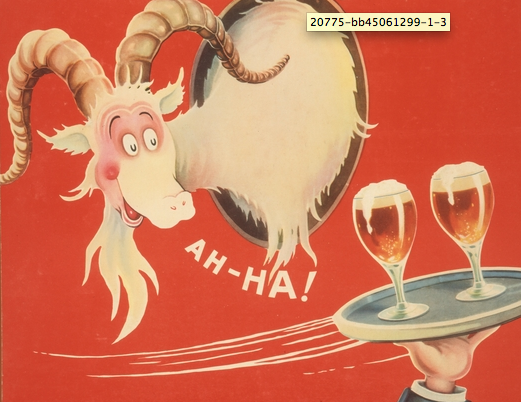
(Image from a Schaeffer Bock Beer advertisement by Dr. Seuss. From the Dr. Seuss Collection, MSS 230, Mandeville Special Collections Library, UCSD via The Millions)

The Mystery Of Wisconsin’s District One, Ctd

by Chris Bodenner

A reader writes:

This isn't as much for you as for John Fund, but this is just Paul Ryan lying to John Fund. Bush carried Ryan's district in both 2000 and 2004.

Another:

Furthermore, Ryan's district voted for McCain at higher percentages than the nation at large. The district has a partisan voting index of R+1. In the last century, it has sent 11 Republicans to Congress and only 4 Democrats (and 1 Progressive).

Another:

Ryan's crossover appeal possibly is potent, but I'm not sure if looking at his election record speaks that strongly to such an appeal at a national level. According to Lizza's recent piece, the Ryan name goes a long way in his district:

Three families, the Ryans, the Fitzgeralds, and the Cullens, sometimes called the Irish Mafia, helped develop the town, especially in the postwar era. The Ryans were major road builders, and today Ryan, Inc., started in 1884 by Paul’s great-grandfather, is a national construction firm. The historic Courthouse section of Janesville is still thick with members of the Ryan clan …

So it seems his name was a big reason he was recruited to run for office. Even though he's able to score Dem votes locally, that might simply be because his family has deep roots in the district and has employed many for years (Corporate HQ is still in town). I'd need to see more evidence to believe independents and Dems across the nation will eventually find him and his proposed policies palatable enough to vote for his ticket. And considering the polling done about his budget … I'm skeptical.

Another:

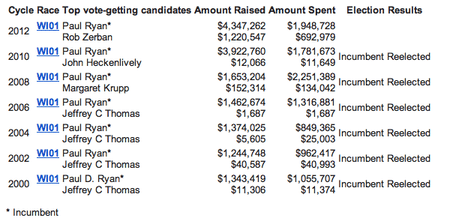
Philip Klein's argument is disingenuous; Paul Ryan has never faced a serious challenger in his district. That factor, not the cross-over appeal of his views, or his persona charm, explains why he's won with such large margins of victory. The Democrats in WI and nationally have never taken seriously the notion that they should mount a serious challenge to Ryan in his House contests. Take a look at the expenditures of his opponents to see what I mean:

Screen shot 2012-08-15 at 4.41.26 PM

Why Do Most Adaptations Suck?


by Zoë Pollock

It's not easy to turn a great novel into a film , according to Richard Brody, who notes that the usual attempts involve some "plot, the dialogue, maybe some voice-over, in a kind of Classics Illustrated surrogate for the book":

The subject of the cinema is the world, of which good books are a crucial part; whether filming with documentary curiosity or with artistic ambition, they’re hard for directors to avoid—and there’s no reason for a director to avoid them. But there is a rule of thumb that’s worth noting: a director is likely to stumble when taking on the work of a writer who is a greater artist. Many directors of moderate merit do well in capturing their own experience or that of others of modest and practical insight—but when they lay hold of works of genius, they simply aren’t up to the material and reveal not the vastness of the author’s imagination but the limits of their own. Welles and Godard are in their element when they film Shakespeare, as is Bresson with Dostoyevsky, Hawks with Hemingway, Sirk with Chekhov. Those of us who are standing on the shoulders of giants shouldn’t try to wrestle with them; only giants can wrestle with giants, and adaptation, if it’s any good, is no mere mark of respect but an active and dangerous contention, an assertion and self-assertion that is as brave and as daring as it is potentially catastrophic.