Ryan Trims Romney’s Coattails

by Patrick Appel

Sam Wang argues "that a major consequence of the Ryan VP nomination is not for the Presidential race, but for control of Congress in 2013":

What if the Romney-Ryan ticket causes candidates to campaign explicitly on GOP budget priorities? Imagine that slightly more voters switch their votes in one direction or the other based on what they hear. If 1% of voters flip toward Democrats, the resulting 2% swing leads to this. In this scenario, the probability of Democratic control [of the Senate] is 82%.

What Is Romney’s Monetary Policy?

by Patrick Appel

Adam Sorensen asks:

It was probably politically unviable for Romney to support another term for Bernanke, who’s become a monetary boogeyman on the right in the wake of the financial crisis. But just because he opposes a third term for Bernanke does not mean he opposes Bernanke’s broader approach to monetary policy. (Romney has said Fed easing in 2009  was "effective to a certain degree.") On the same note, just because he opposes "massive" easing right now doesn’t mean he generally opposes the Fed’s mission to foster employment. (The Romney campaign didn’t immediately return a request for clarification on his position.)

Recent Dish on Ryan's monetary radicalism here.

State Stereotypes

Screen shot 2012-08-09 at 3.12.24 PM

by Zoë Pollock

Renee DiResta investigated them:

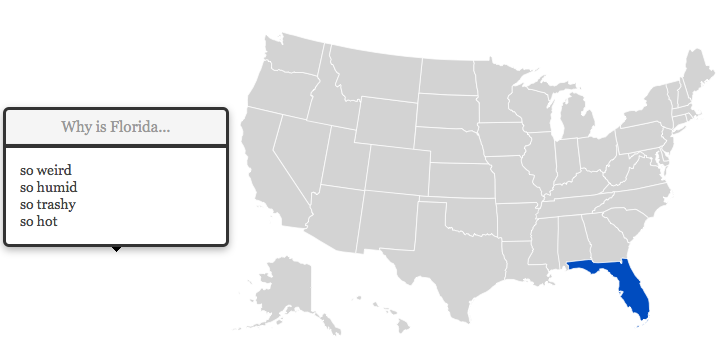
I started wondering, how do Americans really think about "those people" in other states? What are the most common stereotypes? For each of the fifty states and DC, I asked Google: "Why is [State] so" and let it autocomplete.

The results:

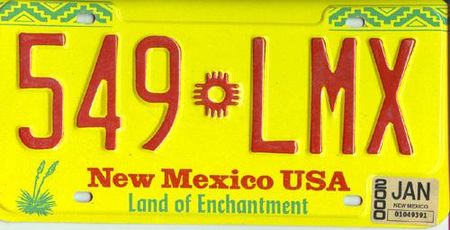
The single most common result of all was "boring," which appeared for 18 states with no particular regional concentration. Other popular terms (returned for >10 states) were "humid", "windy", "expensive", and "liberal". Strangely, Connecticut and Pennsylvania both returned "haunted"; apparently there are a lot of ghost sightings (and related walking tours). My favorite result of all was "enchanting": New Mexico is beautiful.

Update from a reader:

Stands to reason that "enchanting" came up on autofill for New Mexico:

Nmy2kpl

(Hat tip: Nathan Yau)

The Ryan-Obama Plan

by Patrick Appel

Aaron Carroll analyzes the campaigns' health care plans. He concludes by wishing for a middle way:

A bipartisan plan could come from Republicans accepting the Affordable Care Act as it stands for all those younger than 65, without further talk of repeal, in exchange for implementing the Ryan-Wyden plan for those 65 and older. After all, that proposal isn't really much different than the way the exchanges will work in the Affordable Care Act, with the exception that there is a public option (which should be opened to everyone under 65 as well). Everyone gets something they want, with all the tools available being brought to bear on containing future costs.

This would require compromise, though, something that is in short supply in election years.

The Mystery Of Wisconsin’s District One

by Gwynn Guilford

Michael Gerson thinks Ryan's Tea Party ties are a red herring more than they are kryptonite:

Ryan’s critics will attempt to make him out as the second coming of Michele Bachmann. In fact, they fear him more, because he is infinitely more serious. He represents not the inchoate frustration and nostalgia of the tea party but a developed, thoroughly modern conservative approach to governing.

Apt that he should mention Bachmann since, as Michelle Goldberg put it in an article Patrick's linked to earlier this week, "[O]n abortion and women’s health care, there isn’t much daylight between Ryan and…Michele Bachmann." (For more detail on Goldberg's point, there are plenty of lists out there enumerating Ryan's voting record.) But as Walter Russell Mead argues, Ryan equals buy-in for those Mormon-squeamish value voters out there:

The [Ryan] choice didn’t just define Romney; it energized the Republican base and did it in a way that works well for the ex-governor. Romney may be socially conservative, but because his personal views are rooted in a religious faith that many of the most zealous Republican social value voters deeply dislike, this connection can never make Republicans fall in love with him.

Beyond the question of whether Ryan will help energize the base lies a more vexing perplexity in Ryan's voter-block record. As Philip Klein points out, the congressman has consistently won not just independent but Dem votes:

Everybody should remember that Ryan doesn’t come from some sort of deeply conservative area, but a moderate district in the Midwest. C00k Political Report has ranked the district 218th in its partisan voting index out of 435 Congressional districts — in other words, it is right smack in the middle. Ryan been running on entitlement reform since 1998 and has been consistently attacked for wanting to destroy Medicare and Social Security, yet he’s won comfortably seven times. In 2008, his district went for Obama 51 percent to 48 percent, yet Ryan beat his Democratic challenger by 29 points (64 percent to 35 percent).

John Fund observes that even Ryan is confident in his own crossover appeal:

[I]f Ryan is an extremist and his proposals are so unpopular, how has he won election seven times in a Democratic district? His lowest share of the vote was 57 percent — in his first race. He routinely wins over two-thirds of the vote…. Ryan has pointed out to me that no Republican has carried his district for president since Ronald Reagan in 1984.

A radio segment by Patt Morrison digs into this mystery (my transcription):

Reporter Chuck Qurimbach: "His opponents…have been not particularly polished debaters over the years so he hasn't in a number of years had that candidate-versus-candidate debate experience."

Elsewhere in Morrison's radio interview, politician John Heckenlively, who ran against Ryan in 2010, distinguishes between the "aw, shucks" Wisconsin persona and the Washington "hard-nosed politician" that votes the party line 95% of the time. Adds Qirmbach, "He's an engaging fellow with a more conservative voting record than comes across in his demeanor." Steve Benen agrees:

Ryan is a congressional Republican, and nearly all congressional Republicans are very conservative on social issues. But that's why the details matter — the perception of Ryan as a budget wonk obscures his deep commitment to fighting cultural battles, and for that matter, even on Capitol Hill, Ryan is considered very far to the right, as evidenced by his sponsorship of a "Personhood"-style measure…. Given Mitt Romney's new-found interest in the culture war, it's worth realizing the Republican ticket's focus goes far beyond the budget and the economy.

Part of this might be because, as Kevin Drum points out, Republicans don't tend to tout their fetal politics much these days. Perhaps that's because, as we've covered in the past, Obama independents tend to be "younger, female and more secular" – not the types who would be endeared by a "Personhood" pol. Another possible advantage for Team Obama might be that, as Patrick noted over the weekend, despite Ryan's vaunted intra-Beltway profile, most voters don't have a clue who he is. That's a blank canvas that could be painted in Michele Bachmann's likeness as easily as it could be done in Reagan's.
Obama’s Medicare Cuts

Medicare_Cuts

by Patrick Appel

Sarah Kliff looks at where they come from:

The Medicare Advantage cut gets the most attention, but it only accounts for about a third of the Affordable Care Act’s spending reduction. Another big chunk comes from the hospitals. The health law changed how Medicare calculates what they get reimbursed for various services, slightly lowering their rates over time. Hospitals agreed to these cuts because they knew, at the same time, they would likely see an influx of paying patients with the Affordable Care Act’s insurance expansion. The rest of the Affordable Care Act’s Medicare cuts are a lot smaller. Reductions to Medicare’s Disproportionate Share Payments — extra funds doled out the hospitals that see more uninsured patients — account for 5 percent in savings. Lower payments to home health providers make up another 8.8 percent. About a dozen cuts of this magnitude make up the green section above.

Ed Kilgore adds his spin.

The Gossip Rag Formula

by Patrick Appel

Alyssa Rosenberg flips through the tabloids:

Relatively neutral photographs are interpreted whatever way will pique pageviews and cover-lines, or read for body language retroactively, as with the snaps of Kristen Stewart at dinner with Rupert Sanders, her married director on Snow White and the Huntsman with whom it emerged that she was having an affair. No touching? No problem: Us Weekly read the fleeting expressions on their faces with all the voraciousness and certainty of augurs picking through entrails. Sources are "close friends" with the stars in question, or "in a position to know." Health experts have never treated the celebrities they analyze. The story can change radically from one week to the next, and nobody cares, no corrections required, and it doesn't occur to anyone to question the utter inconsistency of the narratives tabloids sell us.

Reality Television Goes To “War” Ctd

by Chris Bodenner

Alyssa joins the chorus against the new series:

Stars Earn Stripes is helping raise money for some organizations that provide those kinds of material support, including the Armed Services YMCA of Alaska, a state that is home to a disproportionate number of military families, the Wounded Warrior Project, the USO, and the Pat Tillman Foundation, which provides educational scholarships to service members and their families. But in its first episode, at least, the emphasis is more squarely on the competition aspect of the program, the sight of Terry Crews talking about how awesome it is to have figured out a sniper challenge, seeing Picabo Street kick in a door, than on the charities their efforts benefit, and the reason those charities need public support so badly.

Awesome and staged explosions are easier for a reality show to pull off than building long-term support for efforts to fill in the holes in our official support systems for service members and military families. But it would be nice if Stars Earn Stripes embraced a deeper and more nuanced sense of what it means to support the troops. The stories behind the charities the show supports are a lot richer than the sight of celebrities running around an obstacle course playing with military hardware.

Ironic that one of the charities is the Pat Tillman Foundation, given that the real Pat Tillman fiercely resisted any celebrity treatment that the Pentagon and Bush administration tried to bestow up him, for their own PR purposes. By the way, for a remarkable bit of hathos, check out US 4 Palin's review of Todd's performance:

Todd Palin started his mission with a splash, dropping into the water from a helicopter. As one man – Dolvett Quince – nearly drowned – unable to swim weighed down with over 70 lbs of gear – and was rescued, Palin immediately focused on saving the mission and treated viewers to nearly 12 minutes of valor, leadership, courage under fire, adapting, improvising and overcoming.

Once ashore, Palin took out the guard shack with an FN Herstal MK 13 EGLM 40 mm Grenade Launcher affixed to his FN Herstal SCAR MK 16 LB. Then with the SCAR 16, he took out six targets, most on the first shot. He slid under low barbed wire as easily as he crawls on his living room floor with Trig – as shots crisscrossed over his head and explosions went off all around him.