How The Conventions Skew The Polls

by Patrick Appel

Silver expects small convention bounces:

[M]y research suggests that the volatility of polls before the party conventions is correlated with the magnitude of the convention bounces. Volatile polling years seem to predict larger convention bounces, but they are smaller when the polling has been more stable heading into the conventions. Since the polls have been especially steady this year, we should probably expect below-average convention bounces: perhaps more like four percentage points rather than the long-term average of around seven points.

Because the conventions "introduce a lot of noise into the system" Silver advises "reading the polls with a more of a jaundiced eye during the next several weeks."

The Canard Over Current Seniors, Ctd

by Chris Bodenner

Readers continue to be better spokespeople on this issue than Debbie Wasserman Schultz:

The big effect Ryan's plan would have right way on the over-55 set is the change to Medicaid spending. Block grants to the states for Medicaid would not keep pace with health care cost growth, thus either forcing states to pay more and more (and raise taxes to fund these payments) or spend less on Medicaid. About 50% of Medicaid spending [pdf] is consumed by the elderly (though they comprise only about 20% of the recipients) and most particularly about 50% of all long-term care in this country is at least partially funded by Medicaid.

Another:

Debbie certainly does screw up here. Current seniors are impacted by the Ryan plan, but not in the way she tries to explain it. Medicaid provides the final safety net for most seniors who become chronically ill in old age.  After they burn through all of their assets and family assistance, seniors end up in nursing homes on Medicaid. If you haven't noticed, Ryan also gets rid of Medicaid as we know it, by cutting spending sharply (and soon) and block granting to states.

Also, it is not ridiculous to think that today's seniors actually care how their children and grandchildren will fare in retirement. So it's not unreasonable for them to look at voucherizing Medicare and seeing that it just won't work for their own families.

Another speaks from experience regarding the Medicare-Medicaid connection:

The current Ryan budget will impact today's seniors immediately, due to its cuts to Medicaid. I blog about dialysis; here's how the Ryan budget plays out in the provision of dialysis:

Medicaid is an important part of the dialysis payer mix. Among the ~400,000 people using dialysis in the US, Medicaid is the primary insurer for over 10% and Medicaid is the secondary payer to Medicare for nearly 40% of all Americans using dialysis (the "dual eligibles", who need Medicaid to pay the 20% left by Medicare). It is accurate to say ~50% of the people using dialysis rely on Medicaid for at least part of their funding.

The care every dialyzor receives is based on the average reimbursement at a unit. In a dialysis unit everyone uses the same machines, the same doctors, the same staff following the same policies and procedures, no matter how much your care is reimbursed. Even if you are in the first 33 months of using dialysis and are insured through an Employer Group Health Plan that is paying many times more than the Medicare (and by extension Medicaid) allowed rate, your care, the level of care available to you, is based on the average reimbursement rate at that clinic.

The Medicaid cuts in the Ryan budget take effect immediately. Lower Medicaid reimbursement means more states will be paying less than 100% of the Medicare allowed rate, which means there will immediately be a lower average reimbursement for each treatment. A lower average reimbursement rate means less funding for the care everyone receives. The unit’s policies and procedures, its staffing levels, how often equipment is maintained/replaced all depend on the unit’s average reimbursement. When that goes down, services decline. So beyond those with Medicaid as their secondary insurance, Medicaid cuts affect everyone who uses dialysis.

The Romney “Laugh” Ctd

by Gwynn Guilford

Paul Waldman thinks Romney's laugh will come to personify him:

Some public figures get defined by a single image, or a single statement ("Ask not what your country can do for you"; "I am not a crook"). Others have a characteristic linguistic tic or hand gesture that through repetition come to embody them….

For Mitt Romney, it's the laugh. I'm sure that at times Romney laughs with genuine mirth, but you know the laugh I'm talking about. It's the one he delivers when he gets asked a question he doesn't want to answer, or is confronted with a demand to explain a flip-flop or a lie. It's the phoniest laugh in the world, the one New York Times reporter Ashley Parker wrote "sounds like someone stating the sounds of laughter, a staccato 'Ha. Ha. Ha.'"

Andrew gave his thoughts on Romney's pinched cackle here. Money quote: "[He] talks as if he's learned the English language from some tribe of extremely cheerful, mainstream, extremely white Americans from around 1958".

The Dark Money Election

by Chas Danner

Just two conservative 501(c)(4)'s, Americans For Prosperity and Crossroads GPS, are spending more to influence this election than all the Super PACs combined:

The two nonprofits [AFP and C-GPS] had outspent each of the other types of outside spending groups in this election cycle, including political parties, unions, trade associations and political action committees, a ProPublica analysis of data provided by Kantar Media's Campaign Media Analysis Group, or CMAG, found. Super PACs, which do have to report their donors, spent an estimated $55.7 million on TV ads mentioning a presidential candidate, CMAG data shows. Parties spent $22.5 million. Crossroads GPS, or Crossroads Grassroots Policy Strategies, is the brainchild of GOP strategist Karl Rove, and spent an estimated $41.7 million. Americans for Prosperity, credited with helping launch the Tea Party movement, is backed in part by billionaire brothers David and Charles Koch, and spent an estimated $18.2 million.

As a reminder, the difference between a Super PAC and a 501(c)(4) is that the 501(c)(4) doesn't have to disclose its donors (thus: "dark money"), and in theory (but never actually in practice) the groups can only support a "social welfare" issue, not a candidate (though the groups can donate to Super PACs that do explicitly support a candidate). And just to show how one-sided the spending is so far, conservative 501(c)(4)'s are outspending their liberal counterparts more than 35 to 1. And the spending is not just on the presidential race; dark money hijinks infect the smaller races too. Here's just one example from OpenSecrets' Dan Glaun:

Las Vegas-based [Super PAC] It's Now or Never, has spent more than $155,000 supporting or opposing candidates so far this year, according to the Federal Election Commission. Of that total, $140,000 went to influence Utah's state-level attorney general race; the other $15,000 was split between supporting Sen. Orrin Hatch (R-Utah) in his primary, which he won, and Nevada State Sen. Barbara Cegavske in her unsuccessful bid to be the GOP nominee for a House seat. The group has raised $171,900. And $160,900 of it has come from the same place: the It's Now Or Never 501(c)(4) nonprofit group, a tax-exempt social welfare organization registered to the same address as its sister super PAC. The groups share leadership, a name and a location, but the key difference is that the nonprofit does not have to disclose its donors, meaning that the original source of the super PAC's funds may never be known.

Plus now a new 501(c)(4) is going to try to "swiftboat" Obama over the Bin Laden op, though of course they maintain that is not their aim:

The OPSEC group says it is not political and aims to save American lives. Its first public salvo is a 22-minute film that includes criticism of Obama and his administration. The film, to be released on Wednesday, was seen in advance by Reuters. "Mr. President, you did not kill Osama bin Laden, America did. The work that the American military has done killed Osama bin Laden. You did not," Ben Smith, identified as a Navy SEAL, says in the film. "As a citizen, it is my civic duty to tell the president to stop leaking information to the enemy," Smith continues. "It will get Americans killed."

OPSEC is also working on TV ads containing similar claims that they intend to air in at least six battleground states. It is of course absolutely ridiculous to call a group "not political" when it's funded by unknown donors and is producing material specifically aimed at President Obama to air in battleground states in the middle of an election year. Perhaps the FEC will come after these groups, like they eventually did the similar one that "swiftboated" John Kerry over his Vietnam service, but as was the case in that election, the punishment came long after the intended effect.

The Canard Over Current Seniors, Ctd

by Chris Bodenner

A reader writes:

The Ryan Medicare plan absolutely will effect people currently on Medicare.  If you establish that in 10 years the Medicare risk pool will stop growing and start shrinking, you do damage to how the program works.  First, you increase the risk in the pool and drive up cost by stopping younger healthier seniors from entering the plan.  Second, as the pool shrinks Medicare looses power to dictate reimbursement rates.  Doctors will begin not to accept Medicare patients because not only will the volume of patients no longer justify the low reimbursement rates, but those left in the pool will be older, sicker and more expensive to treat.  The program that they say will be in place will not only become much more expensive to maintain then projected, but it will collapse on itself.

Why Wasserman-Shultz can't communicate this, I do not know.  Democrats, particularly in Congress, are generally their worst spokespeople.  It is absolutely maddening.

Another is on the same page:

While it appears that Ms. Wasserman Schultz is not a policy wonk and was not prepared for the question, the assertion that the Ryan plan for Medicare would affect current seniors is not a canard.   Mr. Ryan’s plan affects current beneficiaries in two (albeit indirect) ways:

First, the only reason that many doctors put up with the low reimbursement rates offered under Medicare is because of the sheer size of the program.  Start creating incentives to shrink the program, and it becomes less enticing for doctors to continue to take Medicare patients. So seniors would continue to have their traditional Medicare but fewer doctors willing to treat them.

Second, the Ryan plan destroys the political/social contract between older citizens and younger workers.  Why should I continue to pay for the healthcare of people who happen to be over 55 when the Ryan plan says I have no chance of ever getting that kind of coverage?  I find that prospect insulting, frankly.  I refuse to be part of that system.  Ryan’s plan creates a generational divide that will eat away at the consensus behind providing health care for older citizens, which is what I suspect he wants.

Lastly, the Guy Benson "narration" really set me off.  Democrats HAVE a plan to start putting Medicare on a sustainable path – it’s called ObamaCare.

Another expands on that point:

One of the primary purposes of the Patient Protection and Affordable Care Act is to slow Medicare cost growth, primarily by limiting fee-for-service payments and making Medicare Advantage payments more competitive. Plus, there are a host of pilot programs to examine other ways to contain overall health care cost growth for the country. Ryan's plan doesn't constrain health care cost growth; it merely shifts the cost for care to private citizens. In fact, the CBO acknowledges that total health care costs are likely to be higher under Ryan's plan and would grow much faster.

Another adds:

Fact: The Ryan plan would repeal Obamacare – including the closing of the donut hole. That would effect CURRENT seniors on Medicare – costing them up to thousands a year.

“The Gender Revolution For Boys”

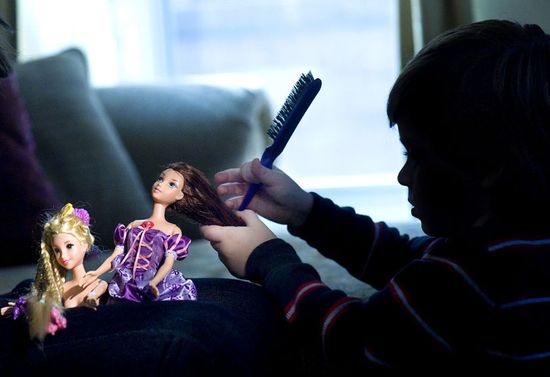
Rainbow_Barbie

by Gwynn Guilford

In an article in the latest NYT Magazine, Ruth Padawer took on the growing acceptance of “pink boys” – boys with a strong interest in traditionally female gender presentation but who identify as boys or biologically male kids who identify as both genders. (This contrasts with transgender children, such as one of the twins profiled in this excellent Boston Globe article.) Padawer documents the stories of a slew of such children, noting the evolution of their parents’ attitudes as well:

Many of the parents who allow their children to occupy that “middle space” were socially liberal even before they had a pink boy, quick to defend gay rights and women’s equality and to question the confines of traditional masculinity and femininity. But when their sons upend conventional norms, even they feel disoriented. How could my own child’s play — something ordinarily so joyous to watch — stir up such discomfort? And why does it bother me that he wants to wear a dress?

Despite a general dearth of data on the phenomenon, Padawer offers some preliminary research:

Studies estimate that 2 percent to 7 percent of boys under age 12 regularly display “cross-gender” behaviors, though very few wish to actually be a girl. What this foretells about their future is hard to know. By age 10, most pink boys drop much of their unconventional appearance and activities, either because they outgrow the desire or subsume it. The studies on what happens in adulthood to boys who strayed from gender norms all have methodological limitations, but they suggest that although plenty of gay men don’t start out as pink boys, 60 to 80 percent of pink boys do eventually become gay men. The rest grow up to either become heterosexual men or become women by taking hormones and maybe having surgery.

More comprehensive research on gender expression suggests “nature” weighs much more heavily “nurture”:

The largest study was a 2006 Dutch survey of twins, 14,000 at age 7 and 8,500 at age 10. The study concluded that genes account for 70 percent of gender-atypical behavior in both sexes. Exactly what is inherited, however, remains unclear: the specific behavior preferences, the impulse to associate with the other gender, the urge to reject limits imposed on them — or something else entirely.

E.J. Graff wonders if “the gender revolution is beginning for boys,” picking up on other signs of a shift in attitudes toward masculinity:

Researchers of workplace policies are finding that more and more young men want to take time during their children’s early years so that they can be part of those children’s lives—whether it’s parental leave when the child first arrives after birth or adoption, or the ability to be home for dinner during the week without stepping off the career track. If boys are allowed to have a little more variation in their behavior, might we end up with less bullying, fewer gay teen suicides, or even a drop in male violence at large?

Responding to photos of a camp for gender-variant children that accompanied the article, Lisa Wade sees something more akin to little drag queens than expanded masculinity:

I was struck by not just the emphasis on the dress/skirt, but the nail polish, jewelry, and high heels (on at least two of the children).  Their poses are also striking, for their portrayal of not just femininity, but sexualized femininity. It’s hard to say, but these boys look pretty young to me, and yet their (or their camp counselors?) idea of what it means to be a girl seems very specific to an adult hyperfemininity.  (After all, even most biological girls don’t dress/act this way most of the time and lots of girls explicitly reject femininity; Padawer comments that 77% of women in Generation X say they were tomboys as kids.)

Wade considers how this differs with non-conforming gender expressions biological girls:

In contrast, girls, when they enact a tomboy role — and now I’m off into speculation-land — don’t seem to go so far into the weeds.  We don’t see girls dressing up like lumberjacks or business men in suits and ties.  They don’t do tomman, they do tomboy.  There’s something more woman about how some of these boys perform femininity.

(Photo from “Raising my Rainbow“, a blog about “raising a slightly effeminate, possibly gay, totally fabulous son.” Previous coverage of the blog here.)

Guides To The Unfree World

by Patrick Appel

Michael Moynihan castigates Lonely Planet and Rough Guides for excusing the crimes of dictatorships:

[I]t's useful to begin by skimming their guidebooks for undemocratic countries like Cuba, Iran, North Korea, and Syria.

There's a formula to them: a pro forma acknowledgment of a lack of democracy and freedom followed by exercises in moral equivalence, various contorted attempts to contextualize authoritarianism or atrocities, and scorching attacks on the U.S. foreign policy that precipitated these defensive and desperate actions. Throughout, there is the consistent refrain that economic backwardness should be viewed as cultural authenticity, not to mention an admirable rejection of globalization and American hegemony. The hotel recommendations might be useful, but the guidebooks are clotted with historical revisionism, factual errors, and a toxic combination of Orientalism and pathological self-loathing.

Does Sunscreen Stop Skin Cancer?

Bondi-beach-horizontal

by Zoë Pollock

There's inadequate evidence that's true, according to the National Cancer Institute, a branch of the NIH. Emily Elert explains the problem with sun protection today:

First of all, the way sunscreen’s effectiveness is measured—its SPF rating—basically only describes its ability to block UVB rays. That’s because UVB is the main cause of sunburn, and a sunscreen’s SPF stands for how long you can stay in the sun without getting a sunburn (a lotion that allows you to spend 40 minutes in the sun rather than the usual 20 before burning, for example, has an SPF of 2).

UVA rays can cause cancer but not sunburn, so they don’t factor into the SPF calculation. That means that if you slather on a high SPF sunscreen that only protects against UVB, you’d still absorb lots of UVA radiation, potentially increasing your long-term cancer risk.

The FDA recently decreed that sunscreens have a “Broad Spectrum” label if they block wavelengths across the ultraviolet spectrum. Those regulations start in December.

(From the series "à la plage, à la piscine" by Maison Gray, courtesy of the artist. Gray shoots out of a doorless helicopter to capture beaches and pools around the world, via Junkculture)

The Gruesome History Of Hand Amputation

by Gwynn Guilford

The recent discovery of the remains of 16 human right-hands in the Nile river delta offers evidence of a grisly practice of the Hyksos military:

[A] soldier would present the cut-off right hand of an enemy in exchange for gold, [excavation director Manfred] Bietak explains in the most recent edition of the periodical Egyptian Archaeology. "Our evidence is the earliest evidence and the only physical evidence at all," Bietak said. "Each pit represents a ceremony."

Cutting off the right hand, specifically, not only would have made counting victims easier, it would have served the symbolic purpose of taking away an enemy's strength. "You deprive him of his power eternally," Bietak explained.

The horrific practice of using hands as currency has more recent (and likely larger-scale) precedent, in the Belgian Congo:

Some of the most famous images and anecdotes from the Congo include photos of men, women, and children even in single-digit age with hands hacked off with axes and machetes, most often for not meeting the unreasonable demands of Belgian quotas [for rubber]. Hands were chopped off to prove to officers, who insisted bullets not be wasted by soldiers on recreational hunting, requiring a severed hand for each bullet discharged. Not meeting quotas was also punishable by outright execution.

Amputation was also a widespread intimidation tactic in Sierra Leone in the 1990s and early 2000s.