Shopping, Revisited

by Zoë Pollock

Same-day delivery service from Amazon already is available in ten cities, and in July there was speculation that it would be rolled-out across the US. The innovation makes Ken Doctor wonder how our purchasing habits will evolve over the coming years:

In an ideal world, we may have less time for mundane shopping and more for more fruitful activity. Or we may have big empty buildings, fewer community jobs, and less socializing. And, maybe people will have more time to read. We’ll probably see all these things happening at once. Amazon, of course, just wants to make money. Yet, it has already, in part, disintermediated shopping itself. Expect it to be extend its Subscribe (interesting choice of words, right?) and Save program, wherein you get small discounts for getting regular deliveries of goods, like detergent, that you reorder over and over again. Expect it to try to change our mindsets from shopping to deciding and then letting it go, and getting it delivered without a second thought — changing the very notion of shopping.

Starting this fall, you'll be able to pay at Starbucks without pulling out your phone or wallet using the Pay With Square app. Matt Buchanan isn't suprised:

There are few things so obvious in technology that you're truly able to say it's a matter of when they will happen, not if. Paying for things with your phone seems to be one of those things, judging by the number of companies that are trying to make it happen. Google, Microsoft, Intuit, PayPal, Venmo, and Square, just to name a few, would like to replace your wallet with your phone. … There are perhaps people who might be wary of using their phones to pay for things, but it's ultimately just a matter of the right incentives to get people to switch. Namely, money. Shopping online was weird and scary once. Now half of Americans do it, spending on an average $1200 a year, with most shopping online to save money.

The Bread Of War

by Zoë Pollock

Annia Ciezadlo visits Beirut bakeries. How the Lebanese civil war changed bread-making in the city:

During the war, cooking gas would periodically run out. When that happened, Beirut
returned to a tradition as old as the city itself, the habit of the communal oven. The practice of sharing an oven goes back to the ancients, when Babylonian temples fed their subjects on the leftovers from the feasts of the gods. But the urban public oven came into its own in the medieval Mediterranean. In cities all around the Middle Sea, Christians and Muslims, Arabs and Armenians alike brought bread and other foods to the oven at the pandocheion, a Greek word for inn that means ‘accepting all comers’. For a small fee, the public baker would cook your food, saving scarce heat and fuel for all to share – a kind of culinary carpool. Private ovens encouraged segregation; public ovens led to mixing, cross-pollination, and negotiation – in a word, relationships.

Getting Personal

by Chris Bodenner

Ben Smith recoils at yesterday's rhetoric:

[T]he campaign has reached its ugliest, most fevered moment. President Obama himself invoked an old story about Romney strapping a dog to the roof of his car. The Chairman of the Republican National Committee shot back with a jibe about Obama having eaten dog as a schoolboy in Indonesia. Biden suggested that Republicans want to put voters back "in chains." Romney demanded Obama takes his campaign of "division and anger and hate back to Chicago." Obama's spokesman called him "unhinged." The atmosphere bristled with conflict, Twitter spilled over with gleeful vitriol, and the campaign reached the sort of fevered political moment when it feels like anything can happen.

That's when the Super PACs step in. Paul Mirengoff focuses on what was probably the ugliest rhetoric of the day – Biden's "in chains" comments to a largely black audience in Danville, Virginia:

To be sure, the king of saying "literally" wasn’t speaking literally. Even at his most wound up, Clueless Joe doesn’t believe that Republicans want to enslave African-Americans. Biden was just using a figure of speech. But it was an extremely distasteful one in any context, and amounts to playing the race card when delivered to a black audience. … If Biden had any decency he would, at a minimum, have walked the remark back. Instead, as Politico says, he opted to "dig in on chains."

Watch for yourself here.

The Bug Bite Diet

by Gwynn Guilford

It turns out that tick saliva can make you go vegetarian (with the exception of poultry and fish) due to its creation of an allergic response to a mammal-meat based sugar. Helen Chappell explains the condition's growing prevalence in the southeastern US, where the lone-star ticks – and possibly other species – responsible for the allergy live:

I was hoping for some reassurance when I spoke with Dr. Scott Commins at the University of Virginia about the allergy. “We believe this is becoming an epidemic in the South,” he told me instead. There aren’t any published estimates yet of the prevalence of the allergy, but anecdotal evidence makes it clear that there are a whole lot of us missing out on our barbecue.

Reality Television Goes To “War”

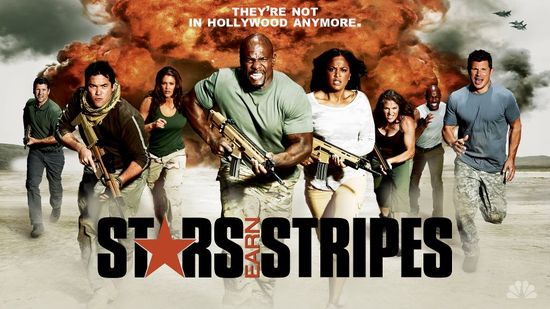
StarsEstripes

by Chas Danner

This week NBC premiered a new show in which "celebrities" like "4-Time Iron Dog Champion" Todd Palin are paired with military and law enforcement personnel then set loose in competitive war simulations (the winnings go to charity). Allison Keene pans it:

There have been protests in recent weeks that the show attempts to turn war into entertainment. If only. There are extreme amounts of platitudes offered by the contestants to the military, and while the reverence and deference towards the soldiers may be well earned and deserved, it does not make for interesting television. The complaint that the show unfairly sanitizes the gruesomeness of war is valid. It does seem to belittle the soldiers' experience to turn what they do into a competition. Worse, after merely one exercise the celebrities already begin talking about how they "understand what the soldiers have been through." Doubtful.

The protests she's referring to include a letter that nine Nobel Peace Prize winners wrote to NBC trying to get the show canned. Speaking of getting canned, Spencer Ackerman has done a must-read post-mortem on the less-than-sparkling career of one of the show's hosts, General Wesley Clark:

[Becoming the military representative on Stars Earn Stripes] seems like a bewildering career decision from a man who finished first in his West Point class and became a Rhodes scholar. But ever since retiring, Clark’s made a second career out of pimping his first. He shilled for dubious tech products before turning himself into a product — that is, attempting to become president of the United States within three years of getting fired from his job running NATO’s Kosovo war. Along the way, he inadvertently bolstered the case of his many, many military critics, who considered him a clown. Oh, and according to one of his subordinates, he came close to starting World War III.

Was Ryan Involved In Insider Trading? Ctd

by Gwynn Guilford

As per Patrick's earlier post, it seems like a clear no. However, a former index-fund analyst writes in to say Ryan's excuse – that the trades of Citigroup, Goldman Sachs and JP Morgan that seemed to coincide with a momentous meeting on Big Finance on the same day were traded within the Russell 1000 index fund – doesn't compute:

This is simply and utterly wrong. The whole point of a mutual fund is you farm out the trading of the individual holdings to a manager. Index funds are not an exception. If you're trading individual equities, you are not trading in and out of a mutual fund. And even if Ryan's investment people were indexing – i.e. following a strategy in which they mimic the returns of the Russell 1000 index – then they would have traded in and out of individual stock positions only on Russell's publicly announced reconstitution days, not "at various points throughout the year." 

He points us toward Brad DeLong's take on the situation (to follow what he's referring to, see pages 12 and 13 of Ryan's 2008 returns (PDF)):

There is no way in hell–if you are rebalancing to try to track the Russell 1000 index–you make only 58 trades in a year, that you make 27 of those 58 in large money-center banks, and that 10 of those trades involve shifting your money from Citi to Goldman and back five times. No way in hell. I don't know what was going on. But it appears that Ryan's flacks are–for some reason–simply making s@#& up.

Okay, so Ryan wasn't guilty of insider trading. But his spokesperson was clearly dissembling about the nature of the trades. Why, though? DeLong's comments section offers a sound hypothesis about the trading strategy at play:

It is very obvious what was going on. This was tax-loss harvesting, designed to avoid the 30 day wash sale rule. All the sales came 30 days or more after purchases and everytime something was sold, a correlated asset was bought. Rebalancing the index??? That is hilarious.

Another explains why Ryan's tax-loss harvesting was focused on the financial stocks – to catch an anticipated sector rebound while taking advantage of the losses for tax purposes. Keeping the financial stocks in a holding pattern, if you will. Here's the finer grain of sleuthing from DeLong's reader:

I've got a different theory. I'm willing to believe that these were arms-length trades executed by his advisers, but I think he's being deliberately disingenuous about what they were up to. This strikes me as a trading scheme devised to take advantage of the tax law, by harvesting losses.

Here's what happened. Starting on June 25 of 2007, his disclosure forms show that 'RHIP' – presumably, Ryan-Hutter Investment Partnership – purchased individual stocks in eight extremely large-cap firms. It's an idiosyncratic group, weighted toward financials, but there may have been some sort of underlying logic. He added a ninth, Wachovia, in August – and made some additional purchases as the year went on. And in 2007, there's no rapid-fire trading in and out of these stocks. It's straightforward buy-and-hold.

That changes in 2008, as the financial crisis sets in. It's not clear exactly how much money Ryan had tied up in these purchases – they were all initially in the $1k-15k range, so somewhere between $9k and $135k, which is pretty much useless. But remember, financials were plunging. He's taking a bath. On the other hand, as we went through the crisis, lots of folks expected us to hit a floor and rebound.

On reasonable strategy, under those circumstances, is to maintain the same overall level of exposure to the sector, but to ensure that you've always registered the maximum losses…. So once a month, you look at your holdings. If your stock in a particular company is down, you sell it, and buy shares in another firm, locking in the losses while maintaining your chance of enjoying any recovery. If it's up, or stagnant, you hold for another month to see what happens – or maybe even buy some more.

If you match up the dates of Ryan's purchases and sales with stock prices, that's precisely what you see. He always bought high and sold low. It's part of what makes the insider-trading charge absurd. No one's that unlucky; Ryan was deliberately registering losses on these sales. That seems strange. But if you're trying to stay in a sector to catch an eventual rebound, and want to maximize your losses for future taxes, it makes a fair degree of sense. And sure enough, once 2009 rolls around and the markets achieve a degree of stability, the strange sales suddenly stop.

So why doesn't his spokesperson just say that? Why the strange explanation involving indexes and partnerships and algorithms? My guess is that Ryan recognizes that the truth here would be awkward. "Well, in 2008, a family partnership in which I hold a 20% non-controlling interest executed a series of trades designed to minimize my future tax liabilities. I was loss-harvesting to shield my future income. That's what you're seeing on these forms."

Things that seem normal to the tiny fraction of Americans with family trusts and tax attorneys are likely to strike the average voter as immoral, unethical, or dishonest – even when they're perfectly legal. Mitt Romney has already discovered this, much to his chagrin. Ryan would far rather put out a smokescreen related to the Russell 1000 and wait for reporters to realize that there wasn't any insider trading, than explain forthrightly what this was actually all about.

Pure cynicism on the parts of Romney and Ryan. But very consistent with the larger disdain for voters' intelligence and intergrity.

The Daily Wrap

Hot ticket
by Gwynn Guilford

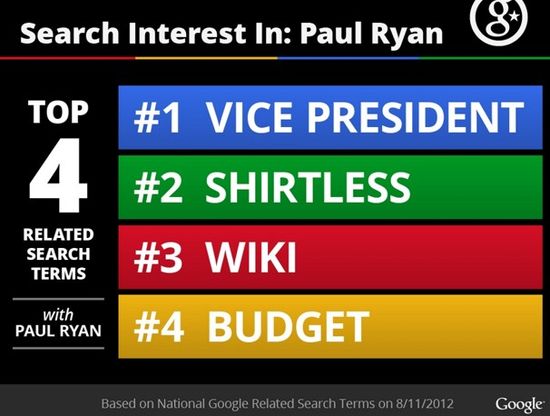
Today on the Dish, as the blogosphere debated how the Medicare Wars will play out, Wasserman-Schulz misfired her opening salvo. Nicole Gelinas proposed loophole-closing, Nate Cohn analyzed the senior vote and Ryan didn't trade insider-ly. Nate Silver forecast middling polling for Ryan as Jared Bernstein contextualized the magnitude of Ryan's budget cuts and Romney talked dirty in Spanish. And though it may have been Romney who tapped Ryan, Google users certainly wished they had.

Virginia Postrel endorsed The Perot Method, Warren flailed and Barney defended Dodd-Frank. And while a historian explained why Clinton will never be great, Douthat took on the Mormon business theology thing.

Fevered nationalism formed one of China's cornerstones, Mexico struggled with specificity in memorializing the Drug War and The Jeffersons resonated with Iranian wit. Sushi nearly decimated the world's blue tuna population, Art De Vany applied the Pareto principle to workouts and the medal count hangover continued.

In shark-related coverage, Ashley Fetters investigated the origin of Shark Week, while old shark-tooth weapons revealed dwindling biodiversity. The world's organ shortage endured, the web christened a bug, and climate change spiked heatstrokes among football players. The Swede version of Telephone involved the Interwebs, Sue Savage-Rumbaugh explained proper bonobo-raising and Maastricht's pot crackdown caused the rise in black market-trade, shockingly.

And while water diluted drunk-person pee, winning bred more winning. VFYW contest here, Julia Child remix here and Maine, as usual, was breathtaking.

Literature And Love

Lonelytree

by Matthew Sitman

Maura Kelly describes the way a dashing suitor's literary sensibility obscured the reality of their doomed romance:

Because we were on the same poems, I’d assumed we were on the same page. I thought Luke had been signaling the loftiness and grandeur of his feelings for me with verse. But I should’ve done a closer read. That first Stevens poem he sent me is about how one’s desires for unity can never be perfectly realized, about how even sexual union is an "imperfect paradise." And yet bodies come together more easily than minds. Of course, some part of me must have known our thing was doomed. Why else would I have sent a poem about what happens when an affair comes to an end? It’s just that I never thought it would end so quickly.

(Image via Flickr user -mrsraggle-)

The Perot Method

by Patrick Appel

Virginia Postrel wants Romney-Ryan to get some charts:

To play up its team’s strengths as numbers guys, countering the self-congratulatory idea of Democrats as the party of intellect, the Romney campaign could make a gutsy move. It could deploy Ryan to talk to the public at length about the looming fiscal crisis, producing a series of long-form, Perot-style videos. Nowadays the Republicans wouldn’t even need to spend money for prime-time television (although that would certainly get attention). They could rely on YouTube.

This might make sense if Romney planned to run on the Ryan plan. But he shows little appetite for that.