by Chris Bodenner
A reader writes:
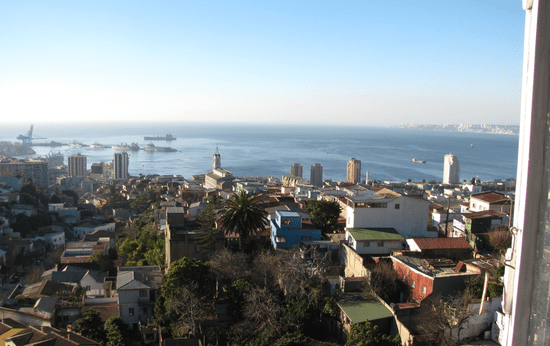
This is my first attempt at a VFYW, but this one just jumped out to me from my last trip to Israel almost ten years ago. The palm trees, seemingly large harbor to the left, the fact that this view is from above and much of Haifa is built along the slopes Mount Carmel, all of it point to Haifa to me. I just wish I could tell you which churce that is in the foreground, since based on past contests, I’m sure someone will.
Another writes:
I’ve been on the lookout for this one for a while and wish I could be more confident. Looks to me like downtown Dar es Salaam. Not sure I recall the harbor wrapping around like that, but I was at ground level. I will say specifically from the Kilimajaro hotel.
Another:
Tangier, Morocco, that’s my guess. I’m too lazy to figure out exactly where and have too few moments of mommy time left to waste time searching Google Earth, but I spent a blissful hour on a treadmill there once looking at a very similar landscape.
Another:
I motorcycled through southern Chile last November and Puerto Montt marked the end of smooth tarmac and the beginning of the many ferries and kilometers of gravel connecting Chilean Patagonia. The bay in the pic looks very similar to the crescent-shaped bay Puerto Montt sits on and the sunrise from the left matches Puerto Montt’s southern face. Lastly, the church and steeple look very much like the traditional wooden churches built throughout southern Chile and the island of Chiloe.
Close. Another:
That has to be Long Beach, CA, looking from the Signal Hill neighborhood. That’s the Palos Verdes Peninsula reaching out to the North, just south of Santa Monica Bay. Or it’s Valparaiso, Chile.
Sometimes it’s better to go with your second guess. Another:
My first thought was Chile, but the only cities I’ve been to in Chile recently were Santiago, which is not on the coast, and Punta Arenas, which among other things does not have more than a sew tall buildings, and it’s a much smaller port. But there was something about that blue house that continued to scream Chile, and Valparaiso popped into my head. I was an exchange student in neighboring Vina Del Mar in 1969 so “vaguely familiar” is about right (add some skyscrapers in the ensuing 40-plus years and…). So I did a 60-second Google image check of Valpo, and yup, that’s it all right. What fun!
Another:
Multi-colored houses, cobble-stoned walk ways, horseshoe bay, Viña del Mar in the distance – this has to be Valpo. I was there for an amazing New Year’s Eve two years ago. The size of the city doubles for NYE and it’s a free-for-all street party topped off by a great fireworks display over the bay at the strike of midnight. But sadly, the New Year’s kiss is not practiced by the Chileans.
Another sends an aerial shot:
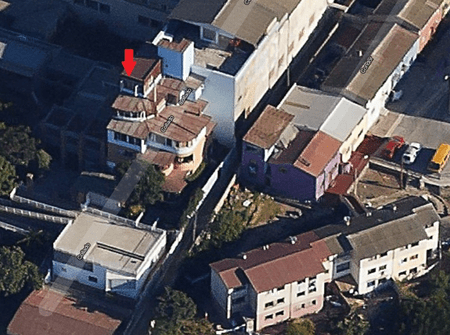
Since my soon-to-be husband and I are looking for a Caribbean or South American getaway this winter for our delayed honeymoon, I’ve now added Valparaiso – apparently the San Francisco of South America – to our list, especially after reading about the positive changes on the LGBT rights front after this year’s horrible death of Daniel Zamudio.
Another:
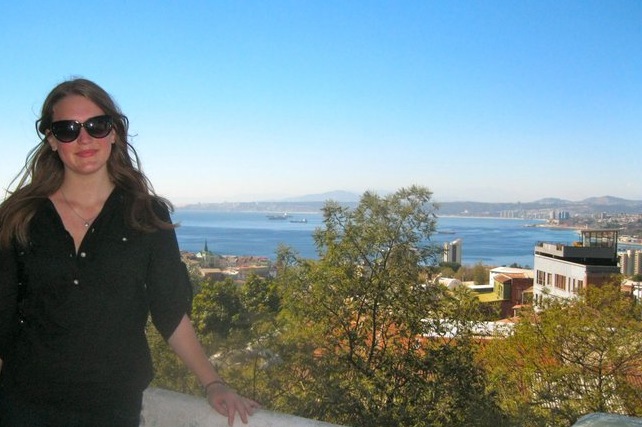
My wife is from Chile and her parents have a house overlooking the beach in the suburb of Renaca which is the point of land in the distance in the top right of the photo. We try to take the kids to visit every year and frequently take day trips into Valparaiso. I’m guessing that this photo is taken somewhere near La Sebastiana, the famous house of Pablo Neruda that is now a museum. This stock photo looks to be the same as the one in your competition.
Another:
The real giveaway though are the four battle-ships docked at the harbor. I’ve seen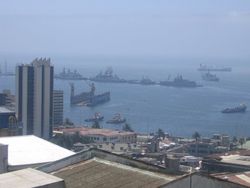 those myself, and are the treasures of the Chilean navy fleet. The city is known for its “miradores” or look-outs, and clearly this was taken from on high. The proximity to the fleet suggests the picture might have been taken near one of Pablo Neruda’s three houses, La Sebastiana, however the church in the middle of picture is south of Neruda’s house. The church is Iglesia Matriz, and judging from its position relative to the photographer I’d hazard the picture was taken on calle Palazuelos near parque Bilbao.
Another sends the above photo of the warships. Another writes:
I was fortunate enough to take a trip with my family to Valparaiso, Chile in 2007 where we were able to retrace my great-grandfather’s steps as a 16 year-old merchant seaman who sailed around the world in 1885, including a brief stop in Valparaiso. The stars aligned for this trip, as my mother was invited to an academic conference and my father wanted to take his sons (my brother and me) and his grandchildren to see part of our family history. During our visit, I spent one day wandering around Valparaiso, taking in the brightly painted corrugated tin roofs that dot the city and seeing the part of the Chilean navy stationed in the harbor.
My father died five months after we returned from this trip. This picture brings back many happy memories of the trip and of him. Thank you.
Another:

This is my first entry! I’ve been reading the Dish for years, and follow the VFYW contest every week, but have never come close to recognizing the “view” until today … I hope. I think this is a picture of Valparaíso, Chile taken from one of the cerros (hills) above the plano (flat part) of the city. The church in the center of the photo looks like Iglesia de la Matriz in Victoria Plaza.
I studied abroad in Viña del Mar – the city around the curve in the corner of the picture to the right – about a year ago. Valparaíso is a beautiful and colorful city (literally – most of the houses are brightly painted, and the city is famous for its murals). Last 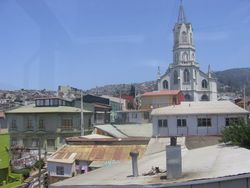 night I actually just got together with some friends from my Chile trip – we drank piscolas (the Chilean and Peruvian national liquor pisco mixed with coca cola), ate completos (Chile’s famous hot dogs covered in avocado, tomatoes, and mayonnaise), and had a really nice time reminiscing about that wonderful city – full of poets, musicians, and student revolutionaries – and of course, kiltros, the (beloved) stray dogs that litter Chilean streets.
This is the view from Pablo Neruda’s house La Sebastiana? Is it?? Every Chilean knows the Neruda line, “Amo el amor de los marineros que besan y se van.” (“I love the the love of sailors, who kiss and leave” – that’s a shitty translation but you get the point). I’ve visited all three of Neruda’s houses – they are all quirky and amazing. And they all have at least one bar. Neruda often wrote about Valparaíso.
Another sends the above photo of the church. Another nails the right floor of Neruda’s house:
I was thrilled to look and know immediately, I was there just a couple months ago  when I was interning in Chile this summer! This is Chilean Nobel Prize winning poet Pablo Neruda’s unbelievable house in Valparaíso, known as La Sebastiana after the original architect, Sebastian Callao. Interestingly, the house sat unfinished for ten years before Neruda, looking for a second residence outside Santiago, transformed it into what it is today–a pseudo-surrealist, towering, artistic house (reminiscent of the Weasley house in Harry Potter) filled with a bizarre and artistic collection of antiques and artifacts.
The window itself is in his fifth floor study (where, according to the foundation, Neruda would write in between long and alcohol-filled lunches and dinners in the city below), the white window framing and height of the photo gives it away. As for which window, it appears to be the only one that opens. Photos, both inside and out, attached.
To me though, this house is more than just an interesting literary and artistic site. There’s also a tremendous amount of irony, in that as the least opulent of Neruda’s three grand houses across Chile, it’s a huge contrast to his socialist beliefs and political actions. I guess maybe great artists are exempt from charges of hypocrisy …
Five readers answered the correct floor, but only one of them has guessed a difficult view in the past without winning (and in fact has a few dozen entries total). So this week’s winner is:
Wow! Easy city to get, but the location was difficult until … it became clear that this was taken from the top floor of Pablo Neruda’s house in Valparaiso, “La Sebastiana.” I’ve included numerous photos showing the “View from His Window” if you will. Very, very cool – a VFYW submission from beyond the grave?
In “picture 4” you can see a window ajar on the top floor of the house (it’s directly next to the vertical white pipe). I submit that the person who took this week’s VFYW was standing next to that window while it was ajar and stuck his camera slightly out of the window. You can see the window with latch in the right hand side of the submission – I say that’s the open window which shuts by swinging in, to the left. So, top floor, Pablo Neruda’s house, window all the way on the left side as you are looking out of the house towards the port. And, the address of the place is “Ferrari 692, Valparaiso, Chile.” Here’s another view from the window:

Whoo! Lovin’ the VFYW contest.
From the submitter:
You all probably get this one a lot. But here is the view from Pablo Neruda’s writing room on the 5th floor of the house he built in Valparaiso, Chile. It was taken around 5pm. Apparently he spent a lot of time looking out the window with a telescope.
By the way, for last week’s contest from Waterton, Alberta, a reader wrote:
I’m taking this weeks’ contest photo as good sign! My wife and I are leaving Tuesday for a long scheduled trip to Glacier (and Waterton) National Park. Although I have not been there yet, I’ve been looking at a lot of pictures, and the photo was immediately recognizable as being from the Glacier National Park area, and I quickly confirmed my guess that it was taken from the Prince of Wales Hotel in Waterton. I look forward to looking out this same window in a week or so!
He follows up:
Attached is an admittedly cheesy photo of me pointing to the correct window at the Prince of Wales hotel:

We’re having a great trip.
(Archive)



 The Dish