
The Ethics Of Sushi

by Zoë Pollock

Andrew O'Hehir reviews a new documentary on sushi consumption around the globe:

In addition to interviewing Japanese fishermen, fish traders and high-end sushi chefs upholding a centuries-old tradition, [filmmaker Mark S. Hall] travels to a football game in suburban Texas and the Polish city of Lodz to demonstrate the global explosion of what was once (at least outside Tokyo) an eccentric and/or ethnic specialty cuisine. We learn about the stroke of entrepreneurial evil genius that is Sushi Popper, pre-sliced sushi rolls served in a Pringles-type can with a push-up apparatus. (The cucumber roll looks great, but the so-called California Roll contains a panoply of truly frightening ingredients.)

The documentary extensively covers sushi sustainability issues and the depressing fact that bluefin tuna populations "are believed to have fallen by 60 to 80 percent, with no end in sight."

Feel The Burn

by Zoë Pollock

The Pareto principle, named for Italian economist Vilfredo Pareto, holds that "the most unusual events will have the greatest impact." Art De Vany, author of The New Evolution Diet, applies the law to exercise:

The peak moments of a workout count far more than the amount of time you spend working out. This is why a series of 40-yard sprints at full speed benefits you more than a half an hour of jogging. It’s also the reason why lifting a weight heavy enough to make your heart pound your your muscles burn counts more than spending hours at the gym always in your comfort zone, never truly challenging your body. When a workout becomes an unvarying, monotonous routine, it loses its effectiveness.

The Week Sharks Always Attack

by Chas Danner

Ashley Fetters investigates the origin and evolution of TV's most famous week, now in its 25th year and thus "the longest-running cable TV programming event in history". It started as an idea on a cocktail napkin in 1987, and has matured ever so slowly since then as the Discovery Channel has tried to make sure Shark Week never jumped the shark. The most recent change has been the transition to ultra high-speed cameras (used in the video above), but there have been other shifts as well:

Before the advent of Phantom cameras, Runnette says, Shark Week's evolution included a growing reliance on vivid human testimonies and gruesome cautionary accounts. "It's kind of like a campfire tale," she says. "One thing I've found kind of amazing is that almost invariably, the people who talk to us about surviving their attacks all say, 'I was in the wrong place at the wrong time.' Or, 'I was swimming when I saw a seal over there and I should have gotten out of the water.' Or, 'It was dusk. Everybody knows you don't get in the shallow water at dusk.'"

In other shark news, environmentalists on the West Coast are trying to get the great white added to the US endangered species list, and a recent study has shed some light on shark-fin soup consumption here in the US:

Out of 32 samples taken across the country of the Chinese delicacy with identifiable shark DNA, 26 bowls, or 81 percent, contained fins from sharks listed as endangered, vulnerable or near threatened, according to a report released on Thursday by the Pew Environment Group. The study was based on tests of the soup in 14 U.S. cities, and shark attack survivors collected the soup samples.

Recent Dish on the practice of shark-finning here, here and here.

The Organ Shortage

by Zoë Pollock

It's still a problem:

In the United States alone, more than 114,000 people are on transplant lists, waiting for an act of tragedy or charity. Meanwhile, just 14,000 deceased and living donors give up organs for transplants each year. The supply has stagnated despite well-funded attempts to encourage donations, and demand is growing, especially as the organs of a longer-lived population wear out.

The two most promising alternatives are xenotransplantation, the replacement of a human organ with an animal one, or engineering human organs from scratch. Both have hurdles to jump – xenotransplants are often rejected by the patient's immune system and building an organ from scratch usually needs a human or animal scaffold organ to begin with. But now scientists are testing an artificial, synthetic polymer scaffold:

To [Joseph] Vacanti, artificial scaffolds are the future of organ engineering, and the only way in which organs for transplantation could be mass-produced. “You should be able to make them on demand, with low-cost materials and manufacturing technologies,” he says. That is relatively simple for organs like tracheas or bladders, which are just hollow tubes or sacs. Even though it is far more difficult for the lung or liver, which have complicated structures, Vacanti thinks it will be possible to simulate their architecture with computer models, and fabricate them with modern printing technology.

A future with 3D-printed guns, drugs and organs – what else could a girl need?

The Daily Wrap

Egypt

by Gwynn Guilford

Talk about Romney's sneaky weekend VP pick, Paul Ryan, dominated today's Dish. While Team Obama pummelled the Wisconsin congressman's budget plan, the blogosphere debated the ticket's implications and Yglesias worried that it implies distraction from our unemployment woes. Bloggers also lamented Ryan's potentially catastrophic monetary policies, and berated pundits and media lightwieghts who call Ryan "serious." (He's the Baskerville of conservative politicians, it seems.) 

Meanwhile, Stan Collender reminded that the Ryan budget would have Romney paying no federal taxes, Kornacki hailed the longer arc of Ryan's candidacy and no one was really sure what social conservatives would make of the ticket. As bloggers called out Ryan's neocon leanings, the Zoellick pick conflicted with Romney's China policy and both candidates had fallen silent on Afghanistan. Also, Ryan dressed worse than Santorum but he probably didn't commit insider trading. And, alas, Sarah Palin exited, stage right.

In global news, earthquakes in Iran killed hundreds, Marc Lynch summarized tumultuous goings-on in Egypt and readers gave feedback on Sikh traditions. Then in public health, gonorrhea grew terrifyingly antibiotic-resistant, while autism and Asbergers won acceptance.

In Olympics sum-ups, gay gold-winners included the lesbo-dense Dutch women's field hockey team and Megan Rapinoe, and controversy flared over how to conceive of the EU medal count.

While Barney explained how Dems could have prevented the housing crisis, Jack Rakove struggled with the Declaration of Independence and poetry spoke the truth in a soured relationship. Deanna Pan exposed how little Louisianans will soon be learning about the scientific history of dragons, the formation of capillary bridges held up sandcastles and Brian X. Chen wondered why people don't use prepaid plans. Meanwhile, Gotye made fun of himself, a sentimental VFYW here, poem for Monday here and FOTD here.

(Photo: Thousands of Egyptians shout political slogans in support of the Egyptian president Mohamed Morsi as they celebrate his decision on the dismissal of former Egyptian Defence Minister and Field Marshall Hussein Tantawi, on August 12, 2012 at Tahrir square in Cairo. By Gianluigi Guercia/AFP/Getty Images)

Ad War Update: Enter The Ryan

by Chas Danner

The ad landscape is starting to adapt to Romney's veep pick, with the Romney campaign and RNC both releasing web videos that champion the new duo. The RNC video is called "Big Solutions" while the Romney campaign wanted us to meet "America's Comeback Team" (and hear how fast Ryan can talk):

The GOP Super PAC American Future Fund put out a similarly named "Comeback Team" video, in which they take a shot at Biden – and Ryan talks even faster:

Meanwhile, the Obama campaign released the web video we featured the same day as the VP announcement, as well as this Florida-themed video today, which unsurprisingly brings up Medicare:

Planned Parenthood Action Fund also got into the fray with a new web ad invoking the combined Romney/Ryan record on women's issues. TPM reports that PPAF is still deciding whether or not to put the ad on TV:

The Romney campaign also has a new TV ad out continuing their false line of attacks against Obama on welfare policy. And pro-Romney Super PAC Restore Our Future is dropping $10.5 million on this 11-state ad hitting Obama on the economy, including the glass half-empty interpretation of last month's job numbers. It also uses edited-down quotes to paint Obama as somebody who doesn't take the economy seriously:

Lastly, today's Ad War whackiness comes from a PAC named the Committee to Protect Florida supporting State Senate candidate Jim Frishe in the battle for the GOP nomination. The ad suggests his opponent, Jeff Brandes, has a thing for dangerously driver-less cars, which some old lady won't stand for:

Jalopnik's Travis Okulski points out that the ad resembles a great SNL parody.

Ad War archive here.

The Other Debate We Won’t Be Having

by Chas Danner

Dexter Filkins says it's about the mess in Afghanistan, the war that's conspicuously absent from national debate:

You can make your own guesses about why the candidates have said so little about Afghanistan—their positions are virtually identical, the economy is more important, etc. My own guess: neither of them knows what to do about the place. In a mere twenty-eight months, the United States is scheduled to stop fighting, and every day brings new evidence that the Afghan state that is supposed to take over is a failing, decrepit enterprise. 

Filkins goes on the detail new allegations of "corruption, favoritism, and incompetence" against some of the most powerful men in the country: the ministers of defense, the interior, and finance. His takeaway:

Why does all this matter to American voters? Look at this way: after eleven years, more than four-hundred billion dollars spent and two thousand Americans dead, this is what we’ve built: a deeply dysfunctional, predatory Afghan state that seems incapable of standing on its own—even when we’re there. What happens when we’re not? You can bet that, whoever the President is, he’ll be talking about it then.

Face Of The Day

150253230

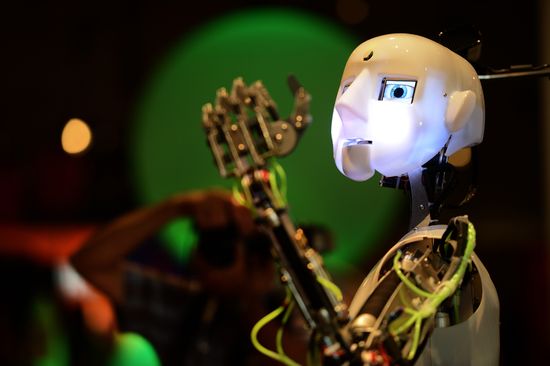
Republican presidential nominee Mitt Romney A robot is moving at the Ideen Park fair on August 13, 2012 at the fair ground in Essen, western Germany. The fair is organised for children, youths and young adults by the German steel company ThyssenKrupp AG to arouse their spirit of research and to promote careers in the business of technique and natural sciences. By Patrik Stollarz/AFP/Getty Images.

– C.B.

Not So Self-Evident

by Matthew Sitman

Reviewing a new book on the uses of the Declaration of Independencee, Jack Rakove ponders the difficulties of squaring its lofty ideals with the more practical demands of institutions and governance:

The argument that the Declaration states the ends for which the Constitution is essentially the means expresses a noble sentiment, which is why we owe the same honor to Lincoln that he wanted paid to Jefferson. Lincoln made us a better nation—indeed, a better people—by insisting that the promise of the Declaration be fulfilled. But that is not the same point as insisting that the Constitution as originally adopted—the Constitution that still badly needed the Fourteenth Amendment—rested on the liberty and equality of the Declaration. How to convert its moral principles into a rule for constitutional governance before the era of Reconstruction first made that attempt remains a puzzle. The framers of the Constitution never discussed this idea, nor did later jurists propound any rules to give the Declaration recognizable constitutional authority.

A Poem For Monday

Gern

by Alice Quinn and Matthew Sitman

"Digging in the Garden of Age I Uncover a Live Root" by May Swenson:

The smell of wet geraniums. On furry
leaves, transparent drops rounded
as cats’ eyes seen sideways.
Smell of the dark earth, and damp
brick of the pots you held, tamped empty.
Flash of the new trowel. Your eyes
green in greenhouse light. Smell of
your cotton smock, of your neck
in the freckled shade of your hair.
A gleam of sweat in your lip’s scoop.
Pungent geranium leaves, their wet
smell when our widening pupils met.

(Reprinted with permission of The Literary Estate of May Swenson, forthcoming in May Swenson: Collected Poems (Library of America, 2013) . All rights reserved. Photo by Flickr user ndrwfgg) Update from a reader:

The attempt was noble, but that's not the flower referred to in the poem.  The "geraniums" of pots and greenhouses were once regarded as species of the genus Geranium and that is how they came to be known that way even still today in common gardening parlance, but unfortunately years before I was born in 1960 botanists collectively decided they were actually species in a different genus named Pelargonium.  This sort of change does happen from time to time in biology, but it can make for confusing horticulture. 

If you do an image search on "Pelargonium" you'll see the sorts of "geraniums" the poem refers to.