The Quakes In Iran

GT_IRANEARTHQUAKEBAJEBAJ_20120813

by Chas Danner

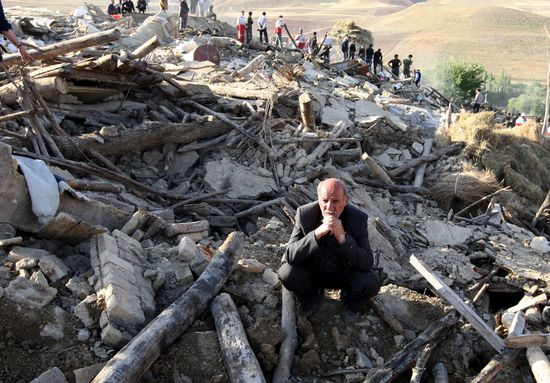
A pair of dangerously shallow earthquakes struck a rural and mountainous region of northwest Iran on Saturday, killing at least 300 and injuring thousands:

The majority of casualties were women and children whose houses had collapsed on them, reported Iranian media. The earthquake occurred at 5 p.m., when most women and children were preparing for the nightly Iftar dinner, which breaks the Muslim daytime fast during the current month of Ramadan.

The death toll is certain to rise. The Iranian authorities have been criticized over their response:

Although officials announced on Sunday, less than 24 hours after the disaster, that search and rescue operations had finished and all survivors had been freed from the rubble, some residents expressed disbelief that authorities could have reached some of the most remote villages so soon. "I know the area well. There are some regions where there are villages that you can't even reach by car," one doctor in the city of Tabriz told Reuters by telephone on Monday, declining to give his name because of the sensitivity of the issue. "It's not possible for them to have finished so soon."

There has also been widespread criticism of how the state media has handled the disaster. More images of the aftermath can be found at the Big Picture. Meanwhile, there is concern among Iranians living in countries like the US that they will not be able to offer assistance to those affected because of Western sanctions. Following the devastating 2003 earthquake in the Iranian city of Bam, the Bush administration did temporarily lift some sanctions to allow Americans to help, but it is as of yet unknown how or if the Obama administration will respond to such requests.

(Photo: An Iranian resident from the village of Baje-Baj, near the town of Varzaqan, stands on top of the rubble of his destroyed home on August 12, 2012, as rescue workers search for survivors, after twin earthquakes hit northwestern Iran on August 11. By Atta Kenare/AFP/Getty Images)

The Most Trustworthy Font

by Zoë Pollock and Chris Bodenner

Errol Morris questions [NYT] the "effect of typography on the perception of truth." He recently asked Times' readers, "Are You an Optimist or a Pessimist?," but the quiz was a ruse to assess their receptivity to various fonts:

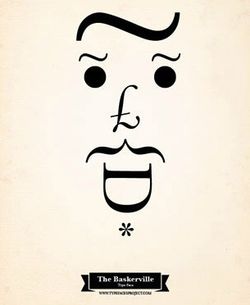
QuadroBaskerville_903I have often wondered about the visual element in text. Yes, we read the word "horse,"  but we also see the letters, the fonts, the shape of the word on the page. Is this not part of the meaning? … The conscious awareness of Comic Sans promotes — at least among some people — contempt and summary dismissal. But is there a font that promotes, engenders a belief that a sentence is true? Or at least nudges us in that direction? And indeed there is.

It is Baskerville.

The second part of Morris' series is here [NYT].

("The Baskerville" illustration is one of many Typefaces by Tiago Pinto, via Mark Wilson)

Was Ryan Involved In Insider Trading?

by Chris Bodenner

A look at the circumstantial evidence:

[Paul Ryan] sold shares in a number of financial companies including Citigroup, General Electric, Wachovia, and JP Morgan Chase on the same day as then-Treasury Secretary Henry Paulson and Fed Chairman Ben Bernanke held a closed meeting with congressional leaders during the financial crisis. … According to The New York Times, the meeting was held in the evening, which raises significant doubt if any member in attendance would have been able to act on the conversation.  Ryan's 2008 financial disclosures, which are publicly available on OpenSecrets.org [pdf], were analyzed by Business Insider (Via The Richmonder).

Even if Ryan did act on secret information gleaned from Paulson et al, it would not have been illegal at the time. But ethically dubious no doubt, and right in line with Romney's legal but despicable 13.9% tax rate. Speaking of which, the IRS just released [NYT] some shocking new info about the taxes paid by the 400 wealthiest Americans in 2009:

Not even Mr. Romney, with reported 2010 income of $21.7 million, qualifies for membership in this select group of 400. But the data provides a window into the financial lives and tax rates of the superrich. Since the I.R.S. doesn’t release data for the tiny percentage of Americans at Mr. Romney’s income level, the 400 are the closest proxy.

And that data demonstrates that many of the ultrarich can and do reduce their tax liability to very low levels, even zero. Besides the six who paid no federal income tax, the I.R.S. reported that 27 paid from zero to 10 percent of their adjusted gross incomes and another 89 paid between 10 and 15 percent, which is close to the 13.9 percent rate that Mr. Romney disclosed that he paid in 2010. (At the other end of the spectrum, 82 paid 30 to 35 percent. None paid more than 35 percent.)

How much did you pay this year?

A Shakeup In Egypt

GT_MORSISUPPORTERS_20120813

by Chas Danner

Marc Lynch summarizes a dramatic weekend:

Over the span of a few days, [Egyptian president Mohammed el-] Morsi removed the head of General Intelligence, the head of the Military Police, the top two senior leaders of the Supreme Council of the Armed Forces, and the heads of all the military services.  In addition to this SCAF-Quake, Morsi also canceled the controversial Constitutional amendments promulgated by the SCAF just before he took office and issued a new, equally controversial amendment and roadmap of his own.  What's more, this all came after he replaced the editors of major state-owned newspapers with people viewed as sympathetic to the Muslim Brotherhood and cracked down on several other critical papers.

He suggests we'll have to wait and see what it all means:

I think that on balance this should be seen as a potentially positive step, despite the real downside risks of Muslim Brotherhood domination.  It could even be a way to overcome at least one dimension of that deep political and social polarization which has been the legacy of the last political period.  Asserting civilian control and removing the top SCAF leaders were necessary steps which most Egypt analysts didn't expect at this point, and which – lest we forget – have been among the primary demands of the revolution since almost the beginning. 

Juan Cole calls it a coup and agrees about the situation's murkiness. Like others, he was very surprised by the timing of it all:

I had suggested that Egypt since Morsi’s election has been sort of like Turkey in the 1990s and early zeroes, with ‘dual sovereignty,’ vested both in an elected, civilian government and a powerful ‘deep state’ or military establishement. I proposed that over time, elected authority has more legitimacy and that Egypt could move in the direct of Turkey in the past half-decade, wherein the elected government has gradually gotten the upper hand over the military. I didn’t expect the process to take a month and a half, but many years.

Hussein Ibish says that "Morsy now has almost unfettered authority in Egypt":

Assuming that the military and, for the meanwhile, the courts, allow Morsy's decisions to go effectively unchallenged, Egypt, in effect, has a new dictator, albeit an elected one. Beyond the urgent need of restoring legislative authority through new elections, the power struggle in Egypt will increasingly focus on the crafting of the new constitution, which will either produce a system that involves real checks and balances or which consolidates yet another system in which the presidency wholly dominates the political system.

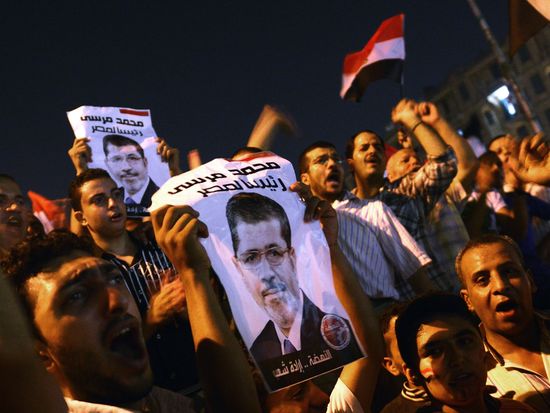
(Photo: Thousands of Egyptians shout political slogans in support of the Egyptian president Mohamed Morsi as they celebrate his decision on the dismissal of former Egyptian Defence Minister and Field Marshall Hussein Tantawi, on August 12, 2012 at Tahrir square in Cairo. By Gianluigi Guercia/AFP/Getty Images)

The Debate We Won’t Be Having

by Patrick Appel

Yglesias worries that "focusing attention on the big-picture disagreement between Democrats and Republicans about long-term fiscal policy means we won't be focusing attention on what ought to be the most pressing economic policy issue of our time—mass unemployment and the tragic waste of human and economic potential it represents." Frum makes a related argument:

Paul Ryan's various plans and road maps contain many interesting elements for the reduction of government in the decades ahead. They do not respond to the most immediate and urgent problem: prolonged mass unemployment caused by heavy household debt. Why not? There's why the ideology makes itself felt. Conservatives ardently believe that big future deficits are the cause of today's unemployment. They feel it. They know it. And they don't want to hear different.

Mike Konczal also notices that Romney lacks solutions to the immediate jobs crisis:

I can, quickly, come up with a set of conservative stimulus ideas on how to get the economy going again, but the wide range of these programs are missing from Romney's economics report. They aren't going to hire market monetarists to run the Federal Reserve. Mitt Romney just publicly said the Federal Reserve shouldn't go ahead with another round of quantitive easing [1]. There isn't the argument that the government should just not collect taxes for a year or two with borrowing costs so low, which will also make it that much harder to raise taxes to Clinton-era rates afterwards. There's nothing in the paper about housing, even though one of Romney's advisors is well known for his mass refinancing program to help boost demand. And there's no conditional lending to states to prevent layoffs on the condition that they dismantle public sector unions, or privatize certain government services, or whatever.

Frum adds:

 Even odder, none [of these ideas] have gained much backing from any of the conservative think tanks whose job supposedly is to generate creative policy alternatives.

Donning The Turban, Ctd

by Chris Bodenner

A reader writes:

It's worth remembering that during the Iraq war, the common slur for Arabs was "Hadji."  In the source of this pop-culture reference – the '60's TV cartoon "Jonny Quest" – the character is actually a Sikh! Wikipedia even says that in the later '90's revival, "Hadji is revealed to be an Indian prince, and is given the last name Singh."

Another:

I'm a Canadian that was raised in a Sikh family and wore a turban until I was in the fifth grade. I chose to cut it off for many of the same reasons that Kevin B. Lee chose not to convert to Sikhism. A few years ago I wrote an article about my experience cutting my hair that won a national diversity writing award. If you're interested in reading it, you can find it here.

In reference to the above scene from Spike Lee's Inside Man, Erik Lundegaard writes:

The movie is about hostages and a bank heist, in the manner of "Dog Day Afternoon," and there's a scene halfway through where a Sikh hostage is released by the robbers only to be ordered by New York cops, with itchy, post-9/11 trigger fingers, onto the ground. They call him an Arab and take away his turban.  Here's a later scene where the cops (Denzel Washingon, Willem Dafoe and Chiwetel Ejiofor) question the Sikh, Vikram, about the hostage situation, while he questions them about his turban situation. "I bet you can get a cab, though," is a good line, but it's a shame Vikram didn't get the last word. He deserved it.

Lundegaard also excerpts a great review of the film from the New Yorker. Update from a reader:

"Hadji" is a common slur for Arabs (or really, Muslims, and especially "unfriendly" ones), but it is "haji" or "hajji" and it comes from the honorific title given to people who have completed the Hajj to Mecca.  I'm 99% certain Jonny Quest had nothing to do with it.

Romney, Zoellick And Asia

by Gwynn Guilford

Against the backdrop of the Paul Ryan pick and the significance of Romney's appointment of a known China-cuddler to his foreign policy staff, it might be worth revisiting what one of those Incredibly Boring White Guys said recently about Romney's China policy.

[Rob] Portman, a Romney campaign surrogate and presumed vice presidential contender, also defended Romney who has come under fire for a campaign pledge to declare China a currency manipulator on his first day in office. He said Romney would balance his push for more free trade agreements with a tough trade enforcement agenda, focusing especially on China. "He’s for immediately changing our trade policy to access the 95 percent of consumers that live outside of our borders by being aggressive on trade openings," Portman said. "He’d get trade promotion authority from Congress and then begin serious negotiations to open up markets."

To Larison's point about Romney's general lack of a foreign policy track record, it's hard to find much in the way of details here. But while it's not clear to me how Portman's words change much of anything compared with Obama's tack, Romney's "Reagan Economic Zone" plan doesn't really clarify either:

Although China is unlikely to accede to the Reagan Economic Zone given its current approach to trade, offering Beijing the possibility of participation will give China significant incentives to end its abusive commercial practices. But with or without China as a member, the Reagan Economic Zone will establish a system of trade that could knit together the entire region, discouraging imbalanced bilateral trade relations between China and its neighbors, limiting China’s ability to coerce other countries, and ultimately encouraging China to participate in free trade on fair terms.

Though there's definitely a lot to be worried about on the coercion-of-other-countries front, it seems that the implied current lack of aggression is a misdiagnosis. The US definitely needs fairer trade arrangements with China – but my sense is that it's more compliance with the terms, and not exactly terms themselves, since so much of China's upper hand comes from its willingness to simply flout said terms when it suits. Also, figuring out how to confront China's increasingly effective use of the WTO and its indigenous innovation strategy should be a priority. Achieving those things might require some finesse, though, rather than brute force. Would Zoellick deliver? No idea. But for reference, here is an example of his approach to trade policy with China, from a World Bank speech earlier this year:

Sometimes in trade or international economic relations…, the disputes have become somewhat of a zero sum traditional trade off. For creative officials in China as well as in other countries, [a recent World Bank] report actually offers some additional opportunities for win/win mutual gains….

As China's labor force starts to get smaller and yet there is an interesting increase in wage growth, you're going to need to have innovation and productivity increases. So you've heard some of the Chinese officials talk about stronger intellectual property rights protection and ways of supporting innovation and technology development. That's another potential win/win. I think you'll find the same in areas like energy and water efficiency.

Sounds…sensible. Meanwhile, elsewhere in Asia, Romney has irked another ally, notes Josh Rogin – this time by identifying Japan as a country suffering from "decline and distress for a decade or a century":

[Japan experts] worry that Romney is needlessly insulting the face-conscious Japanese and giving them the impression that if he wins in November, his administration won't appreciate the importance of America's top alliance in the East at a time when the United States is attempting a diplomatic and military "pivot" to Asia.

Devin Stewart, a senior fellow at the Carnegie Council."Japanese are quite sensitive to statements like this. They are constantly assessing the tone of U.S. candidates relative to those made about other Asian countries. Bashing Japan is now quite passé and even tone deaf. Has Romney even visited Japan? Is he aware of the 2011 earthquake?"

Sounds like a great way to foil the Red Menace! Previous coverage here and here.
The Party Abandons Palin

by Chris Bodenner

Despite the Obama campaign's best efforts to frame Paul Ryan as another Sarah Palin, Joel Mathis states the obvious:

Whatever else you think of him—and there’s plenty that’s not so great, but we’ll get to that soon—Ryan actually has experience in government and knowledge of the issues. With this single act, Romney has already proven that he has more respect for voters and concern about governance than his GOP predecessor, John McCain, whose selection of Palin as running mate in 2008 was utterly craven and looks increasingly worse as the years pass.

And the nail in the coffin?

Sarah Palin has announced that she will not be speaking at the 2012 Republican National Convention, saying it’s time to give others a chance. "This year is a good opportunity for other voices to speak at the convention and I’m excited to hear them," she said in a statement to Fox News’s Greta van Susteren.

Dylan Byers examines how Kristol is now two-for-two when it comes to veep picks.

The Medal Count, Ctd

Screen shot 2012-08-13 at 10.27.41 AM

by Chris Bodenner

A reader writes:

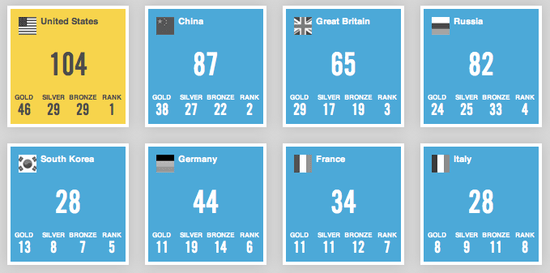
Just to keep things in perspective: If the European Union were counted as one country – similar in size to the USA and in economic size to the US and China – it would have the following number of medals (as of August 10):

Gold: 77
Silver: 86
Bronze: 90

Total: 253

This is 24 more than the US, China, and Russia combined.

The above image, from MedalCount.com, is the final tally of the top 8 countries, and while the reader's numbers have shifted since Friday, the overall point remains. Update from a reader:

Your reader's comment needs to include the following point: If the EU were one country, they'd only get one team in the team sports like volleyball, gymnastics, basketball, soccer, and water polo, and two or three entrants in the individual sports. They probably couldn't accumulate a medal haul of 253 because they couldn't get that many competitors and teams in the various sports.