What You Learn In Louisiana

by Matthew Sitman

Gov. Bobby Jindal's new voucher program in Louisiana will use taxpayer money to fund a private education for a number of students in the state. That means expanding the scope of religion-infused curricula, some of which is nothing short of laughable – especially when the A Beka Book line (out of Pensacola Christian College) and Bob Jones University Press textbooks are involved. At Mother Jones, Deanna Pan summarizes the situation and lists the 14 best/worst items found in the A Beka/Bob Jones resources. My favorite involves the existence of dragons:

"[Is] it possible that a fire-breathing animal really existed? Today some scientists are saying yes. They have found large chambers in certain dinosaur skulls…The large skull chambers could have contained special chemical-producing glands. When the animal forced the chemicals out of its mouth or nose, these substances may have combined and produced fire and smoke." – Life Science, 3rd ed., Bob Jones University Press, 2007

Why Ryan Is Risky

by Patrick Appel

The Obama campaign is already pummeling Romney-Ryan with the Ryan budget:

Zeke Miller and Ben Smith reported yesterday that the Ryan pick was Romney's idea. According to a "top Republican," "everybody was against [Ryan] to start with only Romney for":

Romney's aides have stressed publicly in the 24 hours since Romney electrified conservatives with his choice that the pick was the governor's alone. They have been less forthcoming on the flip side: That much of his staff opposed the choice for the same reason that many pundits considered it unlikely — that Ryan's appealingly wonky public image and a personality Romney finds copasetic will matter far less than two different budget plans whose details the campaign now effectively owns.

Those reservations make a lot of sense after reading Ronald Brownstein's article about public opinion on the Ryan plan. Blue collar voters, where Obama is weak, and seniors, a key GOP constituency, are not fans:

In March, the United Technologies/National Journal Congressional Connection Poll offered respondents two options for [Medicare]. Just 19 percent of whites older than 65 endorsed Ryan’s approach, which said “Medicare should be changed to a system where the government provides seniors with a fixed sum of money they could use either to purchase private health insurance or to pay the cost of remaining in the current Medicare program.” Fully 74 percent of white seniors said instead that “Medicare should continue as it is today, with the government providing health insurance and paying doctors and hospitals directly for the services they provide to seniors.” Among non-college whites, 63 percent said they preferred the current system, while only 26 percent backed Ryan’s approach. 

Allahpundit argues that the Ryan pick "makes winning harder, not easier" for Romney:

The Democrats are going to flood Ohio and Florida with ads aiming to scare the pants off of seniors and blue-collar workers about the “safety net” disappearing under Romney/Ryan. Obama will now frame the election not merely as a choice between Ryan’s budget and his own plan (whatever that is) but as a choice between the president and, as represented by Ryan, the most unpopular Congress in modern history. If the attacks work and Romney fades down the stretch, that could have huge downballot effects in House races too, jeopardizing the GOP majority. I think the best-case scenario is that Ryan’s salesmanship brings enough people around on entitlement reform to fight the Democrats to a standstill on that issue, and then Romney wins the election narrowly due to voter dissatisfaction on the economy. In other words, it’s both a “referendum election” and a “choice election”

Peter Beinart hopes the election teaches the Tea Party a lesson:

Mitt Romney has given the Tea Party the election they want: a referendum on dramatic cuts in federal spending. When Obama wins—as seems even more likely today than it did Friday—the message will now be harder for Republicans to ignore. Ever since 2008, one of the biggest questions in American politics has been when the Republican Party would realize it was out of step with America and begin overhauling itself, as Democrats did in the 1980s. Paradoxically, Ryan’s selection has likely hastened that process. I hope the far right enjoys itself today, because I don’t think the fun is going to last.

The Return Of The Tax Returns

by Patrick Appel

Stan Collender predicts it:

In the immediate aftermath of the Ryan announcement, some analyses indicated that, if enacted, the tax portion of the Ryan plan would mean that Romney would pay no federal taxes whatsoever. That's a PR nightmare for the Romney campaign that obviously wants to change the story away from Romney's taxes because of the damage it has done to the campaign in recent weeks. Now, instead of changing the Romney tax story, Ryan is far more likely to reinvigorate it or, in journalistic terms, give it "legs."

Will The Election Be Good For The Country?

Ryan_Speech_Notes

by Patrick Appel

Saletan loves the Ryan pick. Many pundits are making versions of this argument:

Instead of bickering about Romney’s tax returns and repeating the obvious but unhelpful observation that the unemployment rate sucks, we’ll actually have to debate serious problems and solutions. That’s great for the country.

Brain Beutler echos:

Having Ryan on the ticket will make it difficult for the losers of the election to claim that the winners doesn’t have some claim to pursue their fiscal vision. A decisive electoral resolution to this high stakes political fight is actually kind of scary no matter where you come down on issues like Medicare, Medicaid and tax policy. But it’ll also be good for the country if it means the government will have new running room to pay at least passing attention to things like mass unemployment and eroding infrastructure that the next president will have to deal with, whether he’s a Republican or Democrat.

Ramesh Ponnuru's related argument:

If Romney and Ryan do prevail in November, it will mean that voters accept the need to modernize the welfare state — and this election will end up having been the most important one since 1980.

Francis Wilkinson battles this new conventional wisdom:

If Romney wants an epic clash of visions, he doesn’t need Ryan, the House Budget Committee chairman, on his ticket. He only needs to insert real numbers in his own plan, revealing that the only way to provide his upper-income tax cuts without exploding the national debt is to initiate a sharp retrenchment of government outlays that benefit middle-class and poor Americans. Romney chose not to do that either because he deems it political suicide or because he wants the details sufficiently vague that he can shake free of them if he’s elected president; most likely both.

He quips that a "Romney plan that deliberately doesn’t add up is now complemented by a Ryan plan that deliberately doesn’t add up." James Surowiecki is in the same ballpark:

[Ryan's tax plan] calls for trillions of dollars in tax cuts (heavily weighted, of course, toward high-income earners), but also claims to be revenue-neutral, since Ryan says that the tax cuts will be offset by eliminating loopholes and tax subsidies. But when it comes to detailing exactly what loopholes and subsidies he wants to get rid of, Ryan clams up—just as Romney has done with his tax plan. This is politically astute, since eliminating the tax benefits that have a substantive budget impact would mean eliminating things voters love, like the mortgage-tax deduction. But it’s a far cry from being honest and tough-minded.

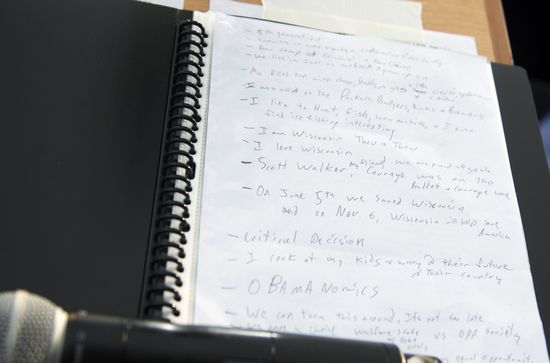
(Photo: US Republican Vice Presidential hopeful Wisconsin Representative Paul Ryan's speech notes are seen on the podium as he greets supporters during a campaign rally with US Republican presidential candidate and former Massachusetts Governor Mitt Romney at Waukesha County Expo Center in Waukesha, Wisconsin, August 12, 2012. By Saul Loeb/AFP/Getty Images)

Paul Ryan, 2016?

by Patrick Appel

Kornacki contends that "the electoral implications of the Ryan pick will extend well beyond November":

[E]ven if Ryan’s budget proves an albatross for Romney and the GOP ticket goes down, it’s not hard to see conservatives rationalizing away the defeat: The problem was Romney couldn’t sell the message – that’s why the next time we need Ryan at the top of the ticket! They’ve believed for a few years now that Ryan-ism should be their party’s future, and [Saturday's] announcement is a major step toward making it so.

Paul Waldman has the same thought:

Winning three consecutive presidential terms is very hard. It has only happened once since 1948, when George H.W. Bush beat Michael Dukakis in 1988. No matter how well things are going, the public eventually gets around to giving the other side a chance. And Paul Ryan just became the most likely 2016 Republican nominee.

Using history as a guide, Nate Silver calculates "about a 15 percent chance of Mr. Ryan someday becoming president." But Ryan's odds are much better if Romney wins than if he loses.

The Nerd’s Guide To Sandcastles

GT_SANDCASTLE_20120803

by Chas Danner

The next time you are at the beach, consider the science that holds the structures together:

The formation of capillary bridges between sand grains are the cause of the stiffness of sculptured wet sand in a sandcastle, as opposed to dry sand which can hardly or not support its own weight. Qualitatively, the liquid leads to the formation of capillary bridges between the sand grains, and the curvature of the liquid interface leads to a capillary pressure causing a force of attraction between the grains. This then creates a network of grains connected by pendular bridges, and allows, for example, creating complex structures such as sandcastles. Not many quantitative studies on the mechanical properties of wet sand exist, in spite of the fact that the handling and flow of granular materials is responsible for roughly 10% of the world energy consumption.

(Photo: A sand sculpture made at Rio de Janeiro's Copacabana beach on April 9, 2010. By Antonio Scorza/AFP/Getty Images)

Will The Social Cons Turn Out?

by Patrick Appel

Daniel McCarthy is unsure:

Paul Ryan checks the appropriate social-right boxes, but I wonder if his intensity is sufficient to mobilize the culture warriors — much as Robert Zoellick, ready though he may have been to sign onto Project for a New American Century regime-change manifestos, is insufficiently intense for neocon hawks. 

Michelle Goldberg reviews Paul's record on abortion:

[O]n abortion and women’s health care, there isn’t much daylight between Ryan and, say, Michele Bachmann. Any Republican vice presidential candidate is going to be broadly anti-abortion, but Ryan goes much further. He believes ending a pregnancy should be illegal even when it results from rape or incest, or endangers a woman’s health. He was a cosponsor of the Sanctity of Human Life Act, a federal bill defining fertilized eggs as human beings, which, if passed, would criminalize some forms of birth control and in vitro fertilization. The National Right to Life Committee has scored his voting record 100 percent every year since he entered the House in 1999. “I’m as pro-life as a person gets,” he told the Weekly Standard’s John McCormack in 2010. “You’re not going to have a truce.”

Larison makes an important point:

We … shouldn’t rule out the effect that media and partisan vilification can have on the degree of enthusiasm for a ticket. The more that Ryan in particular is attacked and vilified, especially on matters related to religion and social issues, the more that his conservative hero status will grow. 


The Weekend Wrap

GT_RYAN-ROMNEY_120813

by Matthew Sitman

This weekend on the Dish, the Paul Ryan VP news dominated coverage. We followed the breaking story on Twitter, rounded up reactions after Ryan's speech Saturday morning, and explored how the conservative base would respond. Most Americans knew little about Ryan, so we provided the basics: his stance on gay rights, ideological fervor, self-proclaimed debt to Ayn Rand, and fiscal positions. Chait argued the Ryan choice was a triumph for movement conservatism, Jonathan Cohn critiqued his Medicare plans, Daniel Larison disdained his partisanship, Douthat suggested why Romney made the pick, Bob Wright dubbed Ryan a "robot nerd," and Bob Bartlett earned himself a von Hoffman award.

We also provided an array of stories on religion. Joanna Brooks pondered Mormons' identification with the tales of ancient Israel, Micah Mattix pointed to Rilke's unconventional Christianity, Carl McColman meditated on the struggle to find inner peace, Amber Sparks found the grace in poetry, Scott Atran urged scientists to study the sacred, and James Q. Wilson commended Tocqueville's understanding of religion's role in America.

In literary and cultural coverage, Jacob Silverman thought online literary communities were too nice, Keith Ridgway showed how we all deploy fiction, Amanda Katz examined non-50 Shades of Grey summer reading, NPR profiled Christianist hack David Barton, Aimee Liu revisited Graham Greene's conflicted Catholicism, and Martin Amis again considered American decline. Mark Edwards confirmed his years as a psychic were a scam, Richard Polt held that evolution can't teach us about ethics, and Anders Henriksson revealed his students' tenuous grasp of history. Read Saturday's poem here and Sunday's here.

In assorted coverage, we asked Barney Frank if Congress was getting worse, continued our thread on how India is failing its women, and revisited the strange history of gender testing at the Olympics. Ben Popper investigated biohackers, Justin E.H. Smith contemplated the drugs of youth, Janko Roettgers discussed crowdfunding porn, and Tom Jacobs summarized findings on the gender of robots. FOTD here, MHBs here and here, VFYWs here and here, and the latest window contest here.

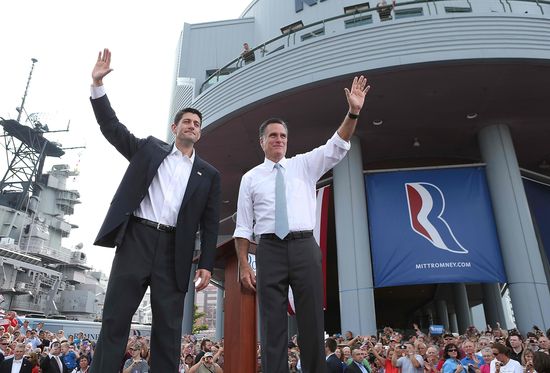
(Photo: Republican presidential candidate Mitt Romney and Rep. Paul Ryan (R-WI) wave as Ryan is announced as his vice presidential running mate in front of the USS Wisconsin August 11, 2012 in Norfolk, Virginia. Ryan, a seven term congressman, is Chairman of the House Budget Committee and provides a strong contrast to the Obama administration on fiscal policy. By Justin Sullivan/Getty Images)

Will Ryan Give Romney A Bump?

by Patrick Appel

Nate Silver notes that "vice presidential announcements often produce temporary but discernible bounces in their ticket’s polling numbers":

Democrats should probably not worry too much if the polls move slightly toward Mr. Romney over the next week or two. For that matter, Republicans probably should not worry much if the polls fail to move toward Mr. Romney, because of the circumstances of the pick. (What if the polls actually move discernibly against Mr. Romney? Well, that might be a bad sign for him.)

Nate Cohn thinks Ryan's home state of Wisconsin could be in play:

Although some might argue that Ryan doesn’t have the appeal necessary to give Romney 2 additional points in Wisconsin, it’s worth recalling that a recent PPP poll showed that Obama’s 6 point lead in Wisconsin fell to just 1 point if Romney decided to put Paul Ryan on the ticket. Moreover, Wisconsin is clearly willing to support controversial conservative reformist politicians like Scott Walker, so there’s no reason to presume that Ryan will be especially unpopular. And although Ryan’s statewide net-popularity rating is relatively low, that’s because a large number of undecided voters haven’t heard of him, which is hardly surprising for a congressional candidate. So there’s reason to wait and see how Ryan’s favorability numbers move in Wisconsin over the next few weeks, especially since Romney and Ryan will be campaigning in the conservative Milwaukee suburbs, where voters will probably learn to like Ryan a lot, even if they don’t know him yet.

History In The Democratic Age

by Matthew Sitman

A graph tracking violence in America over time (click to enlarge):

Violence_Cycles

Writing at Nature, Laura Spinney profiles Peter Turchin, a pioneer of "cliodynamics," the application of mathematical models to human history in search of grand laws or patterns that explain our past and point toward our future: 

Sometimes, history really does seem to repeat itself. After the US Civil War, for example, a wave of urban violence fuelled by ethnic and class resentment swept across the country, peaking in about 1870. Internal strife spiked again in around 1920, when race riots, workers' strikes and a surge of anti-Communist feeling led many people to think that revolution was imminent. And in around 1970, unrest crested once more, with violent student demonstrations, political assassinations, riots and terrorism …

To Peter Turchin, who studies population dynamics at the University of Connecticut in Storrs, the appearance of three peaks of political instability at roughly 50-year intervals is not a coincidence. For the past 15 years, Turchin has been taking the mathematical techniques that once allowed him to track predator–prey cycles in forest ecosystems, and applying them to human history.

None of this would have surprised Alexis de Tocqueville. In Democracy in America, he described how we would come to write history this way:

[Historians in democratic times] attribute hardly any influence over the destinies of mankind to individuals, or over the fate of a people to the citizens. But they make great general causes responsible for the smallest particular events.