National Footprints

by Zoë Pollock

Last year, Tim De Chant published a map showing how much land the globe's 7 billion people would require if they were as densely housed as the residents of various cities. Now he's done a similar job mapping the ecological footprints of countries across the world. He compares the two projects:

Cities’ land requirements far outstrip their immediate physical footprints. They include everything from farmland to transportation networks to forests and open space that recharge fresh water sources like rivers and aquifers. And more. Just looking at a city’s geographic extents ignores its more important ecological footprint. How much land would we really need if everyone lived like New Yorkers versus Houstonians? It turns out that question is maddeningly difficult to answer. While some cities track resource use, most don’t. … But what we can do is compare different countries and how many resources their people—and their lifestyles—use. For countries, the differences are far, far greater than for cities.

The full chart is after the jump because it's a little long:
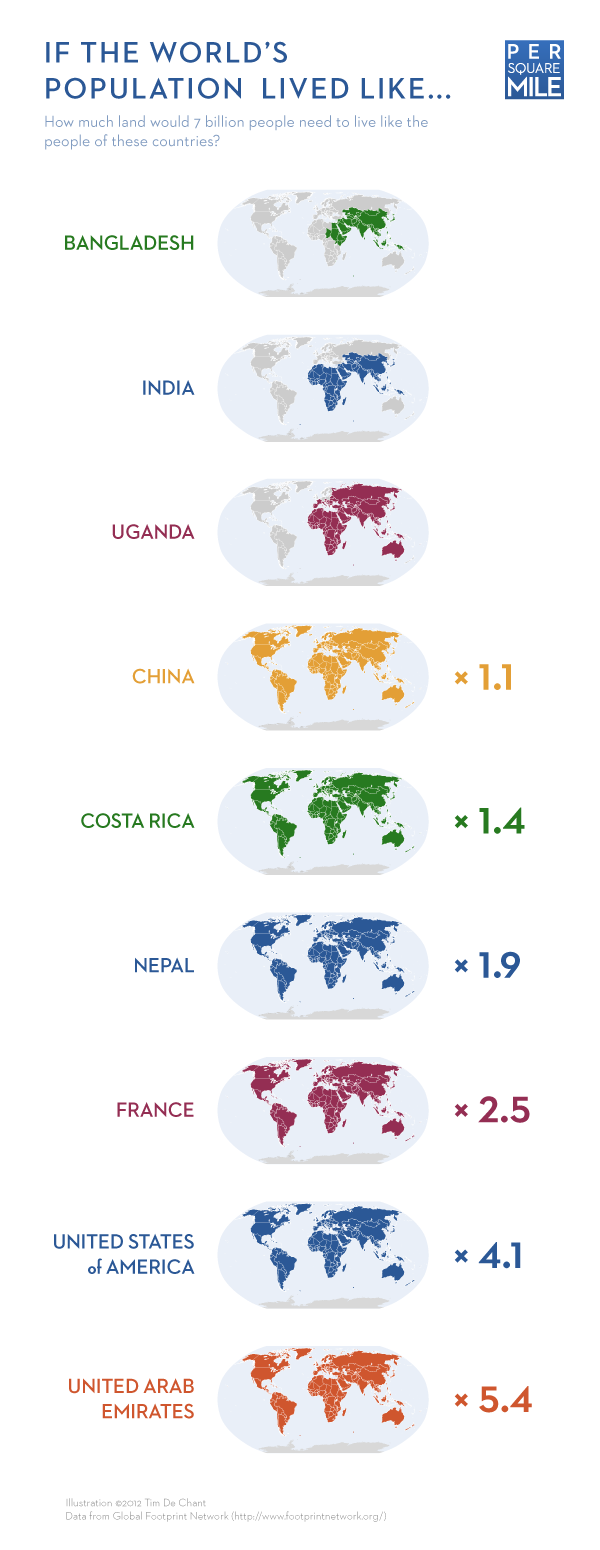
Ecological-footprint-by-country

Between The Dark And The Bright

Peel01

by Zoë Pollock

Aimee Liu revisits Graham Greene's 1948 novel The Heart Of The Matter. Like many of Greene's novels, the story revolves around themes of colonialism, war, and Greene's own conflicted Catholicism:

In Greene's view, even God is fallible, with a nature as divided and uncertain as our own. "We are part of the evolution of God," he said, "and Hitler obviously aids the dark side of God, whilst Gandhi, John XXIII and [Cesar] Chavez aid the day side […] If God is torn as we are between the dark and the bright — and therefore suffers a certain division and anguish as we do — it makes Him a more sympathetic figure."

Through [the character of] Scobie, Greene expressed an abiding distrust of any God who could cause the suffering of innocents, "who was not human enough to love what he had created." Unfortunately, he found abundant evidence of this inhumane God in his lifetime, which encompassed the horrors of two World Wars, the Great Depression, and the Cold War. In Greene's experience, [author Shirley Hazzard] writes, "pleasure could not be an assumption and was not a goal; whereas suffering was a constant, and almost a code of honour. Suffering was the attestable key to imaginative existence." Why? Because, in Greene's experience, suffering was the gateway to compassion.

(Peel lamp by space designer Naoki Ono and product designer Yuuki Yamamoto via Ignant)

The Truth About The Jefferson Lies

by Matthew Sitman

Recently, the Dish noted that David Barton's The Jefferson Lies garnered the History News Network's title of "least credible history book in print." Well, it's in print no more. Its publisher, Thomas Nelson, is pulling it off of shelves, claiming that "basic truths just were not there." NPR's new profile of the Christianist hack seems to vindicate that decision:

For example, you've been taught the Constitution is a secular document. Not so, says Barton: The Constitution is laced with biblical quotations.

"You look at Article 3, Section 1, the treason clause," he told James Robison on Trinity Broadcast Network. "Direct quote out of the Bible. You look at Article 2, the quote on the president has to be a native born? That is Deuteronomy 17:15, verbatim. I mean, it drives the secularists nuts because the Bible's all over it! Now we as Christians don't tend to recognize that. We think it's a secular document; we've bought into their lies. It's not."

We looked up every citation Barton said was from the Bible, but not one of them checked out. Moreover, the Constitution as written in 1787 has no mention of God or religion except to prohibit a religious test for office. The First Amendment does address religion.

If you are feeling especially masochistic, check out the cringe-inducing videos of Barton that NPR compiled here.

How India Is Failing Its Women, Ctd

by Chris Bodenner

A reader writes:

I love that you brought attention to the issue of acid attacks. I hope you'll point to last year's Academy Award winner for a short subject documentary film, Saving Face. It was profoundly affecting and very careful to treat its subject seriously without sensationalizing it (which only intensified the reality of the horrific nature of these crimes). The women are deeply inspiring, and Dr. Mohammed Jawad's work, along with his interactions with the women he's treating, made me think about what heroism looks like in the real world.

Closer to home, the British documentary on acid victim Katie Piper is also riveting – and available on YouTube. Update from a reader:

Acid attacks are also on the rise in Colombia, the beauty pageant-mad society. Here's a piece CNN did on these crimes recently. Like all of these places where this occurs, more attention is needed so hopefully this unspeakably cruel practice can be ended.

American Exceptionalism, American Decline

by Matthew Sitman

Martin Amis writes about leaving England for America, and what a remarkable haven for writers he's found his adopted country to be – juxtaposing his praise, unsurprisingly, with a touch of sadness at our impending decline:

The phrase “American exceptionalism” was coined in 1929 by none other than Josef Stalin, who condemned it as a “heresy.” (He meant that America, like everywhere else, was subject to the iron laws of Karl Marx.) If that much-mocked notion still means anything, we should apply it to America’s exceptionally hospitable attitude to outsiders (and America has certainly been exceptionally hospitable to me and my family). All friends of the stars and stripes are pained to see that this unique and noble tradition is now under threat, and from all sides; but America remains, definingly, an immigrant society, vast and formless; writers have always occupied an unresented place in it, because everyone subliminally understood that they would play a part in construing its protean immensity. Remarkably, the “American Century” (to take another semi-wowserism) is due to last exactly that long—with China scheduled for prepotence in about 2045. The role of the writers, for the time being, is at least clear enough. They will be taking America’s temperature, and checking its pulse, as the New World follows the old country down the long road of decline.

Previous Dish coverage of Amis's fascination with decline here.

A Poem For Sunday

Sun

by Alice Quinn and Matthew Sitman

"Song to Life Giver," translated from the Aztec by Peter Everwine:

What lies in store for us, Life Giver?
Up there, above us,
you forge your designs, you command them,
and, perhaps, in your disgust,
you hide from us on earth
your light and glory.
What lies in store for us,
You, without a friend on earth?

(From Working the Song Fields: Poems of the Aztecs. Translation © 2009 by Peter Everwine. Reprinted with the permission of Eastern Washington University Press. Photo by Flickr user Luca Castellazzi)

A Conflicted Medium

by Matthew Sitman

Mark Edwards, a former "medium," just published a new memoir, Psychic Blues. Along with colorful anecdotes about how he got started in the business and details of his more fascinating experiences, he admits the enterpise is a fraud:

I'm quite confident that I would know by now if I had a spirit guide or my Aunt Ethel's watchful ghost alongside me. I have looked and searched, then looked again. I've traveled all over the planet and humbled myself in front of everything from Celtic priestesses to UFO abductees and their recruiters. This process has been repeated over and over, only to circle back endlessly into the cul-de-sac of my own personal nightmare alley. There's nothing there in the dark, though I have frequently found myself wanting to believe there are supernatural elements to converse with and take refuge in. Their existence would have made life so much easier to understand and exploit. Still, I have a head start at getting your goat. And I will. It's Darwin's survival of the fittest, and a sideshow tent is never far from a psychiatrist's couch; there's just more sawdust on the floor.

Mental Health Break

by Zoë Pollock

Note to self, look up when you're in New Mexico at night:

Andrew King explains our connection to the skies:

As a star collapses towards death, it may throw off its outer layers of gas into space. These are enriched with the new elements created by fusion, and this process gradually adds these elements to all the matter in the universe. Eventually new stars, and often planets around them, form out of this material. Which is where we came from.

“History, A Record Of Things Left Behind By Past Generations, Started In 1815.”

by Zoë Pollock

In 1983, lightyears before Shit My Students Write, history professor Anders Henriksson compiled a complete history of Europe… according to a decade of freshman papers, quoted verbatim. Recoil and rejoice:

History, as we know, is always bias, because human beings have to be studied by other human beings, not by independent observers of another species.

During the Middle Ages, everybody was middle aged. Church and state were co-operatic. Middle Evil society was made up of monks, lords, and surfs. It is unfortunate that we do not have a medivel European laid out on a table before us, ready for dissection. After a revival of infantile commerce slowly creeped into Europe, merchants appeared. Some were sitters and some were drifters. They roamed from town to town exposing themselves and organized big fairies in the countryside. Mideval people were violent. Murder during this period was nothing. Everybody killed someone. England fought numerously for land in France and ended up wining and losing. The Crusades were a series of military expaditions made by Christians seeking to free the holy land (the “Home Town” of Christ) from the Islams.

Habits Of The Heart

by Matthew Sitman

The Claremont Review of Books recently published an essay on Tocqueville’s Democracy in America by the late political scientist James Q. Wilson. He finds the French aristocrat’s understanding of religion’s effect on American habits particularly incisive:

Habits-heart[Tocqueville’s] most interesting argument was that the mores and the habits of the people are what keep the U.S. great. As you all know, many countries have adopted a system of constitutional arrangements very similar to that which you find in the U.S. In Mexico, in the Philippines, indeed, in most of Latin America you find duplicates of the American Constitution. But despite these duplicates and despite the fact that some countries, like Argentina, are rich in natural resources, you do not find our tradition of settled government, a respect for the rights of others, and the slow emergence of freedom which leads you to give due regard to the interests of other people without abandoning your commitment to the country as a whole.

How can you explain this?

Tocqueville said that our habits of the heart reflected self-interest rightly understood. Self-interest rightly understood is different from individualism; because individualism, he argued (I think wrongly) means withdrawal into a private sphere and the abandonment of collective and public action. But self-interest rightly understood means that individualism has to be tempered by the view that Americans feel it is in their interest to be perceived to be honest and reinforced by a religion which Americans practice without shame.

(Image via Wikimedia Commons)