The Drugs Of Youth

by Zoë Pollock

On the occasion of his 40th birthday, Justin E. H. Smith contemplates them:

Tomas Tranströmer describes life as a comet: with childhood the blazing head, and senescence the dim straggling tail. What causes childhood to blaze like this is surely, in the end, a neurochemical state: we do what we can to keep kids off drugs, but what this misses is that they are always on drugs, drugs that are being produced by their brains themselves. These drugs induce a constant, ecstatic effervescence, and a strong feeling of immortality.

They start to wear off at different times for different people. In my case, their potency dropped off around the age of 27, when I had what might be called my Ivan Il’ich moment, and it finally dawned on me where this process of getting older was ultimately headed.

On a related note, Robert Wright parses a recent study examining the correlation between well-being and "wise-reasoning" as we get older:

Assuming a causal link between these two variables, does the wisdom lead to the well-being or does the well-being lead to the wisdom? … I'm guessing the answer is a little of both: Wisdom leads to well-being, and well-being paves the way for wisdom–and, in particular, for wise action, not just a capacity for wise reasoning. If that's true, then you can imagine getting swept up in a virtuous circle: Acting wisely reduces conflict in your life and strengthens your social relationships, and this fosters a sense of well-being that makes it easier to act wisely, and so on. But there's also the vicious circle scenario–a downward spiral featuring growing unhappiness, commensurately unwise action, deeper unhappiness, and so on. The virtuous circle scenario is certainly more appealing. And it sounds like it wouldn't be that hard. But I'm old enough to know better.
Faces Of The Day

by Zoë Pollock

Fido is ready for his close-up:

The creator explains the concept:

Over the course of the last year, I filmed the expressions of dogs that came to stay at a boarding kennel where I work. … Every dog dealt with being temporarily separated from their home and family they loved in a different way. Some barked- sometimes non-stop, others waited patiently for their family to return. Some were happy, some were sad, some excited, and others depressed. But they all had one thing in common- no matter the breed, size, shape or color, if you looked into their eyes you could see the deep love for their family and how much they missed them while they were away.

The Is And The Ought

by Matthew Sitman

Richard Polt laments our current mingling of evolution with ethics, in which everywhere he turns, he claims, he is told that he is "a machine or a beast…anything but human":

I have no beef with entomology or evolution, but I refuse to admit that they teach me much about ethics. Consider the fact that human action ranges to the extremes. People can perform extraordinary acts of altruism, including kindness toward other species — or they can utterly fail to be altruistic, even toward their own children. So whatever tendencies we may have inherited leave ample room for variation; our choices will determine which end of the spectrum we approach. This is where ethical discourse comes in — not in explaining how we’re “built,” but in deliberating on our own future acts. Should I cheat on this test? Should I give this stranger a ride? Knowing how my selfish and altruistic feelings evolved doesn’t help me decide at all. Most, though not all, moral codes advise me to cultivate altruism. But since the human race has evolved to be capable of a wide range of both selfish and altruistic behavior, there is no reason to say that altruism is superior to selfishness in any biological sense.

Marking The Crossroads

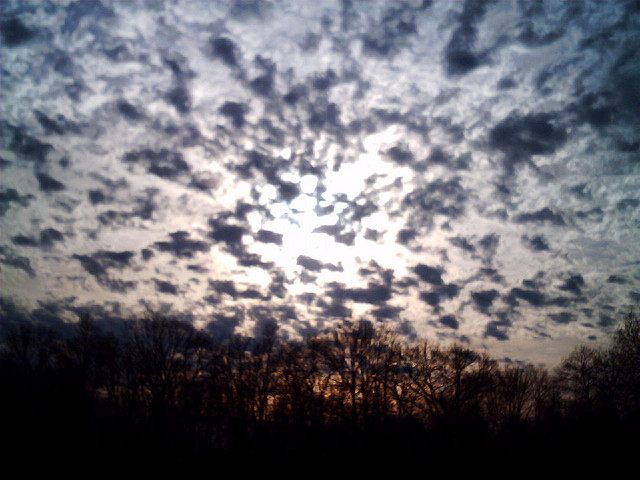
  Sky

by Matthew Sitman 

In a review of the first English translation of Rilke's Letters to God, Micah Mattix points to the poet's unconventional understanding of Christianity:

In this second letter, written in 1922 in the guise of a factory worker and addressed to the deceased poet Emile Verhaeren, Rilke asks: "Who is this Christ that is meddling in everything?" For Rilke, Christ is holy to the extent that he embraced death and, therefore, life. He is an example of a life fully lived. "I cannot believe," the poet writes, "that the cross was meant to remain; rather, it was to mark the crossroads." People who worship Christ, Rilke writes, are "like dogs that do not comprehend the meaning of an index finger and think they have to snap at the hand."

For Rilke, "degraded Christianity" has wrongly disdained sex, which has resulted in its "distortion and repression." His own version of Christianity celebrates boundless sex as a form of participating in the mystery of one's own life. (This is a view, no doubt, that was at least a little convenient for a poet who, to put it delicately, maintained a number of complicated relationships with women.) He comically lauds in this letter the debauched popes "weighed down by illegitimate children, mistresses, and victims of murder." "Was there not more Christianity in them," Rilke asks, "than in the lightweight restorers of the Gospels; namely, something alive, unstoppable, transformed?"

At First Things, Matthew Scmitz provides the inevitable downer: "Of course, the greatest sinner is not half so 'alive, unstoppable, transformed' as the simplest saint." Here's a thought – perhaps the line between sinner and saint is far less distinct than we sometimes grasp. 

(Image by Flickr user tw3k)

Peculiar Peoples

by Zoë Pollock and Matthew Sitman

Joanna Brooks, a Mormon who married a Reform Jew, describes the perils of her church's easy appropriation of the Biblical stories of ancient Israel:

I hear Mormons describe ourselves as a “chosen people” who made an “exodus” (across the American plains) to build our “Zion.” In the American West, some Mormons even call non-Mormons “Gentiles.” And I now understand the hazards—big and small—that come with presuming too much familiarity between Mormons and Jews, hazards that reveal a disconnect in many LDS minds between Israelites as an abstract conception and the reality of contemporary Jewish life. The big hazards we witness every time posthumous LDS baptisms of dead Jews cycle back into the headlines. The small ones I observe whenever my husband sets foot into the world of my observant Mormon friends and relations.

She hopes that more Mormons will take a cue from contemporary Jewish people and acknowledge religious faith's complexity:

If some of my fellow Mormons don’t get contemporary Judaism—especially other-than-Orthodox ways of being Jewish—perhaps it is because we have yet to acknowledge other-than-orthodox ways of being ourselves. Through the framework of Mormon experience, early 21st-century Mormons have become accustomed to thinking of a religion as a monolithic institutional power rather than a multidimensional tradition, as a set of fixed truth claims rather than a set of evolving questions. Candid, self-aware, and critical examination of our own theology, history, and culture—that work is just beginning in Mormonism.

Check out Brooks' memoir of growing up Mormon here.

Studying The Sacred

by Matthew Sitman

In an age of resurgent religion, Scott Atran urges academics – especially scientists – to turn their attention to the sacred. He believes that science can help us "understand religion and the sacred just as it can help us understand the genome or the structure of the universe," and that such knowledge will be vital for grasping the dynamics of world affairs in the coming decades. Atran especially focuses on how the scientific study of religion can aid in explaining the causes and duration of war and violence. For example, he argues that, contrary to conventional wisdom, religion has been behind only a very small fraction of history's bloody conflicts:

[T]he chief complaint against religion — that it is history's prime instigator of intergroup conflict — does not withstand scrutiny. Religious issues motivate only a small minority of recorded wars. The Encyclopedia of Wars surveyed 1,763 violent conflicts across history; only 123 (7 percent) were religious. A BBC-sponsored "God and War" audit, which evaluated major conflicts over 3,500 years and rated them on a 0-to-5 scale for religious motivation (Punic Wars = 0, Crusades = 5), found that more than 60 percent had no religious motivation. Less than 7 percent earned a rating greater than 3. There was little religious motivation for the internecine Russian and Chinese conflicts or the world wars responsible for history's most lethal century of international bloodshed.

However, when religion is involved it can make wars particularly intractable:

Although surprisingly few wars are started by religions, once they start, religion — and the values it imposes — can play a critical role. When competing interests are framed in terms of religious and sacred values, conflict may persist for decades, even centuries. Disputes over otherwise mundane phenomena then become existential struggles, as when land becomes "Holy Land." Secular issues become sacralized and nonnegotiable, regardless of material rewards or punishments. In a multiyear study, our research group found that Palestinian adolescents who perceived strong threats to their communities and were highly involved in religious ritual were most likely to see political issues, like the right of refugees to return to homes in Israel, as absolute moral imperatives. These individuals were thus opposed to compromise, regardless of the costs.

An Agnostic Grace

RING-INSTALLATION_3

by Zoë Pollock

Amber Sparks finds it in poetry, sometimes religious, sometimes not. She quotes Charles Wright's poem, Littlefoot:

How is it we can’t accept this, that all trees were holy once,

That all light is altar light,

And floods us, day by day, and bids us, the air sheet lightning

Around us,

To sit still and say nothing,

Here under the latches of Paradise?

After reading again all these writings, all these poets – the religious, the spiritual, the doubters, the non-believers like me – I believe we are all talking about the same thing. I believe that whether we write about god or the absence of god – if we write honestly – then we write about the greatest unattainable wish, the dream of the cave, the strange note sounded in the night that draws men to their death. We write of ultimate mystery and unknowable meaning. And what that is to each man?  To each writer that wrestles with the problem? That might be religion indeed, for I have no better word for it.

(The Ring installation by Arnaud Lapierre via Ignant)

Serenity Now

by Matthew Sitman

Pivoting off of Reinhold Niebuhr's Serenity Prayer, Carl McColman meditates on the difficulties of finding inner peace while engaging a turmoil-ridden world:

Ironically, when we discern that the peace we enjoy is rooted not in God, but in privilege or in avoiding conflict, such discerning insight is likely to cause us to feel like our "peace" is suddenly lost. Indeed, I suspect one reason why so many people—including many sincere and devout Christians—work hard to ignore or avoid the overwhelming reality of economic and social injustice, environmental degradation, and other types of conflict in our world, may simply be because of how painful it is to face such issues, especially when doing so causes us to question our "analgesic" sense of serenity. Once that questioning takes root in our soul, the "false peace" quickly loses its power to lull us into its false sense of comfort.

Do Robots Need A Gender?

Screen shot 2012-08-08 at 11.30.27 AM

by Zoë Pollock

A new experiment asked participants to judge two robots with slightly gendered features (the female had longer hair, curved lips). Tom Jacobs summarizes the unsurprising results:

Participants were more likely to view the short-haired robot in masculine terms, and suggest it was more suitable for such take-action tasks as "repairing technical devices" and "guarding a house." Conversely, the long-haired robot was perceived as more appropriate for such stereotypically feminine tasks such as household chores and caring for children and the elderly.

Vaughan Bell is intrigued by the new realm of gender politics:

The authors discuss whether it is better to create gender free robots to fight social stereotypes or whether we should create robots that comply with society’s prejudices to make them more acceptable. Personally, I’m all for genderqueer robots. That would really throw a spanner in the works. Or a works in the spanner.

(Partial view of AmalgaMATE by Michael Oswald via LikeCool)