Open-Source Sex

by Gwynn Guilford

Janko Roettgers thinks crowdfunding porn site Offbeatr could knead out some of the kinks found in the G-rated predecessor:

[T]here are a few key differences from Kickstarter. First of all, projects have to be approved to raise funds on the site. Creators post their projects on the site, and the Offbeatr team will then select the more serious proposals. However, it also uses crowdsourcing for curation…, [which is] a really interesting idea, and one that might help a site like Kickstarter to improve its success rate. Currently, around 44 percent of all Kickstarter projects successfully secure funding on the site. A voting phase before the actual fundraising begins could help creators to fine-tune their campaigns and improve their odds.

Roettger finds more to gush about:

Offbeatr is also allowing creators to sell digital content on the site, regardless of whether they’re achieving their goal or not. This can help creators secure some bridge funding even if they fall short of their goal, and it could also turn a site like Kickstarter from a one-off crowdfunding platform into something more like a digital marketplace. Imagine, for example, a digital photo magazine that sells back issues through the site, and then asks readers to commit to the funding of the next issue.

Sounds oddly evocative of election season – democracy, free markets, entrepreneurialism. Oh, and Mormonism. Yes, "Got Mormon Milk?" (NSFW), the lone project in Offbeatr's Gay section, features "hot young Mormon missionaries and their higher ranking priesthood leaders–business-like, suit-wearing, men of the Videntium Oraculi," as well as "magic Mormon underwear." Though apparently the project is more equality-focused than the sect that inspires it:

With a successful launch of Mormonboyz.com, I will start to look at taboo Mormon female sexuality, as well as Mormon polygamy!


Tightening America’s Belt

by Patrick Appel

Josh Barro fears a Romney-Ryan administration would threaten the recovery by implementing austerity measures too quickly:

What worries me most about Ryan is that he is a true believer in immediate fiscal and monetary austerity. In the House, Ryan has been a leading advocate of near-term spending cuts to shrink the deficit. Ryan responded to the second round of quantitative easing by accusing the Federal Reserve of “debasing the currency” and raising fears about inflation. I can imagine Ryan being a good partner for Romney on long-term fiscal policy. But on short-term policy — probably the more important issue — any advice he is likely to give Romney is bad.

Relatedly, Ezra Klein argues that Ryan isn't primarily a fiscal hawk:

[T]he real north star of Ryan’s policy record isn’t deficits or spending, though he often uses those concerns in service of his agenda. It’s radically reforming the way the federal government provides public services, usually by privatizing or devolving those public services away from the federal government.

A Poem For Saturday

Bed

by Alice Quinn and Chris Bodenner

"Waking in Greenpoint in Late August" by D. Nurkse:

We wanted so much that there be a world
as we lay naked on our gray-striped mattress,
staring up at trowel mark on the eggshell-blue ceiling
and waiting, waiting for twilight, darkness, dawn,
marriage, the child, the hoarse names of the city—
let there be a universe in which these lovers can wash
at the pearling spigot, and lick each other dry.

(From A Night in Brooklyn: Poems © 2012 by D. Nurkse. Reprinted with the permission of D. Nurkse and Alfred A. Knopf. Photo by Laura Nahmias.)

The Medicare Wars Begin Anew

by Patrick Appel

Jonathan Cohn reiterates the Democratic party's case against Ryan's Medicare plan:

Ryan really believes in ending Medicare as we know it. The essential promise of Medicare, ever since its establishment in 1965, is that every senior citizen is entitled to a comprehensive set of medical benefits that will protect him or her from financial ruin. The government provides these benefits directly, through a public insurance program, although seniors have the right to enroll in comparable private plans if they choose. But the key is that guarantee of benefits, and it’s what Ryan would take away. He would replace it with a voucher, whose value would rise at a pre-determined formula unlikely to keep up with actual medical expenses.

Avik Roy, on the other hand, believes  that the "Democrats' 'Mediscare' attack won't work against Paul Ryan and Mitt Romney." He claims that the Wyden-Ryan Medicare plan "only applies to Americans younger than 55 years of age, and gives those younger individuals the option of remaining in the traditional Medicare program, or choosing a comparable private-sector insurance plan":

The bottom line: if Romney and Ryan leave you the option to remain in the 1965-vintage, fee-for-service, traditional Medicare program, and you claim that Medicare has “ended as we know it,” what you’ve really ended is the English language as we know it.

Kornacki is skeptical that Ryan and Romney can successfully make this argument:

The Democratic strategy to win back the House this year involves pinning the Ryan budget to every Republican candidate, and Obama has been itching to make the fall race a competition between his priorities and those of Ryan’s plan. The hope for the Romney campaign is that they’ll be able to turn the tables on their opponents by presenting the GOP ticket as a team of unusually serious and courageous policy leaders who are willing to tell hard truths about the country’s fiscal predicament.

There are endless reasons to doubt this will work. 

Chart Of The Day

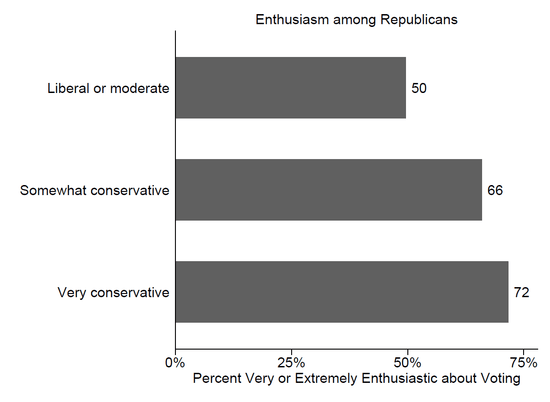
Base_enthusiasm by Patrick Appel The Ryan pick will undoubtedly excite strongly conservative Republicans, but they don’t need much exciting:

Conservative Republicans are more enthusiastic, not less enthusiastic, than other Republicans. If Romney wants to engage in base mobilization, he should be focusing on the 27% of Republicans who self-identify as moderate or liberal.

Romney isn’t the first GOP candidate to pick a veep intended to fire-up the very conservative. Millman reviews recent history:

[S]ince Reagan, every VP choice by a Republican nominee has been, in some fashion, a base-pleasing move to the right. Bush Sr. picked Dan Quayle to reassure movement conservatives that he would keep faith with the Reagan religion and that they would have a voice in the White House through which to reach him if he didn’t. Dole picked supply-side hero Kemp. Bush Jr. picked Cheney, largely to provide heft and ballast to the ticket, but also because Cheney had a rock-solid conservative record in Congress. And McCain picked Sarah Palin, who, at the time of the pick, was ideologically undefined, but who was expected to excite conservatives because of her background and life story.

What The Ryan Pick Means

bu Patrick Appel

Jonathan Chait believes that Ryan's nomination "represents a moment when the conservative movement ceased to control the politicians from behind the scenes and openly assumed the mantle of power":

What makes Ryan so extraordinary is that he is not just a handsome slickster skilled at conveying sincerity with a winsome heartland affect. Pols like that come along every year. He is also (as Rich Yeselson put it) the chief party theoretician. Far more than even Ronald Reagan, he is deeply grounded is the ideological precepts of the conservative movement – a longtime Ayn Rand devotee who imbibed deeply from the lunatic supply-side tracts of Jude Wanniski and George Gilder. He has not merely formed an alliance with the movement, he is a product of it.

Ryan Is No Robot

by Patrick Appel

Ryan's speech this morning, for those who missed it:

Bob Wright dubs Ryan a "robot nerd":

Yes, Ryan comes off as nerdier than Romney, but he doesn't come off as much more human. They seem like two slightly different variants of the classic gladhanding candidate for high-school student-body president. Both would be on the debate team, but the Romney model would also be on the football team, whereas the Ryan model would compete in interscholastic math tournaments. Most kids at my high school didn't especially like either type. They only voted for one of them because there was no alternative.

Ryan has many flaws, but, if you watch the video above, you'll see Ryan sell Romney much better than Romney sells himself. The GOP's vice presidential candidate doesn't border on inhuman the way the man at the top of the ticket does. Earlier today, Ezra Klein called Ryan "'likable" and a "decent-seeming guy." He warned that "Democrats underestimate his political skills at their peril."

What Do Americans Think About Paul Ryan?

by Patrick Appel

Paul who?

[M]ost people know little about Paul Ryan, which gives him an opportunity to introduce himself to the American electorate. At the same time, the people who do know who he is don’t tend to view him favorably (unless they are Republicans). This tendency among independents and undecided voters is potentially troubling for the Romney-Ryan ticket.

Can Ryan change the impressions of those who have them? Probably not. Can he shape the impressions of those who don’t have them, and shape them in a favorable way? That's the big question.