Everyday Fictions

by Matthew Sitman

Keith Ridgway reflects on his life as a writer – and how we all deploy fiction to navigate our worlds:

[E]verything is fiction. When you tell yourself the story of your life, the story of your day, you edit and rewrite and weave a narrative out of a collection of random experiences and events. Your conversations are fiction. Your friends and loved ones—they are characters you have created. And your arguments with them are like meetings with an editor—please, they beseech you, you beseech them, rewrite me. You have a perception of the way things are, and you impose it on your memory, and in this way you think, in the same way that I think, that you are living something that is describable. When of course, what we actually live, what we actually experience—with our senses and our nerves—is a vast, absurd, beautiful, ridiculous chaos.

Ryan’s Ayn Problem

by Chris Bodenner

Jane Mayer reviews the record:

As my colleague Ryan Lizza noted in his terrific biographical Profile of Ryan, Rand’s works were an early and important influence on him, shaping his thinking as far back as high school. Later, as a Congressman, Ryan not only tried to get all of the interns in his congressional office to read Rand’s writing, he also gave copies of her novel "Atlas Shrugged" to his staff as Christmas presents, as he told the Weekly Standard in 2003. Two years later, in 2005, Ryan paid fealty to Rand in a speech he gave to the Atlas Society, the Washington-based think tank devoted to keeping Rand’s "objectivist" philosophy alive. He credited her with inspiring his interest in public service, saying, "[T]he reason I got involved in public service, by and large, if I had to credit one thinker, one person, it would be Ayn Rand.

This video from 2009 says it all. Then this year, in a reversal that would make Romney blush, Ryan told NRO:

"I reject her philosophy," Ryan says firmly. "It’s an atheist philosophy. It reduces human interactions down to mere contracts and it is antithetical to my worldview. If somebody is going to try to paste a person’s view on epistemology to me, then give me Thomas Aquinas," who believed that man needs divine help in the pursuit of knowledge. "Don’t give me Ayn Rand," he says.

And of course no mention of the atheist Russian philosopher aboard the USS Wisconsin today; Romney instead emphasized Ryan's faith and selflessness:

Paul is in public life for all the right reasons — not to advance his personal ambitions but to advance the ideals of freedom and justice; and to increase opportunity and prosperity to people of every class and faith, every age and ethnic background. A faithful Catholic, Paul believes in the worth and dignity of every human life.

Naturally voters on the left already abhor the teachings of Rand and the influence they have on the Ryan budget. So it will be much more interesting to see how Rand's blend of Social Darwinism and atheism will play out in the minds of Christian Republicans already skeptical of Romney's Mormonism and Bain background. If Democrats can effectively brand Ryan with the mark of Rand, a deep wedge could finally open up between free market Republicans and socially-conscious Christians, such as the young man in the above video.
A Partisan First And Foremost

by Patrick Appel

Dave Weigel notes that Republicans excuse Ryan's deficit-busting votes under Bush because "he was only playing for the team." Larison refuses to give Ryan a pass:

He was a bad fiscal conservative because he was a good partisan, but there was never a time before that when he demonstrated a commitment to fiscal responsibility in practice. Just like Santorum’s weak "team player" excuse for voting for legislation that supposedly contradicted his principles, Ryan’s claim that his spending votes made him "miserable" doesn’t make things better. If he was so miserable, why did he vote for the bills? Because he has consistently put partisan loyalty ahead of fiscal responsibility. That’s not a reason to give Ryan a pass on these votes. That’s precisely the reason to hold those votes against him.

The Books Of Summer

Bikini

by Matthew Sitman

It's been the summer of 50 Shades of Grey, but Amanda Katz shows that many have resisted the trend with their beach reading:

There's the guy in a straw hat standing waist-deep in a crowded pool in Palm Springs, reading a book about string theory. There's the woman in the lounge chair, engrossed in William Styron's memoir of depression, Darkness Visible. There's the guy on the beach absorbed in JavaScript: The Good Parts. (That's a friend of mine; he claims that if you hold the cover just right, all anyone can see is "The Good Parts," which sort of disguises it as a beach book. Sure, dude, whatever you say.) And there's my brother, who once spent a pleasant seaside week reading The Rise and Fall of the Third Reich.

What these atypical summer reads say about us:

[T]hese less obviously summery books show just how individual our reading pleasures are. The best-seller list is where we meet, around the books that almost everyone likes; at the margins, we disperse toward our own idiosyncratic interests and tastes. Thus, when asked to recommend summer reading for a general audience recently, I didn't quite have the nerve to suggest Geoff Dyer's weird, funny Zona, a book that marshals a shot-by-shot recounting of a Tarkovsky film into a succinct meditation on criticism and existence. Only an alien, or a film professor, would consider it a Hot Summer Read. Nevertheless, it's one of the books I most enjoyed in recent months, and some people — not all — would find it an excellent vacation companion.

If you are looking for vexing, non-trendy vacation reading, see Emily Wilkinson and Garth Hallberg's list of the top ten most difficult books at Publisher's Weekly.

(Image by MATCHBOOK via Mashable)

Paul Ryan: Not A Moderate

Ryan_Conservative

by Patrick Appel

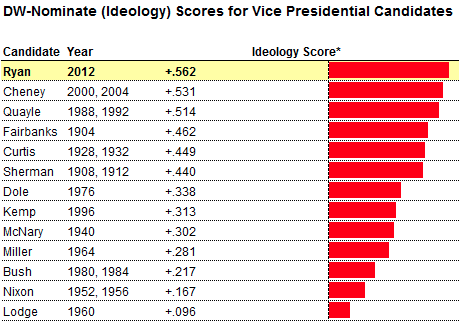
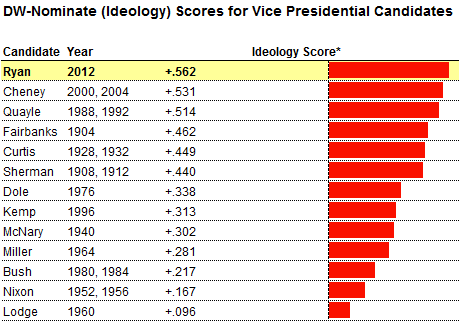
Nate Silver compares Ryan to past veeps:

Various statistical measures of Mr. Ryan peg him as being quite conservative. Based on his Congressional voting record, for instance, the statistical system DW-Nominate evaluates him as being roughly as conservative as Representative Michele Bachmann, the controversial congresswoman of Minnesota.

By this measure, in fact, which rates members of the House and Senate throughout different time periods on a common ideology scale, Mr. Ryan is the most conservative Republican member of Congress to be picked for the vice presidential slot since at least 1900. He is also more conservative than any Democratic nominee was liberal, meaning that is is the furthest from the center. (The statistic does not provide scores for governors and other vice presidential nominees who never served in Congress.)

Ryan’s Gay Rights Record

by Patrick Appel

Start watching around 1:55 to see Ryan downplay the importance of marriage equality discussions:

Jim Burroway believes Ryan is more extreme than Romney on issues of gay equality:

In 2006, he supported Wisconsin’s constitutional amendment which banned both same-sex marriage and civil unions. He voted against “Don’t Ask, Don’t Tell” repeal and the Matthew Shepard Hate Crimes Act. He voted for the Employment Non-Discrimination Act five years ago, but he’s withdrawn his support since then. I don’t know Ryans position on gay Boy Scouts. But that looks like our last hope for a possible pro-gay position. I’m not optimistic.

Jay Newton-Small, on the other hand, thinks Ryan is "less conservative on social issues":

Ryan generally avoids social issues like gay rights, a fact that has sometimes gotten him in trouble with conservative activists. In 2007, he voted for a bill that would ban employment discrimination based on sexual orientation. He explained his vote because he had friends “who didn’t choose to be gay… they were just created that way.” He later lamented that he “took a lot of crap” for that stance.

Brandon K. Thorp passes along the video above as proof that Ryan "probably won't talk about the gays unless he's asked":

Mitt Romney's new running mate doesn't like to talk about LGBT issues. He doesn't go out of his way to talk about any social issues — he's a money man, and he's most comfortable making technobabblish arguments about how middle-class people can benefit from unfettered capitalism. But Rep. Ryan does have his opinions.

Why Did Romney Pick Ryan?

by Patrick Appel

Douthat, who didn't think "Romney should pick Ryan as his number two,"  provides various theories. Among them:

If the Republican ticket triumphs in November, having Ryan on-side will help Romney, a non-Washingtonian, navigate the complexities of Capitol Hill. But here it’s important to keep in mind that Ryan is an ideologue and a Beltway wheeler-dealer, attuned to both the possibilities for bipartisanship (recall that his latest Medicare proposal is co-sponsored with a Senate Democrat) and the need to sometimes swallow hard and take one for the team (hence those Bush-era votes for TARP and Medicare Part D). Thus if Romney wants to push an aggressive agenda in his first hundred days or year in office, Ryan will be a natural point person — but if the Romney White House then needs to compromise well short of conservative objectives, Ryan will be capable of negotiating the deal and ready and willing to sell it to a reluctant base.

 Frum imagines the coming Democratic attack ads. 

Von Hoffman Award Nominee

by Patrick Appel

"I don’t think [Paul Ryan] has the slightest desire to be vice president. While it is a good stepping stone to the presidency even for those who don’t achieve the office through death of a president, I don’t think that is Ryan’s ambition," – Bruce Bartlett, in an article published yesterday titled, "Paul Ryan Will Not Be Mitt Romney’s Running Mate"

The View From Your Window Contest

Vfyw_8-11

You have until noon on Tuesday to guess it. City and/or state first, then country. Please put the location in the subject heading, along with any description within the email. If no one guesses the exact location, proximity counts.  Be sure to email entries to VFYWcontest@gmail.com. Winner gets a free The View From Your Window book. Have at it.