The Cost Of Spam

by Patrick Appel

Alexis passes along research on it:

[I]n a new paper in the Journal of Economic Perspectives, Justin Rao of Microsoft and David Reiley of Google (who met working at Yahoo) have teamed up to estimate the cost of spam to society relative to its worldwide revenues. The societal price tag comes to $20 billion. The revenue? A mere $200 million. As they note, that means that the "'externality ratio' of external costs to internal benefits for spam is around 100:1. Spammers are dumping a lot on society and reaping fairly little in return." In case it's not clear, this is a suboptimal situation.

Why Are Olympic Mascots So Bizarre? Ctd

58014700_e6ec36fd78_o

by Chris Bodenner

Readers keep the thread going:

Hopefully I'm not the only one suggesting that you missed perhaps the most famous Olympic mascot: Fatso the Fat-Arsed Wombat. As befits the Australian sense of humour, Fatso was far more popular nationwide than the more official mascots. From his Wiki page: "During the Olympics, the Australian Olympic Committee attempted to ban athletes appearing with Fatso to stop him upstaging their official mascots. The ensuing public relations disaster forced the president of the AOC, John Coates, and the director general of the IOC, Francois Carrard, to distance their organisations from these attempts."

The above photo of Fatso is from Tim Lucas. Another reader:

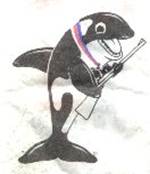
Of course, the Olympics aren’t the only international sporting event with a mascot.  The mascot of the 1994 CommonwealthImage003-1 Games in Victoria, BC, was an orca (killer whale), named Klee Wyck (the Laughing One, in the language of the Ucluelet First Nation).  Pictures were produced of Klee Wyck engaging in each of the games’ events, including shooting, resulting in the incongruous image of a whale – usually used a symbol of all that is good and green – brandishing a rifle.
Another:

In your discussion of Olympic mascots, certainly someone must have already mentioned Springy, created by Homer in an attempt to lure the Olympics to Springfield:

Springy

Another circles back to the London mascots:

Hilariously, you can buy a policeman Wenlock toy. This figurine, which is sold out, is my favorite, especially because of the first product review:
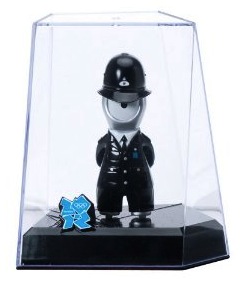
41f5MTz4rnL._SL500_AA300_I bought this toy last week and although it arrived quickly and it seems to be well made, I have some concerns. Every fifteen minute since I've opened it out of the packaging, it will shout phrases such as 'I AM THE EYE OF PROVIDENCE', 'PAX ROMANA' and 'THE SECRET IS WITHIN THE GREAT PYRAMID OF GIZA'.

I cannot find the source of the sound on the toy (speaker, etc) and I cannot find a battery compartment either. It's beginning to worry me very much as my dog will do nothing apart from stare at it incessantly for hours on end until he collapses from exhaustion. When he wakes up, he will continue to stare again. He is unresponsive to anything and he is becoming extremely emaciated.

I really want a toy that actually yells "PAX ROMANA!" at my friends, but that's neither here nor there.

Another:

Saw your post on the London Olympic mascots. When they were first publicised in 2010, I remember noting a striking parallel, and one which I'm surprised hasn't been generally noted. The mascots were announced at almost exactly the time we in Britain got our current coalition government, which is Conservative (blue motif) and Liberal Democrat (orange motif). The mascots are each of these colours. In fact, the streamer design on the chest of the orange mascot is very similar to the Liberal Democrat bird logo. 

Furthermore, there was an image that was released near that time which was a digital combination of Prime Minister David Cameron (conservative) and Deputy Prime Minister Nick Clegg (liberal democrat). This image illustrated how interchangeable the two men are, and few people shown the picture on the street could tell that it was a combination of the two. Similarly, the mascots are largely identical save for the colour scheme. 

Thus I always expected them to be commonly known as 'Dave' and 'Nick'. Sadly, the idea never took off. But it would have been fitting, for the parallels run beyond the colour scheme: the mascots are also shapeless and insipid, stand for nothing in particular, but do look shiny and new. Which just about sums up Cameron and Clegg.
Humanitarian Aid’s Catch-22

by Gwynn Guilford

US government humanitarian aid programs have an unfortunate knack for supporting human rights violators. Maria McFarland Sanchez-Moreno and Naomi Roht-Arriaza home in on the case of Ethiopia, where "human rights groups have reported in great detail how the leadership in Addis Ababa has become increasingly authoritarian over the past few years":

This is not a simple issue. Ethiopia is one of Africa's largest and poorest countries, and donors understandably want to help provide a safety net for its most vulnerable citizens. Unlike in countries where donors can support non-governmental activity in lieu of funding a repressive state, in Ethiopia the government has constricted that opportunity through a repressive law that limits the ability of civil society groups working on any human rights or advocacy issues to receive foreign funds.

They highlight another thorny diplomatic issue: when foreign aid is seen as endorsement of the dominant regime.

Another problem arises when U.S. assistance becomes too closely aligned with a repressive government's priorities and is interpreted as political support for the regime. This is particularly difficult when dealing with countries that restrict the types of support foreign donors can provide. In Egypt, for example, USAID's willingness to comply with President Hosni Mubarak's funding restrictions while he was in power led to criticism from many civil society organizations at the time. What's more, this compliance harmed the credibility of USAID's protests after Egypt's military-led government harassed and intimidated American NGOs last year — the Cairo authorities could simply say they were merely enforcing their own laws, by which the United States had previously abided.

Off-Grid, Ctd

by Chris Bodenner

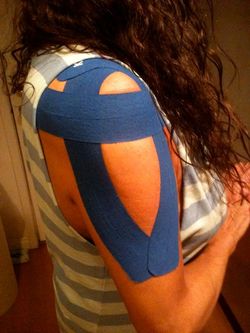
A reader might be going a little loopy in Andrew's absence:

hey, easy on the IMG_1434and sometimes my elbow and forearm
why?
because i have pain from scrolling on my touch pad
reading the dish for hours on end
and it helps tremendously.
i'm hooked on it.
try it.
: ))
had to use the blue
they ran out of pink
there i said it.
have a good summer everybody
and have a good vacation sully!!
but if all hell breaks loose
you have to holla back
promise?!

The Burning Lets You Know It’s Working

by Zoë Pollock

Antiperspirant has come a long way since its invention in the early 20th century. Exhibit A: Odorono from 1912:

Although the product stopped sweat for up to three days—longer-lasting than modern day antiperspirants— Odorono’s active ingredient, aluminum chloride, had to be suspended in acid to remain effective. (This was the case for all early antiperspirants; it would take a few decades before chemists came up with a formulation that didn’t require an acid suspension.) The acid solution meant Odorono could irritate sensitive armpit skin and damage clothing. Adding insult to injury, the antiperspirant was also red-colored, so it could also stain clothing—if the acid didn’t eat right through it first.

Previous Dish on the science of sweating here and here.

How Scary Is Sequestration?

by Patrick Appel and Gwynn Guilford

Christopher Preble embraces it:

Americans shouldn’t worry that sequestration will make our defense budget too small. We account for approximately 48 percent of the world’s military spending. We will retain a margin of superiority over any conceivable combination of rivals, including China, even if our share of military spending fell to 44 or 45 percent of the world’s total. Sequestration was no one’s first choice, but keeping our reckless spending and strategic myopia on auto pilot is worse.

Benjamin Friedman calls sequesteration the "new Y2K" because it's "coming at the start of next year, hardly anyone understands it, and important people say to freak out about it." He explains why we shouldn't:

As for arguments about sequestration’s massive economic effect…, suffice it for now to say that a reallocation of about 0.3 percent of GDP is likely to have a minor but positive long-term impact on jobs and growth. True, that positive impact requires what economists call structural adjustment, which in plain English means it takes a while, and in the meantime some people lose jobs. That makes the change worthwhile but politically tough, a problem that isn’t unique to defense spending. 

However, digesting a recent Goldman Sachs research report, Jared Bernstein isn't ruling out the possibility of a devastating blow in early 2013:

I’m not sure GS is right about the immediacy of the magnitude of these spending cuts on growth. As I’ve written before, there are considerable lags built into the way money flows from the government to, say, defense contractors. Projects they’re doing today were paid for a year or two ago. Nevertheless, the GS researchers are thinking about the way these dollars flow through the national accounts—as government spending which feeds into GDP—so they’ve got a point. And even if the sequester part of [the Q1 2013 projection] is off by, say, a third, that’s still a big hit to an already too wobbly economy.

Jordan Bloom zeroes in on the hypocritical politicking surrounding the sequestration. Meanwhile, Scott Lilly breaks down how airports could face closures as a result of the cuts:

The required 9 percent to 10 percent cut in Federal Aviation Administration spending, about $1.35 billion, must be taken equally from all activities, and that includes operations—in other words, the control towers. Even within the agency’s operations account there is little flexibility. Some airports, mostly smaller ones, are operated under contract, which means the control towers are run by employees of a private contractor and not by Federal Aviation Administration controllers. But since the money that supports those contracted services are discussed separately in the Appropriations Committee reports that fund the agency, they are, under the terms of the sequestration law, a separate activity and must be cut by no more or no less than the funding provided for agency-operated control towers.

Quote For The Day

by Chris Bodenner

"We have no proof today, but I would say to you under Obama’s ideology it is absolutely true that he would be comfortable sending a lot of people checks for doing nothing. I believe that totally," – Newt Gingrich, after repeatedly pressed by Anderson Cooper to admit that the claims made in Romney's welfare ad are totally unsubstantiated. The whole interview is a remarkable bit of propaganda countered by a remarkable bit of journalism.

The Daily Wrap

GT_BEACHVBALL_120808

by Gwynn Guilford

Today on the Dish, campaigns traded blows on welfare waivers while the blogosphere savaged Romney's anti-Obama welfare ad from yesterday and CNN found some gaping holes in Obama's GST Steel worker ad. DeLong pilloried Romney and his economic advisers, Yglesias called out Rubio's Olympic tax break plan – and Obama's support for it – and Suzy Khimm explained how this time, it's different (fiscally, that is).

While fighting raged on in Syria, Jon Lee Anderson considered the conflict's global impact. Meanwhile, the ECB lacked data, Singapore's corny-horny National Night campaign revealed nasty race and class undertones and banks proved too interconnected to fail. Robert Bryce said coal is here to stay and Salmon argued Facebook's listing has made Zuckerberg less effective. Bob Wright wondered why Aurora got more attention than the Sikh temple shooting, and Randy Blazak delved into the history of hate rock.

In Olympics coverage, eight Olympics athletes went missing, Liu Xiang's choke complicated both corporate sponsor and apparatchik messaging and Chris showcased another menacing pic of an utterly unthreatening sport again today. While one reader waxed poetic on the biathlon, another nominated Izzy for contention in the ongoing weird Olympic mascot assessment. Noreen Malone declared Ryan Lochte to be a "himbo," and an Olympic MHB here (though some people are Olympic-ed out).

Tracy Clark-Flory pondered the struggles of the singleton, Jesse Bering talked penis shape and a hacker exposed how he attacked a tech journalist at random. Steve Heller mused on motivation and hipster giving was found to be actually working. And while VR Narayanswami waved "bye" to language police, two of them ranted about "literally" and "actually."

A reader made the case for working remotely, still more readers told Bloomberg to go suck it, and many wise, serious people debated Bruce Springsteen's art. Last but not least, a VFYW here.

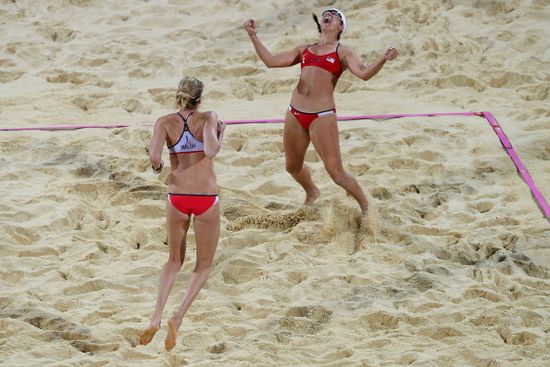
(Photo: Kerri Walsh Jennings (L) and Misty May-Treanor of the United States take the gold – their third in a row – after defeating fellow US volleyballers Jennifer Kessy and April Ross in straigh sets. By Ryan Pierse/Getty Images)

Syria Rages On

by Chas Danner

Juan Cole updates us on the Assad regime's assault on Aleppo, which has now started in earnest:

The Baath government’s attack on East Aleppo, a rebel stronghold in the past couple of weeks, began Tuesday night, with an assault by advanced Russian-made tanks. It began with a drive to cut the district in two, and the heavy shelling is said to have left large numbers of rebel fighters dead. Some 20,000 residents of Salahuddin are said to have fled in recent days, some of them living in schools and other temporary shelter elsewhere in the city, some of them fleeing to Turkey or stuck with scorpions and sand in a Jordan refugee camp. In the past 24 hours, some 2400 Syrians crossed to Turkey, including regime officers and troops who were defecting.

His analysis:

The regime has to hope against hope that Aleppines will blame the Free Syria Army for the military operations in their city, rather than blaming Damascus for responding heavy-handedly. So far, from what we can tell, that hasn’t been the case, and more and more of the country has turned against the government as it has become more and more brutal. On Tuesday, the Prime Minister defected to Jordan. If you are a dictatorial regime, you never want to hear the phrase “the prime minister defected.”

From what EA's James Miller has been able to find out, contrary to other reports, the battle lines in Aleppo have not moved, "The FSA appears to be able to defend the city, but they are not in a position to launch an offensive against the nearby Assad troops, soldiers that outnumber them perhaps 3 or 4 to 1." Meanwhile Farnaz Fassihi investigates [WSJ] the kidnapping of 48 Iranian men by anti-regime forces. The Iranian regime originally insisted they were in Syria as "pilgrims":

"Everyone on this trip was either a Guard or a Basij militia. This wasn't a regular tour group," said an employee of the [Iranian] tour agency that organized the trip[.]

Their purpose:

[T]he people familiar with the trip said the men were active members of the Revolutionary Guard Corps, or IRGC, on a mission to train Syrian forces in counterinsurgency methods as its armed forces fight a decisive battle in Aleppo. That would represent the strongest suggestion of Iran's involvement in Syria's 17-month uprising and could further dig Iran into isolation in the region, fueled by anger among its Arab neighbors for its support of President Bashar al-Assad. 

Reuters reports on the other foreign fighters involved in the conflict – Islamists who formerly fought for insurgencies like the one in Iraq:

Seventeen months into the uprising against Assad, Syria's rebels are grateful for the support of Islamist fighters from around the region. They bring weapons, money, expertise and determination to the fight. But some worry that when the battle against Assad is over they may discover their allies – including fighters from the Gulf, Libya, Eastern Europe or as far as the Pakistan-Afghanistan border area – have different aims than most Syrians.