Instructions For Being Alone

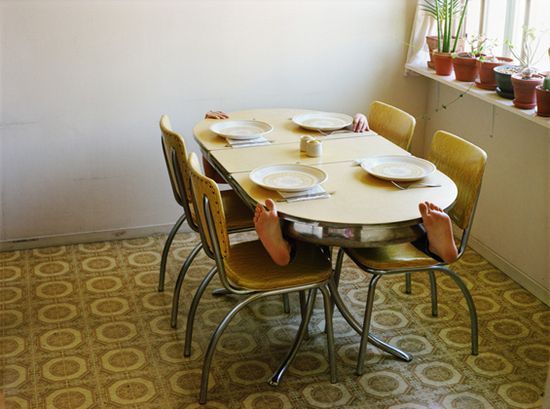
800_Hanging_onto_the_Kitchen_Table

by Zoë Pollock

After a bad breakup, Tracy Clark-Flory consulted the experts for some advice:

I thought I’d be good at this alone thing by now. I’m an only child, for crying out loud. Instead, on the heels of another split, I’m amazed at how difficult just being by myself can be. I have friends – they are wonderful — but I feel a suffocating solitude at the end of the night, in the morning or at any moment of the day that isn’t scheduled with distraction. It wasn’t this way when I was coupled. Just the knowledge that I had “a person” to call my own (even though I know in my bones that you can never truly call another person “your own”) was a comfort; that knowledge itself was a constant companion. 

Judy Ford, author of Single: The Art of Being Satisfied, Fulfilled and Independent, points the way after the jump:

Her practical tips for conquering solitude are to get creative (“creativity is the cure of loneliness”), push yourself to “do something you have never done before” (like taking yourself out to dinner), admit your loneliness to others (“you might be surprised that they feel lonely too”), “get cozy with the gaps,” those empty spaces in between plans, and remind yourself, “Loneliness is not going to kill me.” These aren’t easy fixes — and may induce eye-rolls from self-help haters — but they’re crucial to happiness, she argues: “To experience wholeness, first we experience the void.”

Slate excerpts part of Michael Cobb’s Single: Arguments for the Uncoupled:

Certainly being single is a variation on being individual. Even Thoreau had to keep reassuring us that he was not too lonely in the woods: “I am no more lonely than a single mullein or dandelion in a pasture, or a bean leaf, or sorrel, or a horse-fly, or a bumble-bee.” I’m not sure if he can prove or commit too many pathetic fallacies in these comparisons. Such rhetoric betrays a sense that the question of his loneliness is still very much open, and something about individualism must be thought about as we consider the single.

We've previously covered Cobb's book on the Dish here and here.

(Photo courtesy of Lee Materazzi, via Flavorwire)

Literally, The Worst Word

by Zoë Pollock

Sarah Miller rages against her least favorite adverb:

People use 'literally' because they feel like all their stories have to be exciting. "I literally had to sprint to my class." Okay, who gives a fuck? "I literally ate the whole hamburger." Again, unmoved. Here's one you hear a lot: "Oh my God, my best friend's apartment is literally right across the street from…" …whatever. 

Jen Doll nominates "actually" instead:

While literally and actually can be used interchangeably, actually has a bad attitude. Literally can be mocked and laughed at, because literally almost no one uses it correctly. Actually is more sneaky, a wolf in sheep's clothing. Actually is the word that you use when you're actually saying, "You are wrong, and I am right, and you are at least a little bit of an idiot."

Why Are Olympic Mascots So Bizarre?

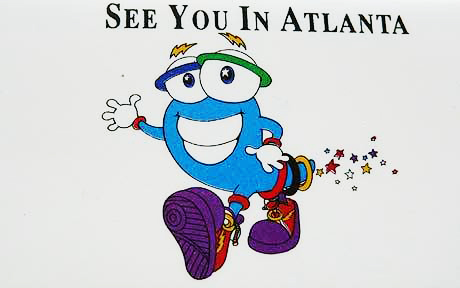
Izzy

by Chris Bodenner

Last week we spotlighted London and Beijing. A reader adds:

If you are going to examine bad mascots, please don't forget Whatizit/Izzy from Atlanta in 1996.  It was a horrible blue sperm with stars shooting out his ass. It was the disastrous result of too many marketing people throwing everything into the pot. We still are living down the shame of Izzy.

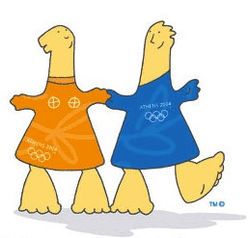
The 2004 Games were not much better – and oddly phallic:

0013729ece6b0822801400The Athens Olympic Mascots, Athena and Phevos, with their wide feet, long necks and tiny heads, one in orange and the other in deep blue, are based on dolls, thousands of years old, found at archaeological sites in Greece. Greek mythology had it that Phevos and Athena are brother and sister, named after two Greek gods: Phevos, the god of light and music, and Athena, goddess of wisdom and patron of the city of Athens.
The remaining mascots, stretching back to 1972, are actually pretty normal.

Commuting Games, Ctd

by Chris Bodenner

A reader writes:

I'm so sick of these schemes designed to motivate people to commute outside of peak times.  Does anyone think most commuters WANT to drive when things are at their most hellacious?  But until we change the tyranny of the 9-5(-ish) workday, which has to begin at the top-down of our business culture, these schemes will accomplish nothing. 

Case in point: I'm currently working an internship for which I conduct open-source research to support various arms control programs for the DoD.  That's all I do.  No interaction with the clients from the DoD, the teams that actually use my research during their missions, or anyone else for that matter, besides maybe a once-a-month sit-down with my immediate boss.  Why, WHY, do I need to be in my office for 8 hours some time between 8am and 6pm to do that?

For that matter, why do I need to be in an office at all?  My personal laptop and desktop are light-years better than the dinosaur my internship provides, and I don't need access to any kind of secure network to do open source research.  Hell, I could do this work from my real home in Hampton, rather than spending a summer in my parents' spare room in the DC area.  But common sense reforms to address these kinds of issues have never felt so unobtainable.

For us at the Dish, our most efficient work gets done when we aren't in the same room, or even the same state. And we often blog on trains, planes, buses, taxis and sometimes sidewalks. And once at a wedding. The flip-side of that freedom, however, is that it follows you everywhere.

The Daily Wrap

GT_KIRANI_120807

by Gwynn Guilford

Today on the Dish, bloggers differed on the veracity of Harry Reid's statement about Romney's taxes, Nate Cohn prescribed a Sister Souljah moment for Romney and Pareene christened Jennifer Rubin as a member of the hack list. And while the Warren-Brown war encapsulated the Massachusetts authenticity curse, Wikipedia predicted the 2008 VP choices and Josh Barro clawed back with his Romney's secret weapon economic plan argument. Meanwhile, Gopnik disintangled creed and commerce in Romney's persona and Barney got frank on Obama.

As for the ad war, a pro-Obama Super PAC put out a ruthless new ad while Team Romney argued that Obama gutted welfare. And Andrew Romano explored how pro-GOP spending floods downticket races. 

In Olympics, Saudis lashed back against the participation of their female athletes, and while the reader thread continued on objectification of Olympic lesbian footballers like Megan Rapinoe and beach volleyballers, they debated the potential enhancements of cannabis. Also, this photo offered a rare glimpse at the menacing side of synchronized swimming.

Curiosity's journey received tribute as the excitement for its documentary abililites built. A new ad campaign encouraged citizens to lie back and think of Singapore, Ugandan queer activists staged the country's first Pride Parade and the Bush administration missed the diplomatic boat with Iran. Meanwhile, Pussy Riot embodied political punk in their fight against Putin. 

In assorted commentary, healthcare trended towards chains, a physicist explained the finer points of the death zone and a new study rehabilitated bisexual men – via their eyes. And while Adrian Vermeule showed how SCOTUS prizes convention, Homer overlooked blue because it was scarce. One's 20s proved to be crucial years, readers dug deeper on PTSD and no one wanted to sit next to strangers on the bus. And Randall Munroe dismissed the robot revolution, Jeremy Harding exposed the art behind pre-digital photography and Balaji Prabhakar made the case that incentives might help traffic congestion. In weed updates, a new documentary examined how drug prohibition fuels the business while the long view on pot legalization was an optimistic one. Finally, VFYW contest here, MHB here and a deluged VFYW here

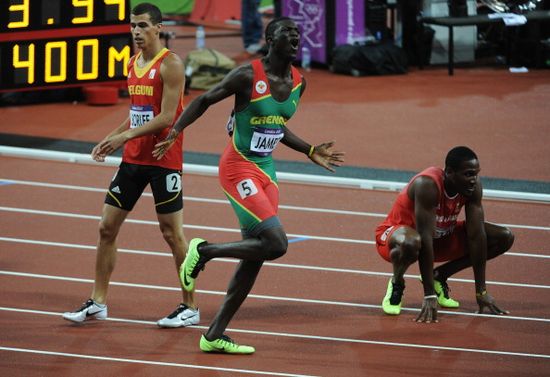
(Photo: Kirani James of Grenada celebrates after winning the gold medal in the Men's 400m final on Day 10 of the London 2012 Olympic Games. James won Grenada's first-ever Olympic medal. By Harry How/Getty Images)

Picturing The Past

/

by Matthew Sitman

Jeremy Harding uses the publication of Magnum Contact Sheets, a collection that reveals how photographers worked before the advent of digital cameras, to meditate on the meaning of the art:

So much of what photography has to say about appearance, it turns out, is really about disappearance: cultures and places changed beyond recognition, lives long gone, and the old arts of the analogue camera and the darkroom with them. Both subject and practice take on a lyrical, heritage quality as they’re superseded or extinguished. In his piece about the end of the Kodachrome colour slide (LRB, 3 February 2011) Julian Stallabrass pointed out that nine of the images produced by the American photographer Steve McCurry – another Magnum member – when he petitioned to shoot the last roll of Kodachrome in 2010 were of a vanishing nomadic tribe in Rajasthan…

Will Romney Ever Tack To The Center?

by Patrick Appel

Nate Cohn thinks Romney needs a "Sister Souljah moment":

This is a unique moment. Here's a candidate completely dependent on winning moderate, independent, and perhaps even Democratic-leaning independent voters making no effort to reposition himself toward the center at a time when his party is unpopular. At the same time, a relentlessly negative campaign has begun to define him as the worst manifestation of the forces responsible for undermining the economic security of the middle class, and the Obama campaign is poised to highlight the most severely conservative elements of Romney's agenda.

The Sex Appeal Competition, Ctd

by Chris Bodenner

A reader writes:

Regarding the reader who lamented that the lesbian Abby Wambach was ignored by the media for the likes of straight Hope Solo and Alex Morgan: Abby is in the ESPN Body Issue too, and dammmnnnnn, she's HOT. And I'm straight even.

The original reader had also lamented over Megan Rapinoe, and, well, see for yourself. Another reader:

This article asks: What if every Olympic sport was photographed like beach volleyball? Pretty interesting results.

On that note, Jack Moore breaks down the various ways sports photographers and their agencies serve up the rear ends of beach volleyball players. Another challenges the premise that Olympic events that show more skin are preferred over others when it comes to coverage:

Networks cover the events that are exciting and usually fairly short. 

In track, there's lots of coverage for sprints, high jumps, hurdles, and pole vaulting.  How much is there for the marathon?  Where's all the coverage for racewalking?  Few people are interested in rowing as a sport.  Ditto fencing.  Cycling can be exciting, but even the multi-week Tour de France can easily be distilled down for the average viewer to two hours a week.  Then there's archery and shooting, which just aren't gripping.  And on and on.

In the winter, it's downhill, ski jumping, bobsledding, speed skating, and the like.  Cross country?  Biathlon?  Eh, not so much.  Back in the days that figure skaters had compulsories, you never saw them.  You saw their routines.  Why?  Because the compulsories were boring as hell while the routines are exciting.  Yet the women wore tiny outfits for both. 

Simply put, the events that get the most coverage are the events that are most exciting.  Still, I have to admit that the uniforms for beach volleyball are a very pleasant plus.

Don't forget rowing. Money quote:

Rummel claims he was 'not erect.'

Is Pot A Performance-Enhancer? Ctd

by Patrick Appel 

A reader quotes Ossian Shine:

While it is generally accepted that cannabis is unlikely to give athletes a performance advantage in fast-paced sports, some experts say it could prove helpful in sports like shooting or golf where a steady hand is needed.

I suspect those "experts" (if they even exist) were stoned when they opined that marijauna can help in non "fast paced" sports. Shooting requires intense focus and concentration at the Olympic level. Marijauna does not give any athlete a "steady hand" the way propranolol does and there is no way that a shooter would be safe on the line if under the influence. I suspect the same is true of golf, sailing and equestrian, sports in which drugs like propranolol are forbidden.

Just for the record, I was the US Shooting Team physician in 1980-1984 (it was called something else then) and these issues were discussed extensively at that time although alcohol and beta blockers were the main culprits. It turns out that these substances decrease the desire to win and certainly affect the ability of the shooter to react and make instant decisions – crucial aspects of any type of competitive shooting.

So where does MJ fit in the reason for banning in international sport? Probably in the "harmful to the athlete" section, but that could include almost any drug including aspirin which can cause all sorts of problem in some people.

Ad War Update: Romney Hood vs Obamaloney

by Chas Danner

Beyond today's Priorities USA ad, the Romney campaign decided to rehash the Clinton years by bringing up welfare reform and claiming Obama has been gutting it:

Ed Kilgore is pissed:

[I]t’s no mystery why the Romney campaign and its supporters are pursuing this dishonest and deeply hypocritical tack. In a "memorandum" released to support the new ad’s claims, Romney campaign policy director Lanhee Chan accuses Obama of inflicting "a kick in the gut to the millions of hard-working middle-class taxpayers struggling in today’s economy, working more for less but always preferring self-sufficiency to a government handout." It’s the old welfare-queen meme, which Republicans have already been regularly reviving in their attacks on the Affordable Care Act, on Medicaid, on food stamps, and in their much broader and horrifyingly invidious claims that poor and minority people deliberately taking out mortgages they knew they couldn’t afford caused the whole housing market collapse and the financial crisis that followed.

Dylan Mathews talked to Ron Haskins, an author of the original reform who is quoted in the Romney campaign's memo:

Waivers are what made welfare reform possible in the first place, [Haskins] argues, by letting states experiment with new practices and they can be useful going forward. For instance, he thinks they might offer a way around limitations that prevent welfare checks from going to employers to subsidize the hiring of welfare recipients, rather than to the recipients directly. Such combined welfare-work programs, Haskins believes, hold a lot of promise. "What this really boils down to is an issue of trust," he concludes. "Do you trust that the secretary of HHS is only going to grant waivers that really are promising? … Maybe I’m naïve, but I just don’t come to the conclusion that the Democrats would really use the waiver to undermine welfare reform."

Drum calls the ad a "shameless distortion" turned into an "outright falsehood":

There's no Obama plan in the first place, there's certainly no plan to "drop" work requirements, and Sebelius has been crystal clear that the only waivers that will even be considered are ones that measurably increase the transition from welfare to work.

Buzzfeed put together a video timeline of the evolution of Obama's welfare opinion. Meanwhile, the Obama campaign is pushing the president's shiny new "Romney Hood" line, which is surely a preview of ads to come, as well as releasing a web ad comparing tax plans with people on the street:

The Romney campaign, by the way, has responded to "Romney Hood" with "Obamaloney." In outside spending news, the Koch-funded Super PAC Americans For Prosperity has a new ad out hitting Obama on the economy. It will air in ten states as part of a $27 million multimedia ad buy:

Downticket Democrats might hate Super PACs, but Tim Dickinson lets us know why broadcasters are in love with outside spenders:

While TV stations are required by law to offer discounted airtime to politicians, Super PACs have to pay market rates. With these outside groups expected to buy more than half the ads benefiting the Romney campaign, the increased competition to place ads in battleground states only serves to drive up the price. In a key market like Columbus, Ohio, where campaign spots are already airing at a record pace, the ad buys are expected to exceed the haul from 2008, when political ads made up half of all TV spots purchased during the final week of the election.

In essence, broadcasters are now profiteering from a vicious circle of corruption: Politicians are beholden to big donors because campaigns are so expensive, and campaigns are so expensive because they're fought through television ads. The more cash that chases limited airtime, the more the ads will cost, and the more politicians must lean on deep-pocketed patrons. In short, the dirtier the system, the better for the bottom line at TV stations and cable systems. According to an analysis by Moody's, political ads are expected to account for as much as seven cents of every dollar broadcasters earn over the full two-year election cycle for 2012.

Dickinson also notes that the new semi-functional FCC website will exclude at least 40% of ad spending data when it occurs in smaller broadcast markets. Lastly, the National Organization for Marriage takes a "traditional family" filled victory lap over Chick-Fil-A's appreciation day:

Ad War archive here