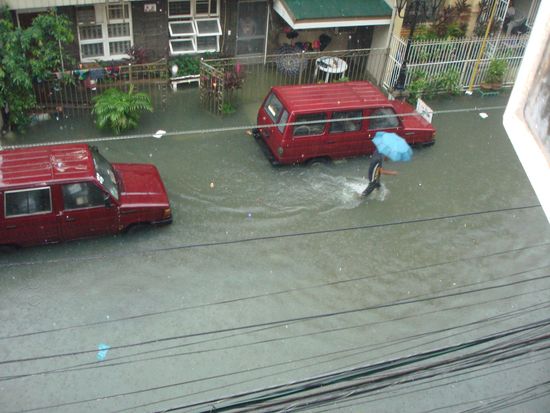
Heavy and nonstop rains have flooded much of Manila, closing government offices, schools, and businesses. This is looking down from the 3rd floor to the street in front of my house here in the Sampalo District of Manila.
Rescue workers raced Tuesday to pluck people from their roofs and out of fast-flowing water as the worst flooding in two years submerged a third of Manila, the Philippines’ overpopulated capital. More than 50 people have been killed and at least 250,000 evacuated in the past week because of a series of storms, monsoon rains and flooding, officials said.
Alexis Okeowo reports on a courageous LGBT gathering:
“Can you imagine that the worst place in the world to be gay is having Gay Pride?” Kasha Jacqueline Nabagesera asked a crowd of cheering gay men, lesbians, transgendered men and women, and queers somewhere in between. It was Saturday afternoon, and we were on the shores of the giant, cloudy Lake Victoria in the Ugandan city of Entebbe, where L.G.B.T. activists had decided to stage the country’s first Pride Parade.
Nabagesera, a lesbian activist covered, for the occasion, in glitter and neon spray paint, with homemade angel wings, was being half-sarcastic. A barrage of media coverage has painted the country as a hell for gays—a place where they are suffering and being attacked constantly—and, despite the need to combat such threats, L.G.B.T. Ugandans were tired of hearing a story that ignored their nuanced experiences of both joy and hardship. But Nabagesera was also sincerely pleased: a crowd of nearly a hundred people had come out, fears of arrest notwithstanding, to celebrate their existence. The air was thick with confetti, paint fumes, and anticipation.
A recent Radiolab episode on color tackled why neither The Odyssey nor The Iliad refer to the color blue. Lisa Wade summarizes:
Scholars theorize that this is because red is very common in nature, but blue is extremely rare. The flowers we think of as blue, for example, are usually more violet than blue; very few foods are blue. Most of the blue we see today is part of artificial colors produced by humans through manufacturing processes. So, blue is the last color to be noticed and named. An exception to the rarity of blue in nature, of course — one that might undermine this theory — is the sky. The sky is blue, right? Well, it turns out that seeing blue when we look up is dependent on already knowing that the sky is blue.
Previous Dish on the science and psychology of color here and here.
by Chas Danner Forget text-alerts and campaign apps, Wikipedia was the first to predict the 2008 VP choices:
Sarah Palin’s Wikipedia page was updated at least 68 times the day before John McCain announced her selection, with another 54 changes made in the five previous days previous. Tim Pawlenty, another leading contender for McCain’s favor, had 54 edits on August 28th, with just 12 in the five previous days. By contrast, the other likely picks — Romney, Kay Bailey Hutchison — saw far fewer changes. The same burst of last-minute editing appeared on Joe Biden’s Wikipedia page, Terry Gudaitis of Cyveillance, told the Washington Post.
Wikipedia data isn’t the only source for political predictions, Twitter has begun leveraging its stats to get into the polling game as well:
Twitter launched a new service [last] Wednesday called the Twitter Political Index, or Twindex. By applying highly tuned algorithms to Twitter’s fire hose of data, the service offers a real-time look at voters’ moods, and scores which presidential candidate is trending up (and who is trending down) day to day.
The index has proved remarkably similar to other polling and real-world results:
The project began when Twitter noticed that conversations about candidates on its own feeds accurately foreshadowed voter sentiments showing up in traditional polls. For example, during a FoxNews debate broadcast in which viewers were asked to rate candidates’ responses as either “answer” or “dodge,” Twitter saw a profound uptick in positive responses about Newt Gingrich. A few days days later, Gingrich was indeed moving up in the polls, but Twitter could see this shift in real-time, much, much earlier, during the debate. Similarly, in the run-up to the Michigan and Arizona primaries, Twitter saw Mitt Romney’s follower count surge, while Rick Santorum’s sputtered out. When the election results came in, they confirmed what Twitter was seeing internally: Its own social media provided an inside line on what voters were thinking.
Update: The Wikipedia VP prediction probably won’t work out this year:
The first part looks at how dealers, mules, hit men, and the rest of the criminal side make money off drug prohibition. The second part looks at how drug testing companies, police departments, prosecutor officers, politicians, and the rest of the drug war infrastructure profit from drug prohibition.
Detailing the Warren-Brown senatorial battle in Massachusetts, Christopher Benfey marvels at the state's ongoing struggle for authenticity:
Massachusetts has a puzzling recent track record of launching candidates in nationally watched races who sputter towards the finish line: Dukakis and Kerry and Coakley and, for that matter, Mitt Romney, who has sputtered in a presidential race before. These New Englanders can seem, at key moments, to lack the common, the authentic, the Kennedy touch. Their efforts to “connect”—zooming around in tanks, claiming to love NASCAR, enhancing their ancestry—can run awry.
Meanwhile, Maggie Haberman wonders whether Warren's DNC speaking spot – she is introducing Bill Clinton – is a good idea for the Dems:
While not the across-the-board liberal she is painted as – she is hawkish on Israel, for instance – Warren nonetheless remains a lightning rod for GOP criticism. She is not yet enough of a known quantity that she can be put on a piece of conservative direct mail and used to stir up the base – like Nancy Pelosi or Harry Reid – but Republicans are hoping to turn her into one.
Ann Althouse snarks about the affirmative action at play:
I suppose that to appeal to women, the convention needs some prominent women speakers — especially if they're going to feature Bill Clinton, which they are. Clinton needs to be vouched for by a woman.
The shape of the mountains screams the Alps. Though I have some confirmation bias at work, I think it looks Swiss. It looks like a late afternoon sun is casting shadows across the view, which mean it has to be north face. So a quick scan of the Swiss lakes shows only a few that are generally north-south in length, and the only good candidate to have a view like this, Lac de Gruyére, doesn’t have any mountains close enough. So we go west into the French alps, and there we find a winner in Lac d’Annecy. We find Duingt situated on a small peninsula affording us the view in question. Duingt, France. Final Answer (do we still say that in the States?)
Another writes:
Since the only Alpine lake I’ve ever visited outside of Lake Tahoe is Lake Como in Italy, this of course must be one of the little towns along that lake. I’m going to go with Varenna, with the photo taken from a ground floor room in the Hotel Olivedo. Boom … give me my damn book!
Another:
This has to be Norway, but harsher than the mainland. Those peaks, with the dramatic timberline, say Leknes, in the Lofoten Islands.
Another:
Andalsnes, Norway? This looks like the view from the youth hostel just at the south edge of town.
Another:
Cisnes, Chile? I see fjords that aren’t Alaskan, but also don’t appear to be Scandinavian. So it’s in the the Southern Hemisphere. Thus Cisnes.
Another:
This has the distinct feel of the Inward Passage, a trip I was lucky enough to make twenty some years ago. Take the ferry from Seattle, relax for 3 days gazing at amazing scenery and wildlife, then get off at Skagway and head into the Great White North. A trip you will never regret. I can’t place this with any certitude, so I will go with Fanny Bay, BC, simply because I like the name.
On the right track. Another:
I don’t know where the hell this is (yet), but I’m leaving for there on Tuesday at about 1:00 EDT.
Another has your answer:
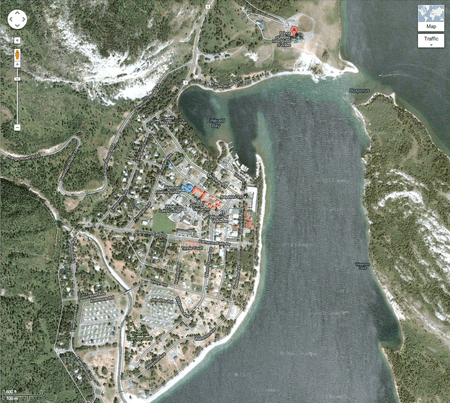
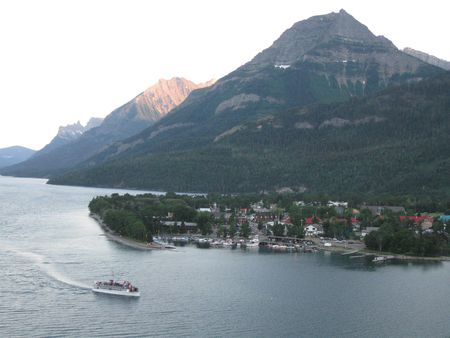
This is the first time I’ve recognized a VFYW pic immediately, and the first time that I’ve attempted an answer. The photo is of a view of Waterton Park Village, Waterton, Alberta, Canada, in the Waterton Lakes National Park, in the Canadian part of the Waterton-Glacier International Peace Park. The last time I visited there was with my friend Jamie, about 10 years ago, although I’ve been back to Glacier National Park just a couple of years ago. The Waterton-Glacier International Peace Park reportedly has the distinction of being the only park in the world to be a UNESCO World Heritage Site, an International Peace Park, and a Biosphere Reserve. Here’s a Google Maps overhead view of the area:
Another:
Interesting, just to the left of the photographer’s view is a narrow inlet connecting one side of the lake to the other that Google Maps calls “Bosporus.” Ha!
Another:
Given that we were camping in Waterton a year ago today, the timing of your contest picture is uncanny. I have a similar picture taken from just outside the hotel hanging on my office wall (though of the townsite of Waterton at dusk):
Another:
The park is the Canadian counterpart of the Glacier National Park in northern Montana. Do I get bonus points for pointing out that the mountains in the background, specifically the last two peaks in the back (Campbell Mountain and Goat Haunt Mountain) are actually in the USA? The lake is a very long, glacially carved lake, and the international border runs right across it about half way down. If you take a boat to the other end and hike the trails you actually have to go through immigration …
Another:
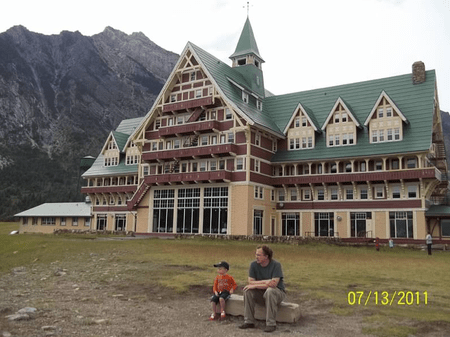
That’s a view from the Prince of Wales Hotel. I went there on a trip with my family last summer. Here’s me and one of my kids looking at that view:
Another:
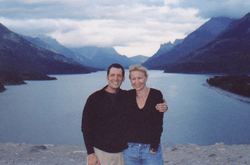
I knew it the moment Google Reader revealed the tops of the mountains. This is one of my favorite views. My husband and I stayed there as part of our month-long honeymoon road trip through the National Parks. Glacier National Park was half on fire (this was August of 2003), our camping plans were dashed, so we headed up to Waterton, since there’s nothing a stay at the Prince of Wales hotel can’t cure. I’d been there as a kid on family camping trips and loved taking my husband back. Nine years, three kids later, and we’re taking our kids on a National Park excursion this month.
Another:
This is the Waterton marina as viewed from the Prince of Whales Hotel. Cheating a bit since I currently live in Calgary, Alberta and was camping in Waterton a few weeks ago with my family. Citadel peak at the far end of Waterton lake is quite easily identifiable from the brochures for Glacier/Waterton international peace park. Waterton is probably my favourite place on Earth and often overlooked by visitors to Glacier.
Another adds:
I’d like the global warming denialists among us to explain why Glacier National Park will soon have no glaciers left if the earth isn’t warming due to CO2 emissions …
Another sends a screenshot:
Are they all this easy? I’ve never entered this contest before, but I found myself with some free time on a Saturday morning so I thought I’d give it a try. Feeding the picture into Google image search placed it at Waterton Lake National Park in seconds.
Playing around with the available snapshots on the web and the Google Maps terrain feature quickly puts it at the Price of Wales hotel, the only building on that particular chunk of land. We’re off the ground a bit and that black window frame must be a clue. The height off the ground and the window frame in this picture look like a good match:
Another:
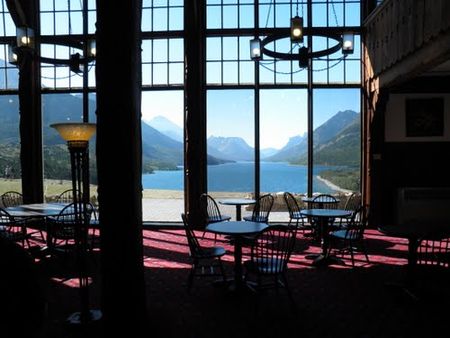
I once hiked 63 miles through Glacier National Park to get to the Prince of Wales Hotel. For the last 20 miles, only the thought of having a cold beer at the Prince of Wales hotel kept me going. By the time I got to Waterton and saw that the hotel was atop a hill, I had no climb left in my legs and opted for a beer at the Grizzly Bear tavern. It had no view, but the beer was cold.
Another:
Here’s a picture taken during a trip with my parents from roughly the same spot on July 13th, 1952 (date recorded in my sister’s diary).
Notice the greater amount of glacier in that old photo. Another:
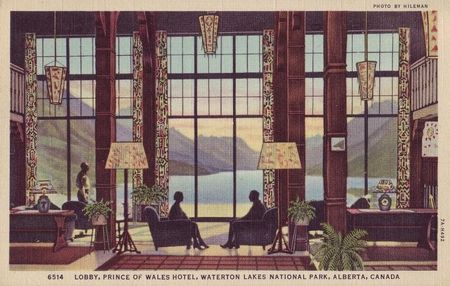
If you take the International cruise boat (the larger boat at the right end of the dock in the photo) to the south end of the lake, you’ll arrive at Goat’s Haunt, in Glacier National Park in Montana. The two parks together comprise the Waterton-Glacier International Peace Park. I spent many summer vacations with my family hiking around Waterton. It’s an oft-overlooked jewel of the Canadian Rockies. Here is a vintage postcard from a similar perspective as the VFYW photo:
Another:
Wow, the memories. My parents took my sisters and me on yearly hiking vacations to Waterton/Glacier during our grade school / high school years. I remember standing on the bluff outside the hotel, with winds coming down the lake strong enough to knock us over. During our grad school years, my younger sister and I returned for a backpacking trip that began in the Waterton townsite with a boat ride to the Goat Haunt trailhead down on the US end of the lake, then backpacking (take a right at the “Cathedral Spires” you see in the distance in your photograph) as far as “Hole In the Wall,” which has to be about the most delightful place on the planet. We camped, surrounded by small streams melting under and through the receding snowcover, revealing fields of glacier lilies, with dramatic mountain views all around. This was in contrast to the previous night, when we camped at Brown Pass, where the mosquitoes were so dense that our dinner consisted of crackers and instant hummus, consumed in haste while we were wearing full raingear for protection.
That was a year with an unusual amount of snow and very slow melting – hikes were opening late and we didn’t make it to our planned destination (Boulder Pass), in spite of hiking in mid-July. Seems to be very different this year.
Another sends a video tour:
I went there in 1981 as a 12-year-old and was fascinated by the Mule Deer walking through the streets of the town. 31 years later and I recognized the location immediately. Funny how memory works.
Another:
A bit of trivia off the top of my head: there’s only one church in the little town of Waterton there and it’s an LDS chapel. Mormons colonists settled in southern Alberta in the 1880s. Like the Mexican colonies that Romney comes from, this was a destination for many polygamist saints trying to stay clear of the feds (though polygamy was also illegal in Canada). My own great-grandfather grew up there, in Cardston, about an hour away from Waterton.
Another goes for the gold:
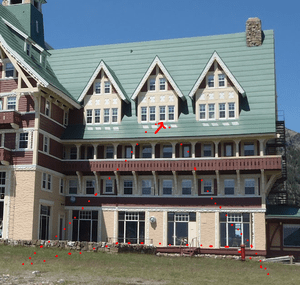
I can’t be the only one to get this location, so here’s my best guess at the location. It wasn’t taken from a lower story since we are way above the outside features, so that rules out someone snapping a shot from the tea room. Further examination shows that it was likely taken from a paned window, and since the panes on the second and third floors are on the upper half, unless someone was standing on a bed they wouldn’t likely get this perspective. The fifth floor seems too high, so I’m guessing the fourth floor.
Now, which fourth floor window? Well, there are two features of note here: the stone wall and the fire hydrant. (Some of the other hydrants are painted as bears, this one is red.) The best photo I found comes from this blog and shows the front elevation of the property. The wall is about 15 feet (or, in Canada, 5 metres) out from the tea room, but more like 15m out from the wings. It must have been taken from a wing to be visible from this high. And the location of the wall gives us the left/south side of the building. Also, the wall ends by about the wing, this would rule out the north-most set of windows; additionally the hydrant at the far left of the photo rules out the southernmost windows. So if I am correct, the photo was taken from the middle set.
Now, it appears that the photographer was standing to the left of the scene, so it’s probably not the left-most window. I’d guess it wasn’t the right-most window, either based on nothing but human nature. So it’s one of the middle two, I’d guess the photographer’s-left one. It’s marked on the photo attached.
Close but not quite. Details from the photo’s submitter:
I know you must get hundreds of these, but as a fanatic Dish reader and (very) occasional identifier of a window, I thought this might make a good window for you, either as just one to post or as a contest view. It was taken on July 19 at 6:24 AM from the famous Prince of Wales Hotel in Waterton, Alberta, at the northern end of Upper Waterton Lake in Waterton Lakes National Park, just across the border from Glacier National Park in Montana. My wife and I were staying there while on a biking trip through Glacier and Waterton Parks, and as soon as we looked out our room window (number 201 by the way), we said “this is for VFYW!”
The view is fairly well known and might be a tad easy for the crazed fanatics who identify windows in Uganda, but it might make a late summer gift to the rest of us who like to get one right every once in a while!
The hotel is situated high on a bluff overlooking the end of Waterton Lake, and it’s reputedly one of the windiest places in Canada. The hotel is held down by cables so it won’t shift in the high winds, and we could hear the wind whistling through the room even with the windows closed. Certainly the most scenic view ever out of a hotel room for my wife and me.
Three readers sent images of the hotel with circles over the correct window, but the following entry was by far the most detailed, so it’s the winner this week:
I was instantly able to recognize the unique glacier formed terrain growing up in Kalispell, Montana and being lucky enough to visit Glacier National Park so many times. The landscape there is so beautiful it’s hard to forget them. The first thing that came to mind was the view from Apgar Lodge at the southern end of Lake MacDonald but I knew that wasn’t right because of the little bay and developed town on the right in the picture. There is no bay like that on Lake MacDonald. I had a hunch it might be in Waterton National Park, which is just to the north of Glacier National Park on the Canadian side of the border. There along Upper Waterton Lake is the town of Waterton, which I visited when I was a kid.
Sure enough the orientation of the bay and in particular the turquoise/blue roof confirmed that Waterton was the correct location. The direction of the photo and little stone wall is a dead giveaway that the photo was taken looking south from the Prince of Wales Hotel which sites up on a bluff across the bay from town. I remember the hotel fondly. We had tea in the restaurant and walked around the grounds enjoying the stunning view.
As for locating the exact window, the red pipe off to the left and the stone wall were the biggest clues. The ride pipe is actually a fire hydrant. Given the stunning landscape surrounding the hydrants (I think there are two of them on the property) they were photographed quite frequently because they are (or were) painted to look like little bears. Based on the elevation above the ground and the absence of a deck in the image I feel pretty confidant the photo was taken from the second floor. As for the exact window I spent many many hours going through flickr trying to triangulate everything. That was pretty hard. I’m going to guess that the picture was taken from the 1st window from the right. The yellow circle in the attached powerpoint shows which window I’m talking about:
Andrew Romano investigates outside spending against Democrats, which is flooding into downticket races:
For all Chicago’s complaining, the impact of outside money on the national contest may wind up being minimal; the polls have been static so far, and after a certain point, there are only so many hundreds of millions of dollars that can be pumped into the Denver ad market. Where the cash could make the biggest difference, however, is on the state level. “Dropping $15 million into the presidential race won’t be determinative,” says Rick Hasen, an expert on campaign finance at the University of California, Irvine. “Dropping $15 million into a Senate race will be a bombshell.”
The effect this money is having on Democratic Senator Sherrod Brown is palpable:
In theory, the contest shouldn’t be close. Brown has outraised [GOP opponent Josh] Mandel by $5.1 million. His approval and disapproval ratings are roughly equal; Mandel’s unfavorables outstrip his favorables by a perilous 15 percentage points. This is part of the reason why Brown was drubbing Mandel by an average of more than 13 points as recently as January—even though the populist, pro-Obama senator is far more progressive than the swing state he represents.
But then the super PACs and 501(c)(4)s began to spend on Mandel’s behalf: nearly $12 million so far, or more than Brown dropped on his entire 2006 campaign, with another $7 million reserved for the fall. The number on Brown’s side of the ledger is much smaller: about $3 million from unions, liberal interest groups, and Democratic super PACs. All told, Mandel’s third-party allies have outspent and outreserved Brown’s 6 to 1, and nearly twice as much money has been spent and set aside by or for Mandel than Brown. No other competitive Senate race is this lopsided. In response, the polling gap between Mandel and Brown has shrunk to 7.7 percent, and strategists are beginning to talk of the race as a possible tossup.
Steve Kornacki thinks presidential race spending may just be a distraction:
It’s races like these that have the potential to be the real campaign money stories of the year. Voters know far less about the average Senate candidate than they do about Obama and Romney, and they follow Senate races with much less interest than presidential contests. The same is even more true when you get farther down the ballot to contests for the U.S. House and state and local offices. This is where the Republican super PAC advantage could really be felt in November, with massive spending disparities lifting GOP candidates in races they might otherwise lose, potentially flipping the Senate and making it impossible for Democrats to win back control of the House.
(Video: Attack ad from Karl Rove's Super ("non-profit issues") PAC, Crossroads GPS, airing against Democratic Senator Sherrod Brown in Ohio)
The Nasa rover called ‘Curiosity’ has finally arrived at Gale Crater on planet Mars after a 154 million miles journey, hurtling towards the Mars at over 13,000 mph. The main aim of Curiosity is to see whether the environment of Mars once held the ingredients of life and so Curiosity will drill into the rocks and soil and analyse samples. It is one of the most fascinating events of our recent times and a giant step forward in space exploration, enjoy :)
Images and video courtesy of Nasa's Mars Science Laboratory mission music by the awesome soundcloud.com/Idenline 'You and Me' extended mix.
And if you missed the exciting footage from the JPL control room as Curiosity sent confirmation of its landing, go here. Highlights here. The two most Internet-famous people to emerge from that room are lead engineer Adam Steltzner, "an old rocker with a pompadour who got us back on Mars, and Bobak Ferdowsi, "NASA's Mohawk Man".
Andrew swatted down the idea that Romney has a secret plan to fix the economy a few weeks back. Josh Barro later doubled down:
It's possible to understand every action in Romney's life as an effort to become president. But once he is president, what will his goal be? I don't know (nobody knows) but I suspect getting re-elected will be near the top of the list. To increase his chances of getting elected, he will have to implement policies that are likely to grow the economy. Redoubling on Bush Administration economic policies — with the added factor of severe budget austerity laid on — is unlikely to serve that end. So, Romney will have good reason to implement policies that aren't in his stated platform, even if that means butting heads with Republicans in Congress.
Reihan adds his two cents. How exactly is Romney going to win a policy duel with Congressional Republicans? George W. Bush managed to get Congressional Republican buy-in on some bipartisan legislation during his time in office, but the Tea Party House is far more extreme than any Congress Bush ever dealt with. At this point, GOP Congressmen are either Tea Party true believers or afraid of getting primaried by Tea Party true believers. Neither group is big on compromise.
A sizable chunk of the Republican base is distrustful of Romney already; he'd risk a rank-and-file revolt if he strayed more than a few inches from the party line. And, despite what you may hear, presidential candidates tend to fulfill their campaign promises.

 views. My husband and I stayed there as part of our month-long honeymoon road trip through the National Parks. Glacier National Park was half on fire (this was August of 2003), our camping plans were dashed, so we headed up to Waterton, since there’s nothing a stay at the Prince of Wales hotel can’t cure. I’d been there as a kid on family camping trips and loved taking my husband back. Nine years, three kids later, and we’re taking our kids on a National Park excursion this month.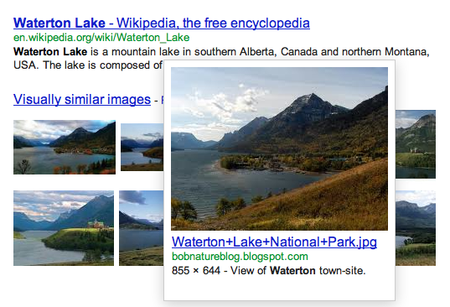

 Now, which fourth floor window? Well, there are two features of note here: the stone wall and the fire hydrant. (Some of the other hydrants are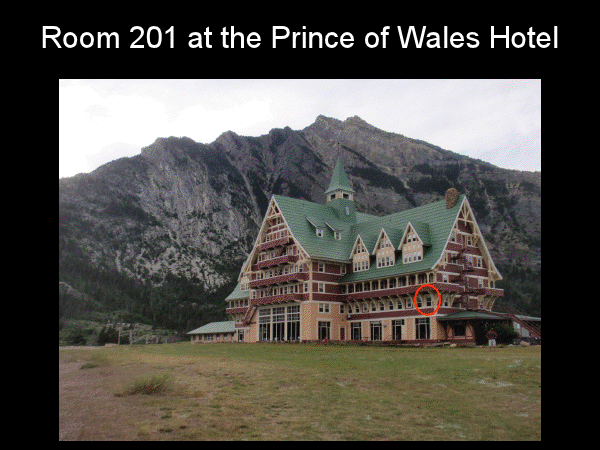

 The Dish