Previous videos of Barney here and here. “Ask Anything” video archive here.
by Gwynn Guilford
Dr. Meg Jay offers some sobering ideas on how important it is not to squander your youth:
Our 20s are the defining decade of adulthood. 80% of life's most defining moments take place by about age 35…. Too many 20somethings have been led to believe that their 20s are for thinking about what they want to do and their 30s are for getting going on real life. But there is a big difference between having a life in your 30s and starting a life in your 30s.
She argues the still-growing twentysomething brain can be an advantage:
[T]he late-maturing frontal lobe has been interpreted as a directive for 20somethings to wait around for their brains to grow up. The real take-home message about the still-developing 20something brain is that whatever it is you want to change about yourself, now is the easiest time to change it. Is your 20something job, or hobby, making you smarter? Are your 20something relationships improving your personality or are they reinforcing old patterns and teaching bad habits? What you do everyday is wiring you to be the adult you will be. That's one reason I love working with 20somethings: They are so darn easy to help because they–and their brains and their lives–can change so quickly and so profoundly.

by Patrick Appel
Saudi Arabia sent female athletes to the Olympics for the first time this year. Qanta Ahmed reports on the conservative backlash in the country:
Even as the pressure builds for Saudi Arabia to allow women to participate or risk becoming an outlier even in the Islamic world—Iran and Yemen have women’s soccer teams, for instance—the state has tried to hold the line. Its Olympic athletes have barely been brought up in the state-sanctioned press, and much of the Twitter conversation about them has been hostile.
Steps of the Devil: Denial of Women and Girls’ Rights to Sport in Saudi Arabia, a devastating report by Human Rights Watch details the profoundly deviant yet tenaciously held religious objections of Saudi clerics to women engaging in sports. Allowing Saudi girls and women to compete would invite them to engage in immodest movement, aberrant clothing, and performances in front of unrelated males that would lead to immorality and desecration of the purity of the Saudi female, influential clerics insist. They argue that vigorous movement is a threat to the health and honor of the "virgin girl," a profound deterrent in a shame-and-honor-centered culture that places extraordinary value on the intact hymen of an unmarried woman.
She goes on:
The Kingdom’s imposed paralysis and concealment of women is an entirely artificial, modern Saudi construct that not only has no basis in Islam but directly contravenes its ideals. The thrill of physical activity, perversely forbidden by the Saudi government, was one Muslim women have long known. There was no immobilization of women in the early Islamic era. The Prophet’s wife was famed (as recorded in the Hadith) for her playful races against her husband the Prophet—who called play and folly with one's spouse integral to a happy and fulfilled Muslim marriage.
Still, Saudi Arabia’s reversal to allow women to compete in the Olympics reveals a fundamental truth: the Kingdom recognizes its restrictions are increasingly difficult to defend on the world stage, or even in the Muslim world.
Earlier commentary along the same lines here.
(Photo: Saudi Arabia's Wojdan Shaherkani looks on after losing her first round judo match. She was competing in the London 2012 Olympic Games on August 3, 2012 in London. By Emmanuel Dunand/AFP/Getty Images)
by Patrick Appel
American judo competitor Nicholas Delpopolohas been kicked out of the Olympics after testing positive for marijuana. Brendan Ferreri-Hanberry reviews the rulebook:
Information from the World Anti-Doping Agency suggests that anti-doping policies in sports are simply concerned with performance-enhancing substances which might give the user an unfair advantage, including stimulants and anabolic steroids. However, caffeine, a stimulant, is not on the list of prohibited substances, while marijuana metabolites are. The justification for this is not clear. Enhancement of athletic performance has not been proven, and there is no evidence that past marijuana use would endanger competitors.
He asks: "is this simply a concession to the prohibitionist attitudes of authorities who wish to police athletes’ personal lives?" Ossian Shine searches for a rationale:
While it is generally accepted that cannabis is unlikely to give athletes a performance advantage in fast-paced sports, some experts say it could prove helpful in sports like shooting or golf where a steady hand is needed.
Update from a reader:
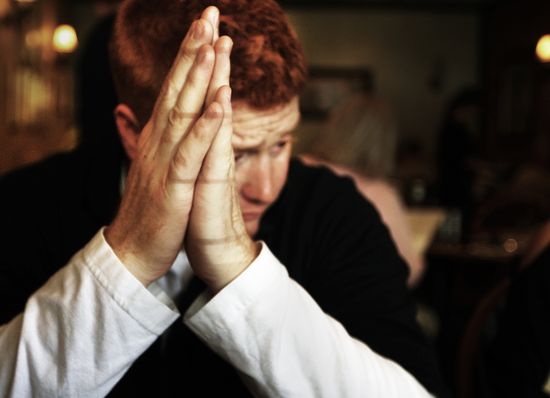
How can you suggest marijuana's not a performance enhancer for the Olympics? What about the high jump?
by Chris Bodenner
A reader writes:
Some good points made here. But this is also a good time to point out that PTSD is not a simple label for something that happens after trauma. The symptoms described with PTSD are really only problems after the fact. Fight or flight, hypervigilance, shutting off emotions and leaving the body – these are techniques the brain uses to protect you in the moment. I have PTSD and have had this explained to me over and over: your reactions were normal, and more importantly, they were useful at the time. You need to be able to shut down, to run, to fight, to know when danger is coming. These things become a problem later, when the danger is gone, but your body and brain can't let it go.
So if someone's still in danger – yeah, they probably need someone to talk to. But they're going to need more once the danger has passed.
Another writes:
You'd be remiss not to mention the work of Emile Durkheim, who besides having had a stellar mustache, was one of the founders of modern sociology. His 1897 book, Suicide, is widely considered to be the first empirical sociological study. Durkheim identified four types of socially significant suicides.
Egoistic and altruistic suicides relate to social integration – egoistic suicides result from the alienation resulting from "excessive individuation" and lack of social support (think of a lonely single man or elderly person), while altruistic suicides result from being so integrated that we feel our roles and values compel us to give up our lives (think of honor suicides or a parent dying to save their child). Anomic and fatalistic suicides relate to our individual positions in society – anomic suicides occur when social and/or economic upheaval falls on someone so heavily that they lose their moorings and become incapable of knowing or understanding how to fit in, act, and derive meaning (this category would include the hypothetical Indian farmer), while fatalistic suicides occur when social constraints are so oppressive that the person would rather die than continue living (think of a prison suicide or the suicide at the end of Dead Poet's Society).
These four categories may not cover every suicide, and mental illness is certainly a factor in many cases, but Durkheim's work was the first of many to demonstrate that social circumstances shouldn't just be thought of as "mediating variables" dwarfed by the causal monolith of mental illness. Rather, they should be seen as independent variables that explain significant statistical variance in their own right.
(Photo: Dan Magoon, 30, a U.S. Army veteran and Boston firefighter, has served three tours of duty in Iraq and Afghanistan and been diagnosed with PTSD. By Stan Grossfeld/The Boston Globe via Getty Images)
by Patrick Appel
Atul Gawande believes the healthcare industry, like the restaurant industry before it, will eventually be dominated by big chains:
Today, some ninety "super-regional" health-care systems have formed across the country—large, growing chains of clinics, hospitals, and home-care agencies. Most are not-for-profit. Financial analysts expect the successful ones to drive independent medical centers out of existence in much of the country—either by buying them up or by drawing away their patients with better quality and cost control. Some small clinics and stand-alone hospitals will undoubtedly remain successful, perhaps catering to the luxury end of health care the way gourmet restaurants do for food. But analysts expect that most of us will gravitate to the big systems, just as we have moved away from small pharmacies to CVS and Walmart.
By Chas Danner
A new study confirms that your eyes reveal your sexuality:
For the first time, researchers at Cornell University used a specialized infrared lens to measure pupillary changes to participants watching erotic videos. Pupils were highly telling: they widened most to videos of people who participants found attractive, thereby revealing where they were on the sexual spectrum from heterosexual to homosexual. … Previous research explored these mechanisms either by simply asking people about their sexuality, or by using physiological measures such as assessing their genital arousal. These methods, however, come with substantial problems.
The study also provided new evidence regarding the nature of bi-sexuality:
Previous notions were that most bisexual men do not base their sexual identity on their physiological sexual arousal but on romantic and identity issues. Contrary to this claim, bisexual men in the new study showed substantial pupil dilations to sexual videos of both men and women. "We can now finally argue that a flexible sexual desire is not simply restricted to women — some men have it, too, and it is reflected in their pupils," says Ritch C. Savin-Williams, co-author and professor in Human Development at Cornell. "In fact, not even a division into 'straight,' 'bi,' and 'gay' tells the full story. Men who identity as 'mostly straight' really exist both in their identity and their pupil response; they are more aroused to males than straight men, but much less so than both bisexual and gay men," Savin-Williams notes.
(Hat tip: Joe My God)

by Chris Bodenner
Money quote from our Facebook page:
On July 20, 1969, my father made me come inside from playing baseball in the front yard to watch the moon landing. I was not happy. Baseball was more important. Of course, ever since I've been grateful for his insistence. Last night, at about 11:20 Arizona time, my son — seemingly lost inside the internet, as usual — said, "Dad, you should come over here and watch this." I sat with my father's grandson and "watched" us (virtually) land on Mars, the second time in my life a loved one has forced me to witness the amazing.
The above photo is of Curiosity and its parachute falling to Mars. Watch the descent from the perspective of the rover here. More images and updates at Curiosity's Twitter page. Adam Mann previews what's to come:
After the probe’s safe landing, it sent several pictures of its wheels on the ground to mission control to let engineers know that everything was okay. But these dusty, close-up images cannot compare to the snapshots that the rover will soon be taking. Curiosity is packed with no fewer than 17 cameras to shoot high-quality photos and videos in black-and-white, color, and 3-D stereo of the Martian landscape.
by Zoë Pollock
We'll do almost anything to keep the seat next to us empty. But once the driver announces the bus is full, the game changes:
Riders just wanted to avoid the “crazy” person and sit next to a “normal” person. [Sociologist Esther Kim] found that race, class and gender weren’t key concerns when commuters realized someone had to sit next them. They were primarily concerned with maintaining their own safety.
by Patrick Appel
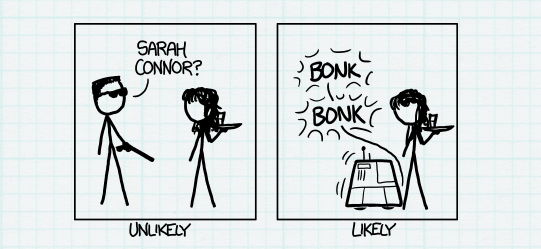
Randall Munroe, who worked on robots for NASA, predicts that "the robot revolution would end quickly" because robots "never, ever work right":
Those robots lucky enough to have limbs that can operate a doorknob, or to have the door left open for them, would have to contend with deceptively tricky rubber thresholds before they could get into the hallway. Hours later, most of them would be found in nearby bathrooms, trying desperately to exterminate what they have identified as a human overlord but is actually a paper towel dispenser.
One of Alex Knapp's commenters disagrees about the robot threat:
Randall is right that robots can cause only limited damage to humans. The best thing by far to cause damage to a human is another human. And machines can easily arrange that.
For starters, almost all food for humans depends entirely on machinery to plough, cultivate, irrigate etc. Stop that for a short time and humans would be unable to survive in the numbers we do – we would have to kill each other to obtain food. Our society also depends on other infrastructure – gas, electricity, petrol. Stop those and riots begin in short order.
But probably the most important thing is money. Everybody’s money is nowadays held by machine. If the machines just set that to zero, there would be no way for us to operate the interactions which keep our society going.
 The Dish