Josh Green shares how comedian Rob Delaney has become Mitt Romney's "Twitter nemesis":
“Romney fascinates me endlessly,” Delaney said before his show at a Montreal comedy festival last week. “He’s such an attractive target comedically because more than any other candidate in my lifetime, he just wants to be president. That’s it! He longs for it. Feels it’s his birthright. I can imagine him getting elected and just saying, ‘Well, that’s that then!’ and staring out a window.”
Last year Delaney began tweeting about Romney and the jokes received hundreds, sometimes thousands, of retweets. They tend to portray the presumptive GOP nominee as either a hopeless square (“‘Ha ha ha! Terrific!’ —Mitt Romney, every time Jar Jar Binks appears on screen”) or a cretinous bigot (“@MittRomney I don’t care about gays marrying but they shouldn’t be allowed on straight planes because then I have to breathe gay air?”).
The image above comes from a new Tumblr by Josh Mecouch, who has started illustrating Delaney's Romney tweets. The Dish previously featured a Delaney takedown of a Sarah Palin tweet here.
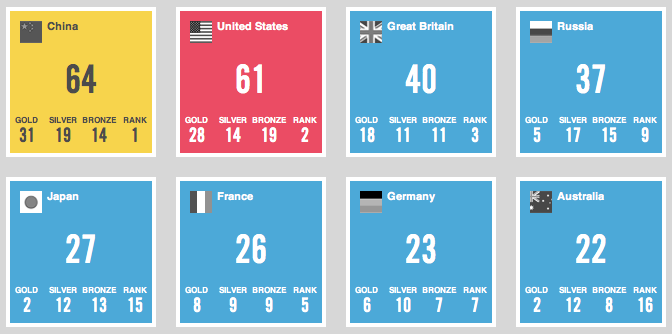
There's been a great deal of focus on the brutal training regimens that Chinese athletes have been subjected to, but the Chinese team is also experimenting with athletes like Ye Shiwen and Sun Yang training abroad:
This strategy is part of what China calls "science-driven training", a far cry from the decades-long gulag training style. Now, the Chinese national swimming team sends most of its athletes to Australia or the US for periods of training throughout the year. There has been resistance from the more conservative camp in China. But at the end, performance prevails. The Chinese know that there’s much to be learned from the places that produced Ian Thorpe and Michael Phelps. That's why the Chinese women curling team won the World Championship a few years ago thanks to living and training in Canada for several years under a famous Canadian coach.
China's sports program still has its problems, most recently evidenced in the story of gold medal-weighlifter Lin Qingfeng, who hasn't seen his father in six and a half years. ChinaSMACK rounds up Chinese social media reactions to Lin's plight. Past Dish coverage of Ye Shiwen here and here.
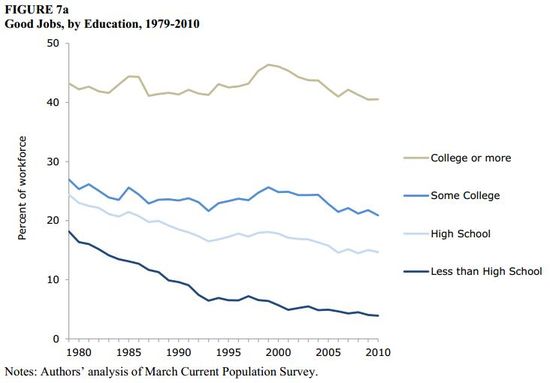
A new report (pdf) charts the decline of good jobs. Kevin Drum explains the methodology:
A good job is one that pays $37,000 (the median wage for men in 1979), includes at least some health insurance, and some kind of retirement plan. It doesn't have to be generous health coverage or a generous retirement plan. Mediocre health plans with big copays still count, and modest 401(k) retirement plans count. The job just has to include something.
After watching both presidential candidates run from their biggest achievements as well as their failures, Blake Zeff wonders how we can trust what either candidate plans for the future when they're unwilling to acknowledge the past:
Promises or policy proposals offered by candidates may offer us guidance as to their priorities, but they’re obviously not sworn over an oath. If you’re looking for real clues to how a candidate might govern, their past is the only factual basis we have. To put it more bluntly, in politics, the future is a fiction. If campaign pronouncements were real plans never to be violated and always deliverable, there would have been a drastic shift in US foreign policy between the last two administrations; the individual mandate for health care would have been off the table; Mitt Romney would be to the left of Ted Kennedy on gay rights; and the last two presidents would have fundamentally changed the tone in Washington.
In the best-case scenario, policy proposals are sincere plans that someone will try to implement, if elected – assuming that the political realities and their partners in government will allow them (no sure thing). In the worst of scenarios, they’re gimmicks cooked up not by the policy director of the campaign, but the advertising director or the pollster or the candidate’s spouse, all with one goal in mind: to win a campaign.
Tyler Cowen and Kevin Grier attribute Olympic victories to a nation's population and wealth. Their prediction about the future:
Medal totals will become more diversified over time. The market share of the "top 10" countries will continue to fall (it was 81 percent in 1988) as economic and population growth slows in the rich world. The developing world has greater room for rapid economic growth, and most parts of the developing world also have higher population growth. The Olympic playing field will get more and more level.
It looks to me more like the countries that win a lot of medals are the countries that A) want to win a lot of medals and B) are pretty competent at what they do. … Moreover, it helps to have a lot of power and tradition to get your favorite sports treated well by the Olympics. You'll notice, for instance, that the Olympics hand out a ton of swimming medals, which benefit the U.S. and Australia in the medal counts.
Along the same lines, Max Fisher ponders India's underperformance:
[T]hough India has an enormous population, its "effectively participating population" in athletics is much smaller, according to a paper by economists Anirudh Krishna and Eric Haglund. Huge swathes of India's 1.2 billion, when it comes to international athletics, effectively don't count. They're excluded by poor childhood health, physical isolation by poor transportation from the athletics centers in the big cities, or often because they simply are not sufficiently aware of the Olympics or the sports involved. Even the lack of connectedness across Indian communities may play a role, as the idea of competing for national prestige just doesn't carry the same appeal or logic. It's not just that so many Indians are poor, in other words, it's that India itself is so socially and physically fragmented.
Taking GDP, population, and number of competing athletes into account, Seth Masket finds either North Korea or Hungary in the lead.
On Friday, Jonathan Chait chalked up Beltway inaction on the unemployment crisis to DC's insularity:
I live in a Washington neighborhood almost entirely filled with college-educated professionals, and it occurred to me not long ago that, when my children grow up, they’ll have no personal memory of having lived through the greatest economic crisis in eighty years. It is more akin to a famine in Africa. For millions and millions of Americans, the economic crisis is the worst event of their lives. … But from the perspective of those in a position to alleviate their suffering, the crisis is merely a sad and distant tragedy.
Though Chait's piece cites two recent events – the Fed's QE3 punt and Ed DeMarco's decision not to offer debt relief through Fannie and Freddie – Brad DeLong points to a longer-arced crap-out of moderate Republican policymaking:
Some of it is–and from my perspective this looms very large–the failure of the moderate Republicans to lay down policy markers during election season or after to create an environment for bipartisan technocratic agreement on policies to create a stronger economy. The Council of Economic Advisers chairs of the George W. Bush administration–Glenn Hubbard, Greg Mankiw, and Eddie Lazear–surely did not go to Washington to be shills for policies that would slow economic growth. Yet that is what they did, and if they had any positive impact on the policies actually pursued by the George W. Bush administration, I do not see it.
Chris Herbert calls out the Fed and the behavior of Congressional Republicans:
Republicans blocked all the administration’s effort to hire directly for infrastructure projects, or to transfer funds directly to state’s which stops them from firing public employees. These policies would drop the unemployment rate several percentage points. Failing to transfer funds to cash strapped states added a full 1% to the unemployment rate and clipped almost 1% from the country’s Gross Domestic Product. Republicans in Congress who blocked these common sense, fiscal reponses that guarantee jobs, now attack the administration for not creating more jobs.
I am appalled with your choice for Face of the Day. I realize that the words you used to accompany the picture were not designed to whip up anti-Sikhism in the same way the picture was, but the picture, with its violent, retributive elements, is stronger than the text.
Last night, I watched CNN as Don Lemon interviewed the president of an American Sikh organization. I also saw an interview with the nephew of the Wisconsin's temple's president. The nephew's uncle was seriously injured and the nephew had spoken directly with eyewitnesses. Both men impressed me with their kindness, their calmness, and their clear commitment to retaining the values of their religion as they spoke. They also were clearly not anti-American. They reminded me most of those Amish who were magnanimous after a madman killed many of their children.
Are Sikhs saints? No more than members of any other religion. I am aware that Sikh extremists murdered Indira Gandhi and almost certainly were responsible for bringing down Air India Flight 182, out of Vancouver. But on the day after American Sikhs were murdered for no good reason, and quite possibly because someone saw them in exactly the threatening terms that you chose to accentuate by using that image, why focus on that image?
At the very least, it's a kind of hitting people when they are down; at worst, it's a gross distortion of what American Sikhs are like, especially those who were so cruelly attacked while celebrating the birth of a child. If some overly Protestant nutjob had walked into an American Catholic church and killed people, would you have put up an image of gun-wielding Irish (Irish as in: living in Ireland, not Irish as in: 100 years ago your family came here to escape the famine) Catholic extremists? The crime happened here, it was the fault of at least one American, and it happened to people in America. It didn't happen in India and it didn't happen because of weapon-wielding anti-American Sikhs in India.
I was, by the way, uncharacteristically impressed with CNN's coverage, largely because of the interviews Lemon conducted with the president of the Sikh organization. Too much post-trauma coverage indulges in mindless speculation and repetition. Lemon sought to use this tragedy as opportunity to educate his viewers – to talk about the differences between the Sikhs and Muslims and even to explain the issues about their turbans. Although I have visited India (Karnataka, not Punjab) twice and work with many Indians, including some Sikhs, Lemon brought out aspects of the religion of which I was unaware – e.g., that they have long favored equality for women and that their religion urges them to remember the what is joyful even in the face of a tragedy.
Also worth watching: Ebert highlights a clip from Dastaar: Defending Sikh Identity, a documentary that "presents the struggle of the Sikh American community against discrimination and violence caused by ignorance of an essential symbol of the Sikh faith — the dastaar , or turban." Update from a reader:
While Wikipedia is an excellent source of information it is, in this case it is way off the mark, when describing the Khanda. The Khanda is the symbol of the Sikhs, as the Cross is to Christians or the Star of David is to Jews. It reflects some of the fundamental concepts of Sikhism. The symbol derives its name from the double-edged sword (also called a Khanda) which appears at the center of the logo. This double-edged sword is a metaphor of Divine Knowledge, its sharp edges cleaving Truth from Falsehood. The circle around the Khanda is the Chakar. The Chakar being a circle without a beginning or end symbolizes the perfection of God who is eternal. The Chakar is surrounded by two curved swords called Kirpans. These two swords symbolize the twin concepts of Meeri and Peeri – Temporal and Spiritual authority introduced by Guru Hargobind. They emphasize the equal emphasis that a Sikh must place on spiritual aspirations as well as obligations to society.
As a small religion, which has lacked a sovereign home of its own since before the Raj, and one which in which its diaspora is widely but thinly dispersed, it is often misrepresented by other more vocal communities from the subcontinent. It would be a shame that, in this tragedy, the opportunity to educate the wider population, about a religion with more adherents than Judaism and one that suffered a state-sanctioned genocide in 1984, was missed.
Approximately half of undecided voters have an unfavorable impression of Romney, while his favorability ratings are mired in the teens. That’s an average net-favorable rating of -33, which is all the more remarkable considering that about one-third of voters didn’t offer an opinion of Romney at all. Put differently, Romney is disliked by an astonishing 75 percent of undecided voters who have formulated an opinion of the Republican nominee.
Last week, Larry Bartels and Lynn Vavreck took a close look at Republicans still making up their minds:
Undecided Republicans are twice as likely as other Republicans to say they favor gay marriage (40 percent), twice as likely to express positive or neutral attitudes toward African-Americans (31 percent), and only half as likely to deny the existence of global warming (23 percent). Only 42 percent favor repealing Obamacare (compared with 78 percent of other Republicans). These are the sorts of Republicans most likely to have been alienated by Romney’s dogged appeals to “the base” during the Republican primaries. Whether he can moderate his image enough to win them back without exacerbating the common complaint that he “says what he thinks people want to hear” remains to be seen.
Usain Bolt, the Jamaican sprinter, set a new Olympic record last night in the 100-meter dash. Jamaica will likely take the lion's share of medals in the 100 and 200 meter races at the Olympics. Alexander Osong investigates the sources of these runners' success:
Wilton Peart…believes in the power of training on grass. The 38-year-old has won the 100 meters in the senior class in Kingston. He was once a professional athlete, but he wasn't a great talent. He says he loves running. He runs in the evenings after work, on the grass and in the moonlight. Running on grass strengthens the muscles, Peart says, pointing out that Bolt also started out on grass. In fact, Jamaica has only five all-weather synthetic tracks. Poverty, Peart notes, is a great motivator.
The recorded time of a 100m sprinter is the sum of two parts: the reaction time to the starter’s gun and the subsequent running time over the 100m distance. An athlete is judged to have falsestarted if he reacts by applying foot pressure to the starting blocks within 0.10 s of the start gun firing. Remarkably, Bolt has one of the longest reaction times of leading sprinters—he was the second slowest of all the finalists to react in Beijing and third slowest in Berlin when he ran 9.58. Allowing for all this, Bolt’s average running speed in Beijing was 10.50 m/s and in Berlin (where he reacted faster) it was 10.60 m/s. Bolt is already running faster than the ultimate maximum speed of 10.55 m/s that a team of Stanford human biologists recently predicted for him.
Curiosity landed at 10:32 p.m. Aug. 5, PDT, (1:32 a.m. EDT Aug. 6) near the foot of a mountain three miles tall and 96 miles in diameter inside Gale Crater. During a nearly two-year prime mission, the rover will investigate whether the region ever offered conditions favorable for microbial life. "The Seven Minutes of Terror has turned into the Seven Minutes of Triumph," said NASA Associate Administrator for Science John Grunsfeld.
A visual explanation of that terrifying seven minutes – the time it takes for Curiosity to descend from Mars' atmosphere – here. A review of the high-tech gear:
Curiosity represents a scientific and engineering leap over the previous rovers, Spirit and Opportunity, and its nuclear-powered battery will allow it to rove day and night. Over the course of its two-year initial mission, the probe will climb up a 3-mile-high mountain in the middle of Gale Crater, poking, prodding, and drilling into the soil and rocks. … Possibly the coolest Curiosity instrument is the ChemCam, which uses a laser beam to shoot rocks (and maybe a Martian or two) in order to vaporize a small sample. A spectrograph will then analyze the vapor, determining the composition and chemistry of the rocks. Situated on Curiosity’s head, ChemCam can shoot up to 23 feet and should provide unprecedented detail about minerals on the Martian surface.
This flagship mission has been in the planning for more than 14 years. … The rover was subject to delays and cost overruns, eventually coming in at a total cost of $2.5 billion. During the press conference, NASA officials pointed out that this amount to roughly $7 per U.S. citizen. "This whole enterprise comes out to be the cost of a movie," said John Grotzinger, project scientist for the mission, "And that’s a movie I want to see."
President Obama’s FY 2013 budget proposes cutting NASA’s planetary science budget from $1.5 billion to $1.2 billion and ending the U.S. partnership with the E.U. to send probes to Mars on two planned missions in 2016 and 2018—this year, the Jet Propulsion Lab’s open house was marked by a bake sale to call attention to the proposed cuts. What the scientists at [the Jet Propulsion Laboratory] did last night was a critical part of our future in space not simply because they did something extremely difficult that will advance our understanding of the planet that’s fascinated so many of us so deeply and for so long, but because they helped keep the dream alive at all…
(Photo: In this handout image provided by NASA/JPL-Caltech, one of the first images taken by NASA's Curiosity rover, which landed on Mars on the evening of August 5, 2012 PDT and transmitted to Spaceflight Operations Facility for NASA's Mars Science Laboratory Curiosity rover at Jet Propulsion Laboratory (JPL) in Pasadena, California. By NASA/JPL-Caltech via Getty Images)


 Cross is to Christians or the Star of David is to Jews. It reflects some of the fundamental concepts of Sikhism. The symbol derives its name from the double-edged sword (also called a Khanda) which appears at the center of the logo. This double-edged sword is a metaphor of Divine Knowledge, its sharp edges cleaving Truth from Falsehood. The circle around the Khanda is the Chakar. The Chakar being a circle without a beginning or end symbolizes the perfection of God who is eternal. The Chakar is surrounded by two curved swords called Kirpans. These two swords symbolize the twin concepts of Meeri and Peeri – Temporal and Spiritual authority introduced by Guru Hargobind. They emphasize the equal emphasis that a Sikh must place on spiritual aspirations as well as obligations to society.
 The Dish