
San Francisco, California, 8.30 pm
San Francisco, California, 8.30 pm
Nicotine. The percentage of users who become addicted to cigarettes is 80%, compared to heroin's 35%:
The reason is that the cigarette is the Galil assault rifle of the nicotine delivery world: fast and reliable. Consider that while a heroin user injects a hit and feels a potent euphoric rush about fifteen seconds later, he is not going to inject again for many hours. The cigarette smoker, on the other hand, will typically take ten puffs from a single cigarette and will often smoke many cigarettes in the course of a day. Each puff will deliver nicotine to the pleasure circuit about fifteen seconds later, approximately the same delay as for intravenous heroin. So while a typical heroin addict may get two strong, rapidly delivered hits per day, the pack-a-day cigarette smoker will get two hundred weak, rapidly delivered hits per day.
After compiling "135 Shots That Will Restore Your Faith in Cinema" and being struck by how many shots were close-ups, Jason Bailey devotes an entire series to "actors and emotion, and the kind of beautiful photography that can result when the foreground and focus is on the human face."
Yes, they went there.
Back in February, I told Michael Tomasky I thought it was one possible scenario this fall. As my nervousness has increased, his has subsided. The Electoral College math is, one should note, pretty convincing as of now. But let's see where we are in October.
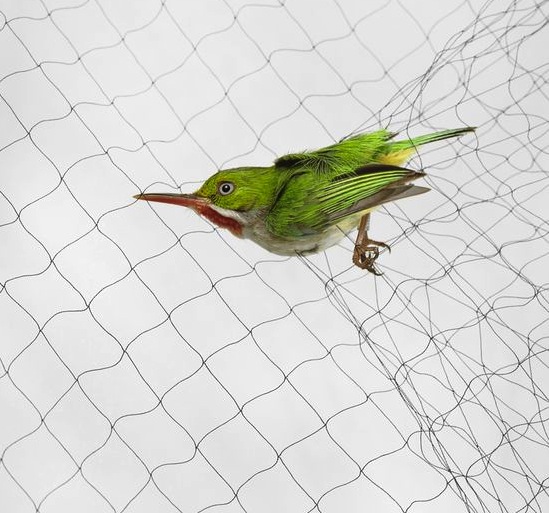
A different kind of bird-watching:
Jonathan Franzen’s got nothing on Todd R. Forsgren. The lifelong bird-watcher and Washington, D.C.-based photographer has traveled the world over in order to shoot countless species as they’re captured in ornithologists’ mist nets in order to be examined; the resulting images of the tangled up creatures — who, it’s important note, are unharmed by the process — provoke a mixed response in the viewer. On one hand, there’s something off-putting about seeing the birds placed in such a compromising situation. On the other, you begin to notice details that you wouldn’t if Forsgren’s unsuspecting subjects were perched in their natural environment.
As Forsgren explained in an interview:
I feel there is a unique mystery to the birds in this fragile and embarrassing moment, to take a creature that is the epitome of freedom and bind it. In some way, the birds are still "unknown" during this moment, as it is before they are taken out of the nets, measured and weighed. Gathering this information is difficult. It’s a struggle, as intimacy often is. But I wanted to take photographs about the process of getting to know a bird deeply.
Update from a reader:
My hobby is photographing birds in the wild (well, in my backyard), and even though I intellectually understand that the birds are unharmed by the nets, those images are still extremely unpleasant for me to look at. One of the things that appeals to me most about the birds I photograph, in addition to their beauty, is their freedom. Seeing them trapped, even if it's harmless and temporary, wounds me to my very core.
(Puerto Rican Tody (Todus mexicanus), 2009, courtesy of Todd R. Forsgren)
If Drudge is flagging a poll, you know almost instantly who has provided it. But no one has more completely swallowed the Rasmussen world's alternate reality than John Hinderaker. He acknowledges that in the Rasmussen poll, there are more Republicans in the sample than in most others. But he runs with it anyway. Romney is clearly winning the race, it seems.
The Rasmussen effect is best seen by using various polling models and removing Rasmussen data to see what happens. So Pollster.com's data, including Rasmussen, currently shows a national tie at 46.1 percent. Removing Rasmussen makes it Obama 47 and Romney 45.7. Small – but in a race this tight, not trivial. I generally remove Rasmussen from the poll of polls, because they are so openly biased in their sample. But whenever I cite a specific poll, I try and place it in the broader context of all the others.
This would be a problematic strategy for Hinderaker. Rasmussen nationally gives Romney a 4-point lead. Gallup – which consistently pegs Obama lower and Romney higher than most – gives Obama a 2 point lead. RCP gives Obama a lead of three points. The poll of polls without Rasmussen gives Obama a 1.3 percent lead. The difference – 5.3 percent to 7 percent – is huge. Hinderaker writes that according to Rasmussen:
Romney has generally led Obama ever since he became the clear front-runner for the GOP nomination.
Gallup shows a pretty even race until late June, after which Obama has a small but steady lead. RCP's poll of polls shows that Obama has never lost a national lead. But when you're busy creating an alternate reality, you don't want other data to interfere, do you?
Because his genius at advancing vice-presidential candidates is so well-established. Seriously, can anyone fail more spectacularly upward than in the Beltway punditocracy?
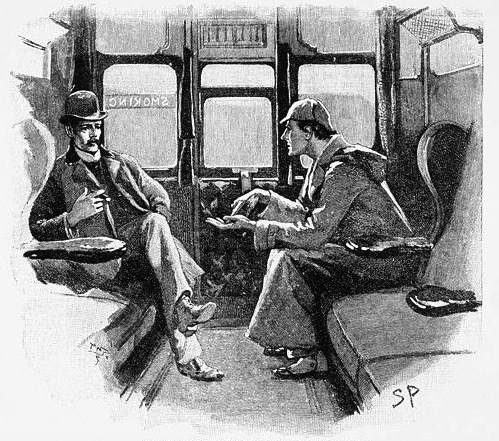
Sarah C. Rich wonders where he got it:
Sherlock’s unmistakeable deerstalker hat…was never mentioned in the printed words of the Holmes books. When Sidney Paget illustrated Doyle’s story, The Boscombe Valley Mystery, for publication in The Strand Magazine in 1891, he gave Sherlock a deerstalker hat and an Inverness cape, and the look was forevermore a must for distinguished detectives—so much so that while the deerstalker was originally meant to be worn by hunters (hence the name), the hat now connotes detective work, even without a detective’s head inside it. Of course, as many Sherlockians know, the deerstalker wouldn’t have been Holmes’s daily choice of headwear. These hats were country gear, not fit for the city.
Update from a reader:
A couple more bits regarding the hat: a clip from BBC's "Sherlock". An article regarding the hat in the above installment of "Sherlock." Money quote:
The deerstalker hat – a feature of Sidney Paget’s illustrations, as all Holmesians know, rather than Conan Doyle’s text – is similarly treated as an in-joke in the TV version: an impromptu shot of Sherlock in a borrowed deerstalker becomes the stock Press image, much to his irritation.
(Illustration by Paget)
Reviewing a new biography of Charles Dickens, Joyce Carol Oates holds that if he isn’t the greatest English novelist, he almost certainly “is the most English of great English novelists”:
Dickens is so brilliant a stylist, his vision of the world so idiosyncratic and yet so telling, that one might say that his subject is his unique rendering of his subject, in an echo of Mark Rothko’s statement, “The subject of the painting is the painting”—except of course, Dickens’s great subject was nothing so subjective or so exclusionary, but as much of the world as he could render. If Dickens’s prose fiction has “defects”—excesses of melodrama, sentimentality, contrived plots, and manufactured happy endings—these are the defects of his era, which for all his greatness Dickens had not the rebellious spirit to resist; he was at heart a crowd-pleaser, a theatrical entertainer, with no interest in subverting the conventions of the novel as his great successors D.H. Lawrence, James Joyce, and Virginia Woolf would have; nor did he contemplate the subtle and ironic counterminings of human relations in the way of George Eliot and Thomas Hardy, who brought to the English novel an element of nuanced psychological realism not previously explored. Yet among English writers Dickens is, as he once called himself, part-jesting and part-serious, “the inimitable.”
Go here for a guide to the best Dickens novels, according to six leading Victorianists.
 The Dish