"This country has a long history of discrimination against certain groups. Eventually we wind up getting it right. Right? Against women, against blacks, the civil rights movement and so on. And in justifying that discrimination when it was in place, some folks turn to the Bible and turn to their religious beliefs and said we have to have slavery because it’s in the Bible. Women have to be second-class citizens because that’s in the Bible. Blacks and whites can’t get married because that’s in the Bible. That wound up in a case. A judge wrote that in an opinion, which the Supreme Court ultimately struck that down, saying that’s not right, judge—the Equal Protection clause says you can't do that. Why is gay marriage any different?" – Fox News anchor Megyn Kelly.
Month: August 2012
Faces Of The Day
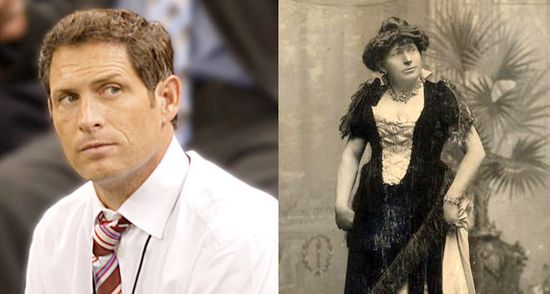
Earlier today, I posted a discovery by Kevin Sessums: a photograph of one of Brigham Young's sons in drag in 1901. Two readers noted a striking resemblance to Steve Young, the football player. And in fact, Young is a great-great-great-grandson of Brigham Young. Strong genes, no? And wouldn't he look great in a dress?
Brigham Young, by the way, announced the revelation of the divine call to restore the polygamy of the Old Testament in 1852 thus:
It has been a long time publicly known, and in fact was known during his life, that Joseph had more than one wife…We could not have proclaimed this principle a few years ago; everything must abide its time, but I am now ready to proclaim it. This revelation has been in my possession for many years, and who knew it? No one, except those whose business it was to know it. I have a patent lock to my writing-desk, and nothing gets out of it that ought not to get out of it. Without the doctrine which this revelation makes known to us, no one could raise himself high enough to become a god.
As for monogamy, this was Young's take:
this monogamic order of marriage, so esteemed by modern Christians as a holy sacrament and divine institution, is nothing but a system established by a set of robbers…
No one could accuse him of hypocrisy! Update from a reader:
Hey, now. Dragging Steve Young into this isn't going to do you any good. I mean, you posted on how he was a Prop 8 opponent way back when. Give the man some credit.
The View From Your Window

New Harmony, Utah, 3.18 pm
Will Legalization Cause A Surge Of Stoned Kids?
Mark Kleiman questions my view that "if [cannabis] were legal and regulated, we’d be better able to keep it from [minors]":
How do you make something way more available to adults and not have it become more available to minors as well? Yes, many kids today have better access to cannabis than adults do. But (despite frequent assertions to the contrary) nowhere near as much access as they have to alcohol, which is dirt-cheap and available from the wino outside any liquor store, or (in most cases) at home. Here are the brute facts: more kids engage in binge drinking every month than smoke pot at all in that month. Is that because alcohol is more fun? Or because it’s so easy to get?
The Dish has addressed this question before. Here's a reader we featured back then:
Survey data reliably shows us that children today can more easily access illicit cannabis than either alcohol or tobacco. California has seen no increase in teen use after the medical marijuana industry in that state exploded. Usage numbers among Dutch teenagers are even lower than they are here. There's simply no evidence that more liberal cannabis policies lead to higher use among kids.
From another reader:
Those who distribute marijuana are already violating the law and operate in a black market, where there is no incentive to follow any rules like age limits. However, legitimate establishments that sell alcohol have many incentives to follow the rules, including the possibility of losing their license to operate.
Some first-hand experience from another:
I started smoking pot at 14 because it was significantly easier to get than alcohol. Buying booze always involved either an illegal fake ID handed over to a stranger, or approaching a homeless person and negotiating with them. Neither of these were things I wanted to do at 14. On the other hand, my friend's older brother sold pot and I had known the guy for years. And since what he was doing was illegal anyway, he didn't give a shit how old we were.
Read the rest here.
Bumper Sticker Of The Day
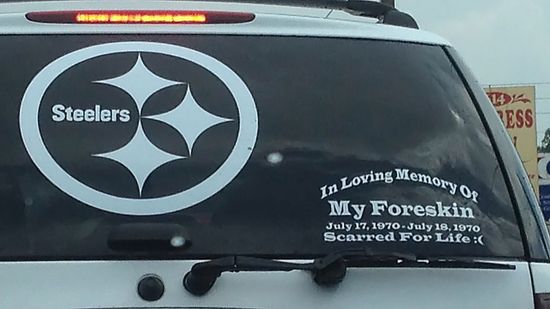
Guess which one. With apologies to Chuck Lane.
Bloomberg Knows Breast?
Readers respond to the latest paternalism from New York's mayor:
I take issue with the comparison you're drawing between this ban and the soda ban. First of all, the "ban" on the bottle is not really a ban at all. It's more like the "behind-the-counter" standard set for Pseudoephedrine – the mother still has access to it but has to ask for it. The really objectionable part is the speech that hospital workers are required to give women who opt for formula.
Another writes:
I am a lactation consultant. Believe me, my job is to know the problems breastfeeding moms and babies face.
One of the biggest problems is incorrect information such as that given by Gayle Tzemach Lemmon. Eighty percent of medications, including most antidepressants, are compatible with breastfeeding. Most breast infections and low milk supplies are caused by early breastfeeding mismanagement. Our health care system is a big part of the problem. It is very difficult and often expensive for new moms to get adequate breastfeeding information, help, and support.
So this ban is not about forcing women to breastfeed but a small step in helping women meet their own goals. If a new mother does not want to breastfeed, the hospital will still give the baby formula while there. It just won't send her home with free formula or bags. Formula companies spend big money to cozy up to doctors, nurses, and new parents in order to undermine breastfeeding and to get babies drinking their brand of formula in the hospital because they know whatever formula is started in the hospital is the one most parents will stick with at home. This ban is purely about restricting marketing to a vulnerable population.
Another:
To understand the baby formula rule change, it helps to understand how entrenched the formula companies are in hospitals now. My wife gave birth five years ago and three years ago in a New York hospital. Each time, less than an hour after giving birth, we were presented with a backpack stitched with a formula company's name, two cans of the stuff, branded bottles, and other supposed goodies. We told the nurse we didn't want the materials, and she responded that they were required to give it to us. (We gave it to the couple in the next room, who wanted to formula-feed).
As I read the article, "hospitals have agreed" to stop forcing such advertisements and products on new mothers, and those who ask for formula will still get it. Of course, some nurses could turn into scolds, but my suspicion is that most will not want to spend all day lecturing patients, and will bring formula to those who want it. The difference between the baby formula rules and the soda ban is that big sodas were in fact banned – this rule mainly keeps people from being forced to accept a bunch of plastic crap with a formula company's name on it.
July Jobs Reax: Much Better Than Expected
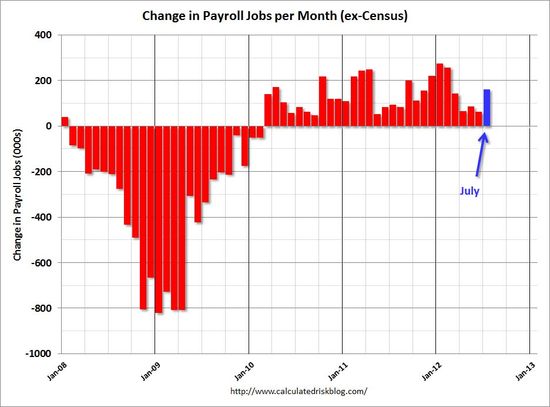
Joe Weisenthal provides a pithy summary of today's BLS report:
There were 163K net new jobs, well ahead of last month, and well ahead of expectations. Analysts had only been looking for 100K new jobs. PRIVATE payrolls surged by 172K. That's well ahead of the 110K that was expected. But there is a dark side. The unemployment rate rose to 8.3% although this was due to a miniscule move and a rounding error. And U-6, which is a broader measure of unemployment that includes discouraged workers and the underemployed, rose to 15.0% from 14.9%.
Phil Izzo details that discrepancy between jobs gained and the higher unemployment rate:
The key reason is because the two numbers come from separate reports. The number of jobs added — the 163,000 figure — comes from a survey of business, while the unemployment rate comes from a survey of U.S. households. The two reports often move in tandem, but can move in opposite directions, especially in months such as July where there are big seasonal issues at play. This month, the household survey was telling a darker tale than the poll of establishments.
Binyamin Appelbaum has more on the month of July, which is "annually adjusted by a larger amount than for any other month save January, when holiday workers lose their jobs." Mataconis puts today's numbers in further context:
[M]ost analysts were expecting a relatively weak net jobs numbers somewhere between 50,000 and 100,000. Given the numbers we’d seen in April, May, and June, and the GDP report that showed just how weak the economy was going in to the third quarter, that certainly seemed to be the best guess. Instead, we got one of the best jobs reports we’ve seen since February, albeit one that still has it’s own share of weaknesses. …
163,000 jobs isn’t enough to keep up with population grown and hardly enough to signal a real recovery. For the second, we’d need to be seeing job growth averaging at 250,000 per month. Instead, so far in 2012 we’ve averaged 151,000 new jobs per month which slightly worse than the 153,000 new jobs per month [in 2011].
Brad Plumer searches for signs of growth:
Manufacturing added 25,000 jobs last month. The automobile industry had fewer layoffs than usually occurs at this time of year. The professional and business services sector added 49,000 jobs in July. Leisure, hospitality, and food services also saw a bump, with 29,000 new jobs. Meanwhile, hospitals and outpatient care sectors continued to hire new workers.
Josh Sanburn looks to the Fed:
The mixed bag of numbers could give the Federal Reserve another reason to further stimulate the economy, perhaps with another round of quantitative easing. But the Fed isn’t likely to take any action before its policymakers meet in mid-September. The markets were up sharply Friday morning, partly because of the semi-positive jobs news, but also because of the perception that the numbers were not strong enough to dissuade the Fed from further monetary stimulus.
Chait comments on the Fed's inaction earlier this week:
[D]espite a weakening economy, it still would not take steps to stimulate growth. The Fed may not like mass unemployment, but it dislikes inflation even more, and in its calculus, the hypothetical prospect of the latter outweighs the immediate reality of the former.
Jared Bernstein downplays suggestions that the fiscal cliff is a major factor in today's report:
I actually think the bigger story is the negative feedback loop between weak job growth, weak paychecks, weak consumer spending, weak demand, weak job growth—and you’re back at the start of the loop. To break the loop, in the near term we need to target jobs, not debt and deficits. Exhibit A in terms of proving that assertion, and from the perspective of what NOT to do, is Europe and the UK. Fiscal policy, however, is frozen both there and here.
Felix Salmon provides a good primer on how politicians will spin today's numbers:
[T]he two parts of the report tell differing stories: the headline payrolls number was higher than most people expected, even as the headline unemployment rate went up.
Ryan Avent also sees "something for everyone":
For President Barack Obama, the payroll employment number is surely a relief. Employment rose by an estimated 163,000 jobs in July, up from a distressingly low gain of 64,000 in June (revised down from last month's estimate of 80,000). Private employers did better still, adding 172,000 jobs, helping make up for the continued declines in government payrolls. …
For Mr Obama's political opponents, including his Republican challenger Mitt Romney, the household survey data offers something to work with. The unemployment rate ticked up from 8.2% to 8.3% in July—statistically unchanged but enough for politicians to claim things are headed in the wrong direction. Household data showed a decline in both employment and the size of the labour force. The employment-population ratio reversed recent gains, dropping back to 58.4% from 58.6%.
Ed Morrissey's take:
National Journal’s Jim Tankersley writes that this will give Barack Obama a boost on the campaign trail, but "the pace of growth still not strong enough to bring down the unemployment rate over time." Certainly the last part is objectively true, and I think he may be right about the boost for Obama, too — but anyone familiar with these numbers won’t buy it. If this is what passes for good economic news for the Obama administration, it’s more of an indictment than a boost. However, most people will hear "163,000" and think that sounds pretty good.
Bill McBride provides plenty of charts, including the one above.
The Bain Of This Campaign, Ctd
The Princeton Election Consortium relies on Pollster.com's data and is best known for what it calls a "meta-analysis", which is viewing the election entirely through the meta-prism of the Electoral College, rather than state or national polls. They now put the odds of an Obama victory this fall at 10 – 1 – more emphatic than Nate Silver's 7 – 3 odds. They got 2004 and 2008 dead-on. What strikes me, however, is their analysis of the Bain ads. Here's what they find:
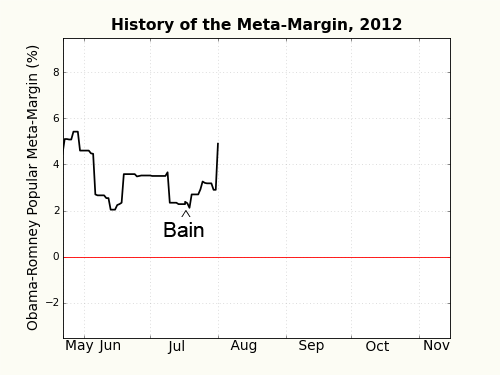
Since the Bain ads started running, Obama's lead in the Electoral College has increased by 3 percentage points to 5 percent. And the week of Romney's foreign tour saw Obama's odds sky-rocket. Here's their probability of electoral vote outcomes as of now:
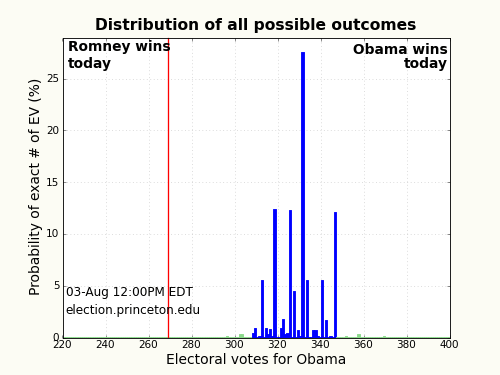
Everything can change. But this is a big hill for Romney to climb.
From The Mouth Of Stratfor
Via Wikileaks and Politicalgates, an unvarnished look at the views of the cold-hearted realists at the private security think-tank. From a Stratfor-analyst's memo in 2010:
America loves "winners". You can be a porn-star banging golfer, gambling basketball player who gets his father killed because of debts or a rapist boxer who eats human ears. Bottom line is that if you can deliver wins, people will be fascinated by you and give you respect. This is why it was so central to the Republicans to defeat Obama on healthcare, not because of its contents but because of its symbolic meaning.
Exactly.
Vidal, Ctd
Meandering through Youtubes featuring him is a rather lovely way to pass the time. This, it seems to me, is proof of what television can do, could still do, but doesn’t:
 The Dish