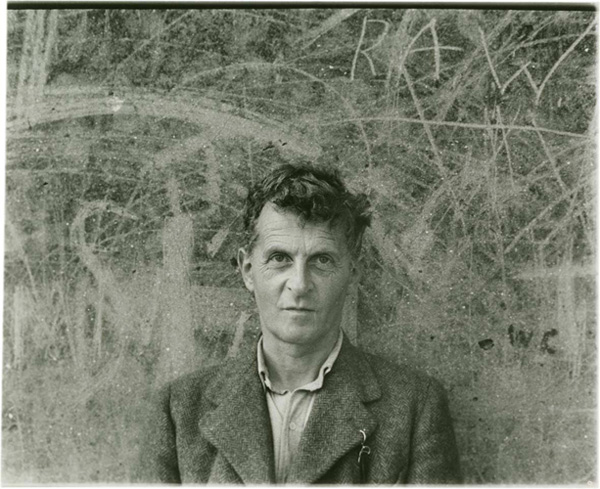
Recently, both the London School of Economics and Cambridge University featured an exhibition, "Wittgenstein: Philosophy and Photography," that included a remarkable series of images from the famed philosopher's life – family portraits, photos of a house he designed, and even photobooth snapshots. Ray Monk, Wittgenstein's biographer, shows why these photographs are not just historical curiosities, but rather point to the core of Wittgenstein's thought:
It was fundamental to Wittgenstein’s thinking – both in his early work Tractatus Logico-Philosophicus and in his later work Philosophical Investigations – that not everything we can see and therefore not everything we can mentally grasp can be put into words. In the Tractatus, this appears as the distinction between what can be said and what has to be shown. “Whereof one cannot speak, thereof one must be silent,” runs the famed last sentence of the book but, as Wittgenstein made clear in private conversation and correspondence, he believed those things about which we have to be silent to be the most important. (Compare this with the logical positivist Otto Neurath, who, echoing Wittgenstein, declared: “We must indeed be silent – but not about anything.”)
To grasp these important things, we need not to reason verbally, but rather to look more attentively at what lies before us. “Don’t think, look!” Wittgenstein urges in Philosophical Investigations. Philosophical confusion, he maintained, had its roots not in the relatively superficial thinking expressed by words but in that deeper territory studied by Freud, the pictorial thinking that lies in our unconscious and is expressed only involuntarily in, for example, our dreams, our doodles and in our “Freudian slips”. “A picture held us captive,” Wittgenstein says in the Investigations, and it is, he thinks, his job as a philosopher not to argue for or against the truth of this or that proposition but rather to delve deeper and substitute one picture for another. In other words, he conceived it as his task to make us, or at least to enable us, to see things differently.
The caption on the photo above reads: "Wittgenstein photographed under his own instruction in Swansea, Wales, 1947." A slideshow of Wittgenstein photographs, from where the above image is drawn, can be viewed here.
 The Dish