This weekend on the Dish, love and literature dominated our coverage. In the realm of romance, Lydia Kiesling searched for the perfect wedding reading, XKCD revealed the dismal odds of finding your soulmate, Nora Caplan-Bricker found a new book about sex at Yale unimpressive, Sybil Sage named Helen Gurley Brown a coach for the sexual revolution, Hanna Rosin evaluated today's hookup culture, the wife of a deployed British soldier described the hardships of being married to a military man, Yelena Akhtiorskaya pointed to the drudgery of being the wife of a great Russian writer, and Bernard Avishai revisited that tale of sexual neuroses and desire, Portnoy's Complaint. Last but not least, Anna Smith covered the difficulties of dating in the little people community.
In books coverage, Mark O'Connell confessed his literary promiscuity, Evan Kindley reviewed the once symbiotic relationship between writers and the Democratic Party, Daniel Mendelsohn provided a formula for good criticism, Benjamin Percy advocated for the slow book movement, and Clive James commended film critic Pauline Kael's writings that proved her acute judgment went beyond movies. We rounded up the reviews of D.T. Max's biography of David Foster Wallace and, as a new collection of Jack Kerouac's poetry hit the shelves, the volume's editor celebrated his capacity to capture the "universal experience of being alive." Read Saturday's poem here, Sunday's here, and Monday's here.
Faith and doubt made their usual appearances on the Dish as well. William Deresiewicz critiqued our attachment to the Protestant work ethic, Vaughan Bell diagnosed the medical symptoms listed in Psalm 137, Robin Varghese unearthed V.S. Naipaul's memoir of religious dimension of the 1984 Republican convention, Brian Jay Stanley explored the obstacles to faith in a pluralistic world, Peter Frase reminded us there once was a "Saint Monday," and Alexander Nazaryan championed Sir Thomas Browne's 17th century doubt amidst our own modern certainties. We didn't forget about the Mormons, either. Laura Winer noted the faith's conflicts with history and Sue Spinale McCrory hoped Mormonism's dietary dimension would get more attention.
Amidst our assorted coverage, we dabbled in philosophy – John Gray praised an older generation of liberal thinkers who grasped democracy's conflict with freedom, Ray Monk explained the surprising connection between photography and philosophy in Wittgenstein's thought, Randy Cohen answered a frequently asked ethical dilemma, and Brent Forrest went in search of an eccentric Russian math genius. Almost as importantly in the search for wisdom, we highlighted a documentary about that great sage, The Dude, and noted why you should consider sleeping rather than cramming for those exams. In politics, Craig Unger deplored Karl Rove's tactics, Bob Duggan wondered what Frank Lloyd Wright was doing at the GOP convention, and Julia David recalled the time-honored tradition of plying voters with booze. In miscellaneous news, Tom Stafford divulged the reason for the stopped clock illusion, Devin Friedman checked out the highest-grossing nightclub in Las Vegas, Quentin Fottrell warned that there's no afterlife for your Itunes, Robert Pearlman recounted Neil Armstrong's strange form of life insurance, Jed Kolko crunched the numbers on where its actually most affordable to live, The Economist disclosed why the airlines are broke, Kay Steiger analyzed why college mainly is for rich kids, Tom Vanderbilt surveyed advances in biomimicry, Kelsey Campbell-Dollaghen appreciated art made from surveillance footage, and Michelle Nijhuis detailed the horrors of Chinese alcohol.
Hathos alert here. FOTDs here, here, and here. MHBs here, here, and here. VFYWs here, here, and here – and the latest window contest here.
Finally, on this Labor Day weekend, Mike Dash believed that hoping for a world without work is what makes us human.
– M.S.
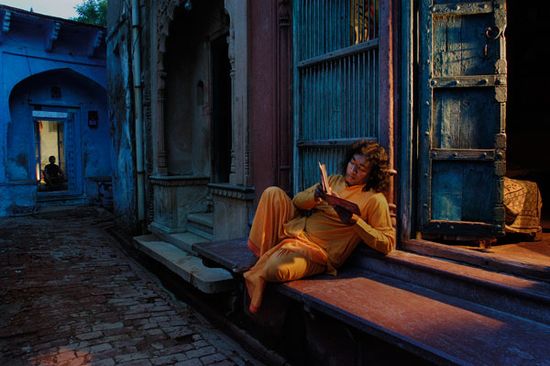
(Image from Steve McCurry's series of people reading around the world, via Emily Temple)
 The Dish