Thomas Heise remembers the downward spiral of one of America's greats:
After forty, all life is a matter of saving face. For those whose successes have run out early, the years are measured less by the decreasing increments of honors
achieved, than by the humiliations staved off and the reversals slowed. Among our canonical twentieth-century writers, none suffered this pronouncement—one avoids labeling it a fate—more than F. Scott Fitzgerald. At what should have been the height of his novelistic powers in the mid 1930s, he was listless, reckless in his personal affairs, sick with tuberculosis and jaw-droppingly drunk. As Fitzgerald himself would later admit, he had become a poor caretaker of everything he possessed, even his own talent.
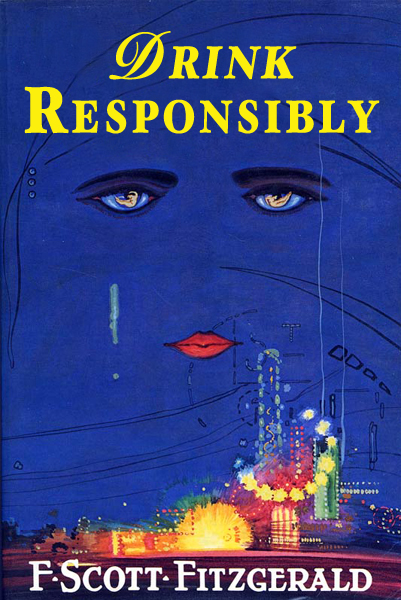
But Fitzgerald would get the last laugh. The New Yorker recently published a short story Fitzgerald produced during those down-and-out years, "Thank You for the Light." The magazine had rejected the story in 1936, so why the change of heart? Heise sees the story's acceptance as proof that the country is confronting its own economic hardship:
The hardscrabble Mrs. Hanson’s American belief in self-transformation even in the depths of the Depression strikes a chord now seven decades later as we stagger through the distress and desolation of the second worst economic downturn in our modern history. …
Fitzgerald had expressed a version of this two-pronged sentiment (a dauntless spirit and a clear-eyed realism about the challenges faced) in his essay “The Crack-Up” (1936), published in Esquire when his editor and friend, Arnold Gingrich, asked him for something, anything, that could justify an advance to the financially strapped writer. At the time, Fitzgerald was ten of thousands of dollars in the red and sustaining himself on canned food at the low-budget Skyland Hotel in North Carolina, while hemorrhaging money on Zelda’s psychiatric care and his daughter’s private education. Fitzgerald wasn’t poor, mind you, just deep in debt due to a lifestyle that outpaced his remarkable earnings. The first of three personal essays that Fitzgerald handed to Gingrich opened at a somber, distant remove, washed in Fitzgerald’s melancholy twilight where the space between the contradictions and polarities of one’s thinking gives way to new possibilities, new prospects, new life. “[T]he test of a first-rate intelligence is the ability to hold two opposed ideas in the mind at the same time, and still retain the ability to function,” Fitzgerald wrote on page one, immediately going on to remark that “One should, for example, be able to see that things are hopeless and yet be determined to make them otherwise.”
Previous Dish coverage of the writer's crack-up here.
(From the blog Better Book Titles via Laughing Squid)
 The Dish