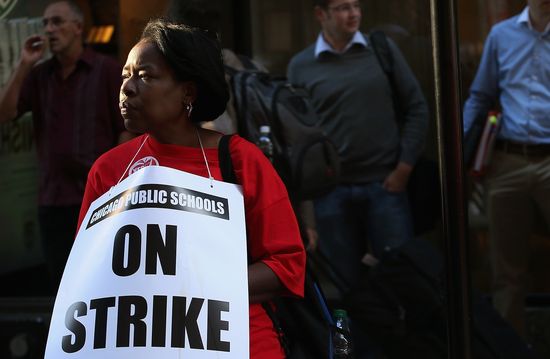
Dylan Matthews has a useful primer on the Chicago Teachers' Union strike. One point of conflict:
The Chicago Public Schools in March unveiled an evaluation system (pdf) in which standardized testing makes up 40 percent of the rubric, a percent that increases by 5 percent every year thereafter (45 percent in year two, 50 percent in year three, etc.), which was designed by panels that included teachers, principals, and teachers’ union officials (including the president). The system goes above and beyond the state requirement that testing make up 20-40 percent of teacher evaluations. The teachers’ unions are resisting this system, calling it too punitive.
Dylan Matthews also rounds up the research on how teachers' strikes affect students. Nick Gillespie takes the Teachers' Union to task for rejecting a salary increase on the basis that it is tied to standardized test performance:
One of the most ridiculous claims emanating from teachers unions is the persistent idea that teaching abilities can't be quantified in any meaningful way as it relates to merit. Somehow, every other profession on the planet – including teaching at the college level – finds ways to assess and reward good performance.
McArdle considers why the Teachers' Union is so adverse to merit pay:
Chicago public school teachers have planned their lives around the way the school system is right now. Anything that threatens this status quo is likely to trigger a violent reaction–particularly since jobs from which it is impossible to be fired tend to attract people who are unusually risk averse.
Doug Mataconis argues that Mayor Emanuel has little to lose in the standoff:
We’ve already seen the electoral benefit that Scott Walker received in Wisconsin for taking on public sector unions, as has New Jersey Governor Chris Christie. Just north of Christie in New York, Governor Andrew Cuomo has been as hard-nosed as his Republican neighbor in dealing with the unions, and he’s got approval numbers that would seem to indicate that he’s pretty much untouchable for re-election in 2014 at this point in time. It’s just as likely that Emanuel will reap political gains from this showdown with the CTU, a showdown that, in the end, he is likely to win simply because of the economic and political realities of the situation.
Mataconis also points out that the strike might bolster the case for charter schools; since most aren't unionized, some 45,000 students at these will still be getting an education. Rick Perlstein is much more sympathetic to the Teachers' Union:
Since Rahm Emanuel’s election in the spring of 2011, Chicago’s teachers have been asked to eat shit by a mayor obsessed with displaying to the universe his "toughness" — toughness with the working-class people that make the city tick; toughness with the protesters standing up to say "no"; but never, ever toughness with the vested interests, including anti-union charter school advocates, who poured $12 million into his coffers to elect him mayor (his closet competitor raised $2.5 million). The roots of the strike began when Emanuel announced his signature education initiative: extending Chicago’s school day. Overwhelmingly, Chicago’s teachers support lengthening the day, which is the shortest of any major district in the country. Just not the way Rahm wanted to ram it down their throats: 20 percent more work; 2 percent more pay.
(Photo: Lisa Bates, a sixth grade teacher, marches with thousands of other Chicago public school teachers in front of the Chicago Public Schools (CPS) headquarters on September 10, 2012 in Chicago, Illinois. More than 26,000 teachers and support staff hit the picket lines Monday morning after the Chicago Teachers Union failed to reach an agreement with the city on compensation, benefits and job security. With about 350,000 students, the Chicago school district is the third largest in the United States. By Scott Olson/Getty Images)
 The Dish
