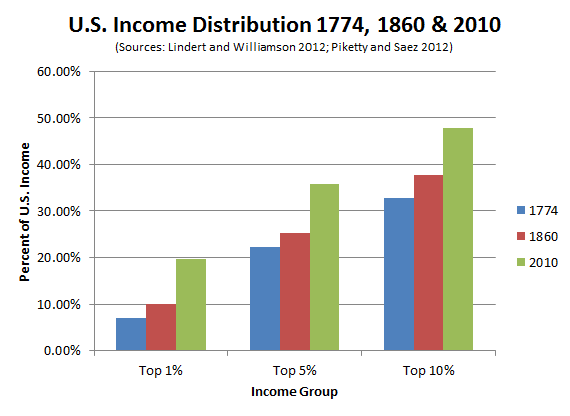
Jordan Weissman calls attention to a study that shows income inequality to be worse than in 1774:
We are much richer nation, and much better off today, than 240 years ago. In the 1770s, America was a heavily agrarian country of yeoman farmers, merchants, and tradesmen, with an economy that accounted to just a few billion dollars in present values. Like India or Russia today, both of which technically enjoy more income equality than the United States, early Americans were relatively poor compared to us.
They were just relatively poor together. The first wave of industrialization in the 19th century increased living standards, but also offered bigger rewards to factory owners than their workers. That pattern neatly fits our classic understanding of what's supposed to happen when economies move from farming to manufacturing. And by now, we've gone through several epic rounds of economic upheaval that have left us with a vast gulf between the rich and the rest, as well as a welfare state that tries to mitigate some of the side effects of that difference.
So, awful as it might sound, the fact that the United States is less economically egalitarian than during its rural, slave-society ancestors is not inherently a reason to fret.
Meanwhile, Colin Gordon maps present-day income inequality by state.
 The Dish