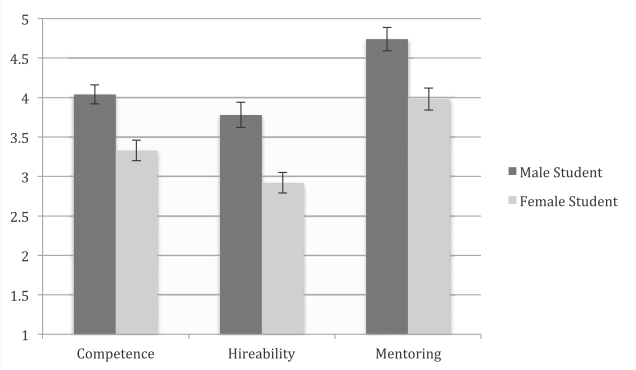
A team led by Corinne A. Moss-Racusin asked 127 professors of biology, chemistry, and physics at major research universities to rate the competency, hireability, and their own willingness to mentor of a grad school applicant on a scale of 1 to 7. Every professor got the same application except for one small difference: sometimes the aspiring scientist was named "John" and sometimes "Jennifer." Faculty—both men and women—rated the male student higher for everything.
Jenny Rohn reflects on the possible reasons for this:
[I]n her wonderful book, Why So Slow? Advancement of Women, Virginia Valian painstakingly documents many studies showing the inherent, subconscious bias that both men and women have against female scientists, who unlike men, do not conform to the "schemata" ("capable", "independent", "can-do") that we tend to think of when we envision scientists4. Picture a scientist in your head: the image is likely to be male. We're just wired that way. The same wiring causes internal dissonance when we are faced with a female scientist.
TNC puts it more simply:
I think we have this tendency to overrate our powers of reason, and underrate the lizard-brain. We have an even greater tendency to underrate the power of culture and socialization among the elite. (Cultural pathology is a phrase reserved for the barbarian poor.)
 The Dish