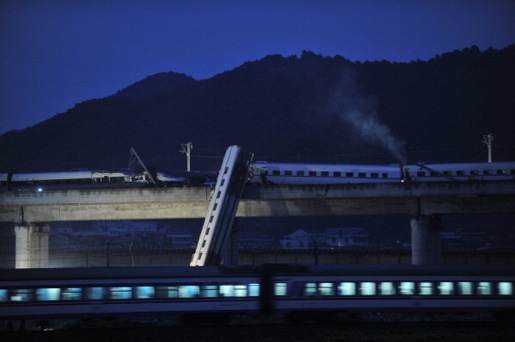
Last year a high-speed rail crash killed 40 people in Wenzhou, China. Evan Osnos explores how public outcry online kept the story alive:
[I]nstead of moving on, the public wanted to know what had happened, and why. This was not a bus plunging off a road in a provincial outpost; it was dozens of men and women dying on one of the nation’s proudest achievements—in a newly wired age, when passengers had cell phones and witnesses and critics finally had the tools to humiliate the propagandists. Within days, the state-owned company that produced the signal box apologized for mistakes in its design.
He adds:
[P]eople see no shortage of reasons to demand better: Beijing spends more today on domestic security, protecting the state from a daily parade of public grievances and unrest, than it does on foreign defense. Despite the efforts of the censors, Chinese people can go online and read that their leaders eat uncontaminated vegetables grown at remote, guarded farms, and breathe air that has been scrubbed by filters.
However, Mark Leonard takes the view that the government's management of social media is highly calculated:
After [the] tragic train crash in Wenzhou in 2011, the government allowed 10 million critical messages about the Chinese railway minister – who was the object of the ire of even top officials at that point – to be aired on social media over five days.
This suggests that the Internet has already "become an integral part of the governing strategy of the Communist Party," argues Leonard:
Many regimes collapse when they miscalculate public opposition to particular policies or because their citizens stop bringing grievances to a state they no longer regard as legitimate. Allowing criticism may legitimize the state and help the regime maintain power. … The Internet could lend greater legitimacy and resilience to the one-party state. However, China’s officials will never stop fearing a technology that could sweep them away.
(Photo: Bullet train D3115 derailed on a bridge on July 24, 2011 in Wenzhou, Zhejiang Province. The first four coaches and the 15th and 16th coaches of the train slid off the track, killing 40 and injured 192 people. By ChinaFotoPress/Getty Images)
 The Dish