A Historian Stuck In The Past

Morgan Meis remembers Eric Hobsbawm, the English Marxist historian who passed away [NYT] recently:

As a historian, Hobsbawm was forced, in his analysis, to take an objective stance, to look at history from a position above the fray. But he also seems to have realized that real history only happens when people are within the fray. History had made him a communist and he was going to stay that way. Hobsbawm didn't try to be wiser than his own times. He didn't believe he could out-think the 20th century. He was content to be a living document of one of the defining forces of his era. Self-aware all the way to the end, he was never embarrassed. He never shirked from the implications. He never wanted anyone else to be embarrassed for him.

In a review of Hobsbawm's Interesting Times: A Twentieth Century Life for The New York Times, Christopher Hitchens admitted a grudging admiration for Hobsbawm. Given Hitchens' usual disgust for figures of the communist Left, who he generally dismissed as apologists for Totalitarianism, it was a surprising position. "Hobsbawm's vices," Hitchens wrote, "mutate into his virtues." Hitchens too was struck by the trudging stubbornness of Old Man Hobsbawm. Maybe Hitchens saw in Hobsbawm a perfect foil to himself. It was always Hitchens' fantasy that he could stay one step ahead of the march of history. Here in Hobsbawm was a man who practically reveled in the fact that he had been left behind. Ahead or behind, history has managed to make both of them look foolish. Hobsbawm had decided it was best to be exactly what he was.
Mental Health Break

A Tron-like trance:

ISS Startrails from Christoph Malin on Vimeo.

This Video was achived by "stacking" image sequences provided by NASA from the Crew at International Space Station. These Stacks create the Star Trails, but furthermore make interesting patterns visible. For example lightning corridors within clouds, but they also show occasional satellite tracks (or Iridium Flashes) as well as meteors – patterns that interrupt the main Star Trails, and thus are immediately visible.

As The World Warms

Chris Hayes on last night's lack of debate on climate change:

Having an energy conversation without talking about climate is like talking about smoking and not talking about cancer.

Andrew Leonard is similarly depressed:

I am sure I am not alone in being baffled at Obama’s reluctance to bring up one of the worst oil spills in American history in the context of a discussion of oil production on federal land, but that’s a minor quibble when compared to the invisibility of climate change. It’s hard to think of a better illustration of how screwed up the debate over energy policy is in this country than the sight of two candidates for president fighting with each other over who supports the coal industry with more gusto. For environmentalists, the worst moment of the debate had to be when President Obama took obvious pleasure in pointing out that Romney had once stood in front of a coal-fired power plant and said “this plant kills.” Ouch.

Lisa Hymas adds:

Obama did talk during the debate about building a clean energy economy: “we’ve got to make sure we’re building the energy source of the future, not just thinking about next year, but 10 years from now, 20 years from now. That’s why we’ve invested in solar and wind and biofuels, energy-efficient cars.”

But in today’s political climate, Obama just doesn’t believe he can turn his back on fossil fuels and still win the election. It’s not even clear that he wants to turn his back on fossil fuels.

Unpacking The Portfolio Pot-Shots

Last night, after Obama attacked his opponent's profiting from China investments, Romney accused the president of personal holdings in Chinese companies and a Cayman-domiciled trust. Laura Clawson provides details:

Obama has between $50,000 and $100,000 in a defined benefit pension plan from the Illinois General Assembly (PDF)…, a pension in which he's one of hundreds of participants in a $60 million fund (PDF). The Romney campaign, by the way, is billing this as Obama's "personal pension fund." Every other member of the Illinois state legislature, past and present, might be surprised to hear this.

Luis Martinez and Jason Ryan note that the Illinois pension fund is Obama's sole investment holding. As for Romney's record, James West sketched out the candidate's involvement in managing his personal portfolio in a post last week:

Romney has said that he has no role in managing his personal investments; one of his aides told the Financial Times recently that [Romney's personal lawyer Bradford] Malt works "to make the investments in the blind trust conform to Governor Romney’s positions, and whenever it comes to his attention that there is something inconsistent, he ends the investment."

Sharon LaFraniere and Mike McIntire, meanwhile, recently examined some contradictions between Romney's estimated $1.25 million in Bain-based China investments and his tough-on-China politicking:

[A] confidential prospectus for one of the Bain funds, obtained by The New York Times, promotes China as a good investment for some of the same reasons that Mr. Romney has said concern him: “Strong fundamentals” like manufacturing wages 85 percent lower than what Americans earn, vast foreign exchange reserves and the likelihood that China will surpass the United States as the world’s largest economy.

LaFraniere and McIntire caution against reading too much into this, though:

It is often difficult to determine precisely how much Mr. Romney benefits from specific investments by Bain funds, since his money goes into a pool used to buy stakes in companies. 

Your Inbox Obsession

Tom Stafford determines its cause:

Irregular rewards have a special power to enforce repeat behaviour, something discovered by psychologists in the early twentieth century, and known for centuries by people who organise gambling (would anyone play slot machines if they just predictably gave you back 80% of the money you put in each time?).

Email drips into your consciousness during the day. Each time you check it you don’t know if you’ll be getting another boring work email, which isn’t very rewarding, or some exciting news or an opportunity, which is very rewarding. The schedule of these constant opportunities for surprise hooks us into checking email. To avoid it, you just need to fix your email so that you collect it all at once at regular intervals, such as every hour or twice a day, rather than checking each email as it arrives.

Fact-Checking The Energy Debate

Part of the back and forth on energy from last night:

One claim Romney made in the debate:

The president's right in terms of the additional oil production, but none of it came on federal land. As a matter of fact, oil production is down 14 percent this year on federal land, and gas production was down 9 percent. Why? Because the president cut in half the number of licenses and permits for drilling on federal lands, and in federal waters.

CBS News unravels it:

Romney is correct that in 2011 oil production was, in fact, down on federal lands: The EIA reported this year that "total crude oil sales of production from Federal and Indian lands increased from 642 million barrels in FY 2009 to 739 million barrels in FY 2010, but decreased to 646 million barrels in FY 2011." That amounts to an 11 percent reduction. The EIA explained that crude oil production from federal lands is "dominated by offshore production from the Federal Outer Continental Shelf" — production that was disrupted by the Deepwater Horizon oil spill.

Romney said production was down because "the president cut in half the number of licenses and permits for drilling on federal lands, and in federal waters." But according to the Bureau of Land Management, the government issued 2,188 new leases in 2011, up from 1,308 in 2010. That's a decrease, however, from the 3,499 new leases issued in 2007. If one considers the total number of leases in effect, the number decreased slightly from 2010 (50,544 leases) to 2011 (49,173). However, there were more leases in effect in 2011 than in 2007, when there were 48,933.

PolitiFact weighs in, confirming Romney's 14% number on oil production – but also dismantling it with context:

Production under Obama was hobbled due to the Deepwater Horizon disaster, making a one-year figure subject to cherry-picking. And it’s not at all clear that the president in charge when the oil is taken out of the ground deserves full credit or blame; years of prior policies on exploration and drilling had an impact. 

For instance, looking back:

• From 2004-08, well into Bush’s tenure, oil production on federal lands and waters fell in four of five years, for a net decrease of 16.8 percent.

• From 2009-11, the Obama years, oil production rose two of three years, for a net increase of 10.6 percent.

The bottom line: overall energy production is up [NYT] since Obama took office. On another energy exchange last night, FactCheck.org points out an Obama fib:

Obama falsely claimed Romney once referred to wind-power jobs as “imaginary.” Not true. Romney actually spoke of “an imaginary world” where “windmills and solar panels could power the economy.”

Losing It On Libya

Ed Kilgore examines GOP talking points on the Benghazi attack:

Conservatives have now had over a month to tie their endless finger-pointing over the events in Benghazi to some larger theme, and have basically failed. If I were them, I’d probably argue the whole series of incidents shows that the administration (and Democrats generally) think the Global War on Terror—which they never much believed in to begin with—ended with the killing of Osama bin Laden, and have been proven very dangerously wrong. But instead, some conservative have gotten distracted by their Islamophobia into going nuts over the administration’s “apologies” for an obnoxious video, and others have gotten distracted by their lust for war with Iran into making this all about “signals” of America’s “lack of resolve.” And Mitt Romney’s done a little of everything without much clarity.

Kevin Drum urges Republicans to give the issue a rest:

Republicans seems to think that this is some kind of huge gotcha moment that will show Obama as a weak and flailing leader on the world stage. But I suspect they’re caught up in their own echo chamber, the same one that insists Obama wants to take your guns away and has spent the past four years apologizing for America. But the more they dive into the conspiratorial weeds on this, the worse they look to ordinary Americans who don’t really mind that President Obama waited a few days to sift through the evidence instead of going off half cocked within a few hours. 

Adam Serwer looks at where Republicans went wrong:

Partisanship can be helpful in the search for accountability. But conservatives have been so eager to exploit the incident in Libya for political advantage that they’ve focused on inconsequential details like what the president said when. The facts surrounding the Benghazi attack are damning enough on their own. But thanks to their penchant for cherry-picking information, the GOP left their presidential nominee on stage with his mouth agape, struggling to understand how something he knew for a fact wasn’t a fact at all.

Romney’s Bind With Women, Ctd

Regarding Romney's record of hiring women, The Boston Globe's Beth Healy points to Romney's time at Bain:

Romney … did not have a history of appointing women to high-level positions in the private sector. Romney did not have any women partners as CEO of Bain Capital during the 1980s and 1990s. The venture capital and private equity fields were male-dominated, to be sure, especially during Romney’s time. Women started to break into the upper echelons of the firm after it started a hedge fund, called Brookside in 1996. Today, 4 of out of 49 of the firm’s managing directors in the buyout area are women.

Garance Franke-Ruta's conclusion:

Romney did a good job appointing women to high office in the context of a bipartisan statewide push to get him to do so as a new governor, but a terrible job in finding and promoting women to senior roles in the context of the high-paying private-sector business he built himself. That may be why, by his own admission, his social power network when he came into office led to an all-male pool of job applicants. And as any woman with a job knows, getting the job is not the same a being paid the same amount as male colleagues for it — the question on the table before Romney Tuesday night, and one he ultimately punted on.

Dish reader reax to Romney's binder-of-women rhetoric here, and why that rhetoric is BS here.

Seniors In The Slammer

Acluoldprisonerschart

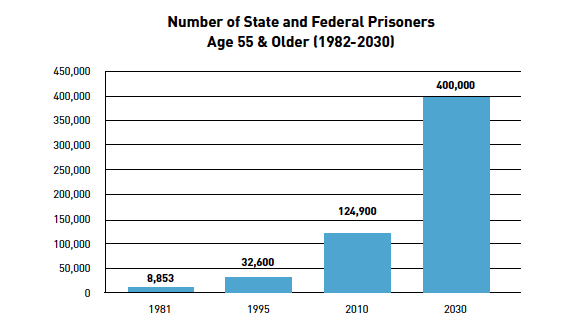
James Ridgeway parses a recent report from the ACLU (pdf) that found by 2030, "the over-55 group will number more than 400,000—about a third of the overall prison population":

In short, more than 100,000 prisoners are currently destined to die in prison, and far more will remain there well into their 60s and 70s. Many of these men—as most of them are men—were never violent criminals, even in their youth. In Texas, for example, 65 percent of the older prisoners are in for nonviolent acts such as drug possession and property crimes.

Keeping thousands of old men locked away might make sense to die-hards seeking maximum retribution or politicians seeking political cover, but it has little effect on public safety. By age 50, people are far less likely to commit serious crimes. "Arrest rates drop to 2 percent," explains [Bob] Hood, the retired federal warden [at the federal correctional complex in Florence, Colorado]. "They are almost nil at the age of 65." The arrest rate for 16-to-19-year-olds, by contrast, runs around 12 percent. Once released, therefore, the vast majority of the older prisoners never return.