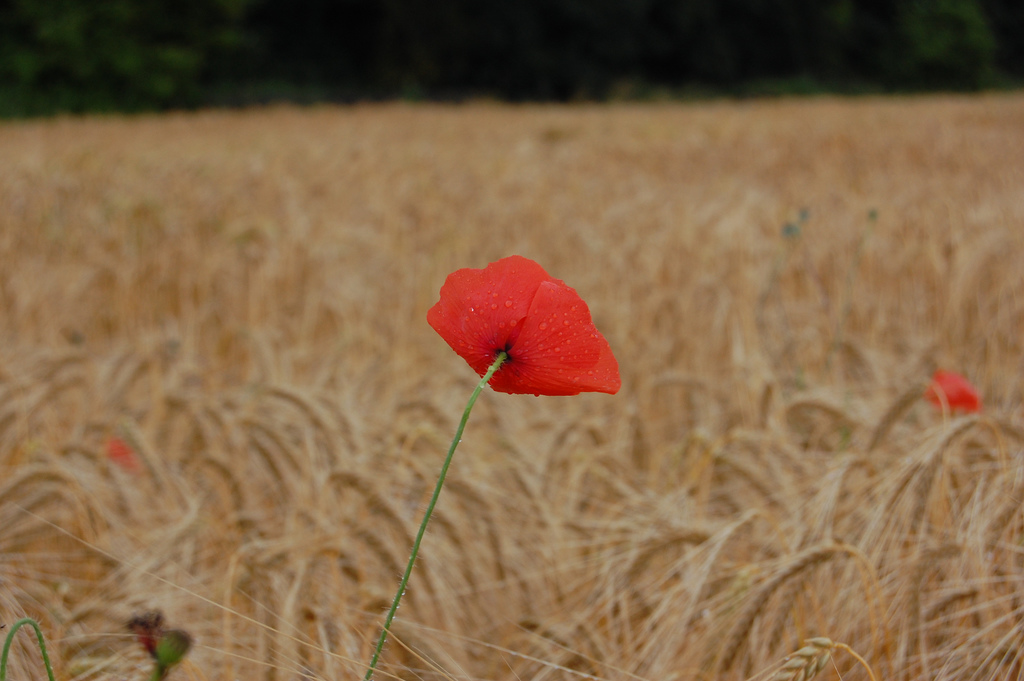
Mark Signorelli captures the way poetry can illuminate the world around us:
We customarily think of the language of poetry as being unique on account of its expressiveness, its sweetness, or even its loftiness of tone and diction. These are clearly proper grounds of distinction. But what I am emphasizing now is that poetic language is unique also on account of its precision, its capacity to display things in their true light, and, in this way, to prepare the furniture of the world for the mind’s reception.
Heidegger made much of this feature of poetic discourse, in particular in an essay he wrote called Holderlin and the Essence of Poetry. There he writes: "by speaking the essential word, the poet’s naming first nominates the beings as what they are," and again, that poetry is "a naming of being and of the essence of all things – not just any saying, but that whereby everything first steps into the open, which we then discuss in everyday language."
The great poets are constantly doing this, nominating beings as what they are, and bringing the multifarious aspects of our world for the first time into the open. We find this happening time and again in the best poetry – a certain turn of phrase, a special application of trope or figure, that presents some phenomenon to our attention in such a way that we feel ourselves to be aware of its true nature for the very first time.
So when Swinburne, in his "Hymn to Proserpine," describes the sea as "white-eyed and poisonous-finned, shark-toothed and serpentine curled," we seem to sense, in a wholly new way, the extraordinarily dangerous and deadly power of the ocean. When Shelley addresses the west wind as a "Destroyer and Preserver," we have revealed to us the broad agency for change inhering in that natural phenomena, which would make it, in Shelley’s mind, such an apt symbol for the aspirations of the poet. Or when Thomas Traherne, in the "Salutation," imagines himself in the mind of an infant, greeting his newly formed limbs as "new burnished joys" and "sacred treasures," we see, stepping into the open for the first time, the perfect contingency, and supreme preciousness, of the human body, and hence of human existence. In every case, we sense that the poet has revealed something essential about the phenomenon, that, speaking simply, he has told us something true about these things.
(Photo by Flickr user Identity Photogr@phy)
 The Dish