Alan Jacobs praises a new study from Pew that found that "more than eight in ten Americans between the ages of 16 and 29 read a book in the past year, and six in ten used their local public library." He doesn't think it matters what titles they turn to:
I have often cited W. H. Auden’s belief that people shouldn’t read masterpieces all the time: "When one thinks of the attention that a great poem demands, there is something frivolous about the notion of spending every day with one. Masterpieces should be kept for High Holidays of the Spirit." And mediocre books often prove to be gateway drugs to better books.
Similarly, Michelle Dean takes comfort, both personally and professionally, in "bad" books:
We want to say that on the one hand are the good books, the hard books, the books that require dedication of the reader, of the work readers do. The books that Real Writers (apparently a self-selecting class) write. And then there are these others. Yet it’s a strange thing to watch book culture, which is itself in a perpetual stage of fear about its own decline, slice off pieces of its very own flesh.
She continues with a great anecdote about DFW:
If you don’t believe that we are all one body here, try this on for size: Of all the details D.T. Max dug up on David Foster Wallace’s life for that original New Yorker profile of his, the one that has always haunted me most is taken from the time Wallace’s mother had to come and pick up her broken-down son in Tucson.
They rented a U-Haul and took turns driving and reading aloud a Dean Koontz novel during the sixteen-hundred-mile trip home
There you have it: the most allegedly "difficult" novelist of our generation spending time with a crap paperback thriller.
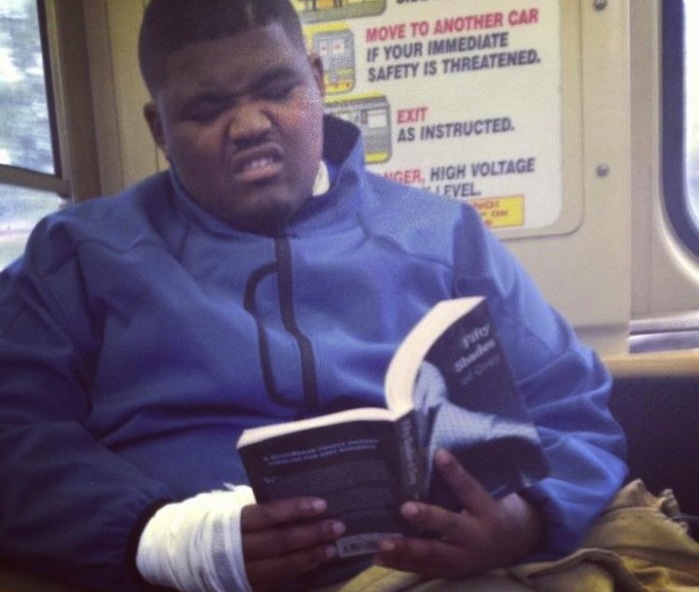
(Photo from a collection of "29 People Caught Reading "Fifty Shades Of Grey" In Public")
 The Dish