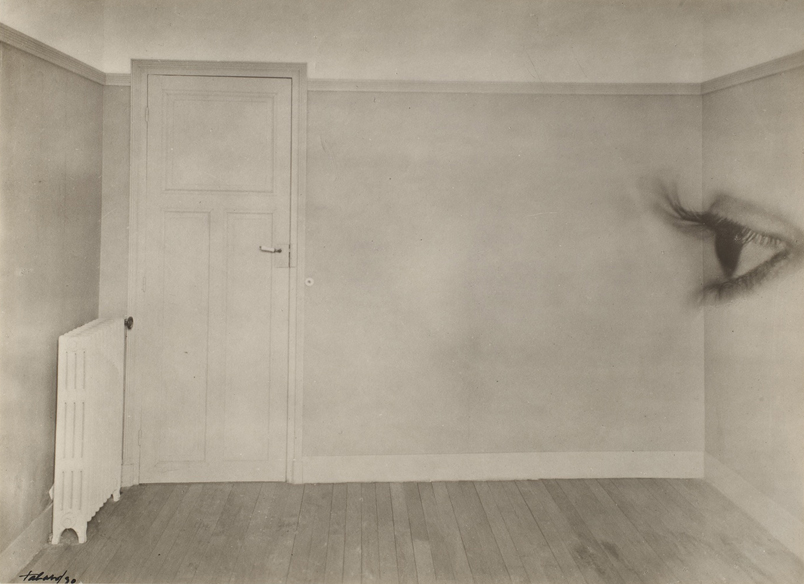
Pivoting off Edward Steichen's assertion that "Every photograph is a fake from start to finish," J. Hoberman takes note of a new photography exhibition, "Faking It," and ponders the medium's relationship to the truth:
Is photography a way of documenting the world that has an inherent “truth-claim” on the real? Or is it, as Steichen suggested, essentially graphic, a technique for creating a certain kind of image? “Faking It: Manipulated Photography Before Photoshop,” an exhibition now up at the Metropolitan Museum of Art (later traveling to the National Gallery and Houston’s Museum of Fine Art), makes a vigorous case for understanding the medium as Steichen did. The argument is amplified in the accompanying catalogue written by curator Mia Fineman, who, in effect, proposes a new truth-claim of her own: “Photography’s veracity has less to do with essential qualities of the medium than with what people think and say about it.”
According to Fineman, photography has been artificially enhanced almost from its advent in 1839. “Especially in the early days of the medium, producing a realistic-looking photograph often required a healthy dose of artful trickery,” she writes. Moreover, the familiar insistence on photographic objectivity is itself something that derives from the early twentieth-century emergence of photojournalism and social documentary—and also, we might add, of motion pictures. In that sense, photography is pre-modern as well as postmodern.
Check out a selection of photos from the exhibition over at Brain Pickings.
(Photo: Maurice Tabard, "Room with Eye," 1930. The Elisha Whittelsey Collection, The Elisha Whittelsey Fund, 1962. The Metropolitan Museum of Art. Used with permission of the MMA.)
 The Dish