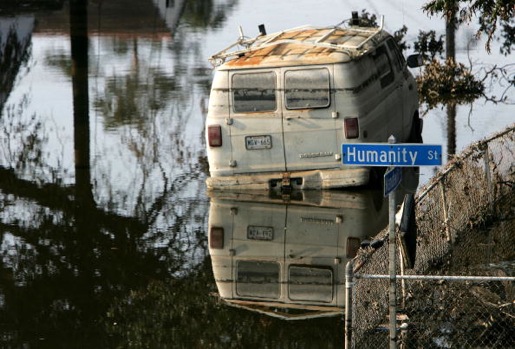
Reflecting on hurricanes Katrina and Isaac, Ingrid Norton mulls overs the futility of man-made defenses against nature's fury:
Chronicles of hurricane-prone regions tend to be strange mixtures of nostalgia, war stories, and amnesia. The same dramas are repeated each generation, the plots gradually shifted but not fundamentally altered by the ways residents and institutions adapt to the effects of storms. After Katrina, the Times-Picayune printed a nineteenth-century map of New Orleans next to a map of Katrina flooding: the areas that flooded the most had been sparsely inhabited in the nineteenth century. "I always say, if you learned lessons from Katrina, you didn’t know too much before," Windell Curole, general manager of the South Lafourche levee district, told me. In a 2010 report, he compared the post-Katrina focus on super strong levees to placing a passenger in a tank to protect from a car accident, and presciently noted that communities outside New Orleans were under protected.
(Photo: A partially submerged van is seen on Humanity Street in New Orleans, Louisiana on September 13, 2005. By Justin Sullivan/Getty Images)
 The Dish