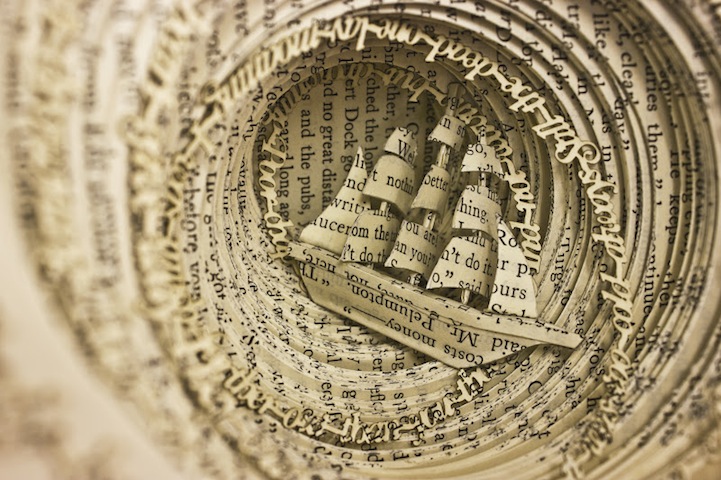
Ian McEwan extols it:
I believe the novella is the perfect form of prose fiction. It is the beautiful daughter of a rambling, bloated ill-shaven giant (but a giant who’s a genius on his best days). And this child is the means by which many first know our greatest writers. Readers come to Thomas Mann by way of “Death in Venice,” Henry James by “The Turn of the Screw,” Kafka by “Metamorphosis,” Joseph Conrad by “Heart of Darkness,” Albert Camus by “L’Etranger.” I could go on: Voltaire, Tolstoy, Joyce, Solzhenitsyn. And Orwell, Steinbeck, Pynchon. And Melville, Lawrence, Munro. The tradition is long and glorious. I could go even further: the demands of economy push writers to polish their sentences to precision and clarity, to bring off their effects with unusual intensity, to remain focussed on the point of their creation and drive it forward with functional single-mindedness, and to end it with a mind to its unity. They don’t ramble or preach, they spare us their quintuple subplots and swollen midsections.
Let’s take, as an arbitrary measure, something that is between twenty and forty thousand words, long enough for a reader to inhabit a world or a consciousness and be kept there, short enough to be read in a sitting or two and for the whole structure to be held in mind at first encounter—the architecture of the novella is one of its immediate pleasures. How often one reads a contemporary full-length novel and thinks quietly, mutinously, that it would have worked out better at half or a third the length. I suspect that many novelists clock up sixty thousand words after a year’s work and believe (wearily, perhaps) that they are only half way there. They are slaves to the giant, instead of masters of the form.
(The Medium is the Message by Thomas Wightman via My Modern Met)
 The Dish