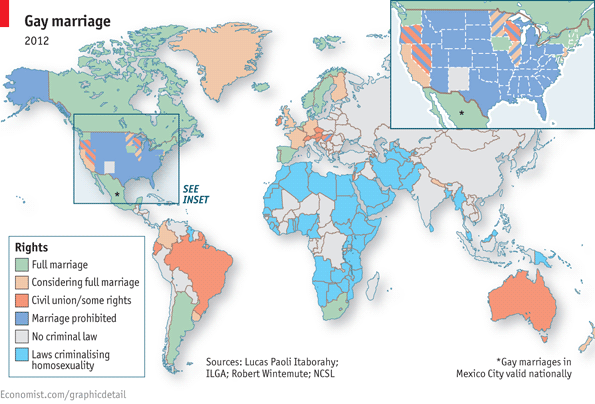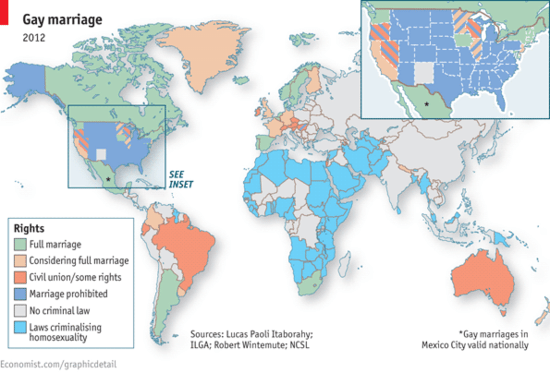
The Economist maps global marriage laws:
Same-sex marriage is now legal nationwide in 11 countries, including Argentina and South Africa, as well as in parts of a further two. In Mexico it is allowed in the capital. In America nine states and the District of Columbia have legalised it, including three which, for the first time, did so by popular vote on November 6th, ending a succession of electoral defeats for the measure in 32 states. In Catholic France the new Socialist government has just approved a bill to permit same-sex marriage. That said, in 78 countries—mostly in the Muslim world, Africa and other developing states—gay sex is still a crime, punishable by long prison terms and even death.
One more striking development in the US: Michigan residents now favor marriage equality by a double digit margin in new polling.
Sometimes I think the whole world is really a version of America's red and blue – but with the red much redder elsewhere (think Pakistan) and much bluer too (think Paris or Barcelona). Globally, we are witnessing an evolutionary shift about sex and marriage, men and women, gays and straights, blacks and whites and all the nuances in between. In the past, such shifts occurred gradually, as tradition reinvented itself in coherent societies. Today, with new media and a global economy, the conflicts and shifts that might be resolved gradually and peacefully in various societies at various stages of evolution, are unmissable and graphic everywhere at once. So you have both Victorian homophobia in Africa alongside the emergence of a gay rights movement in that continent. You have the web uniting the teens of Iran and Tunisia – but polarizing their own societies into modernists and fundamentalists (where the fundamentalists have the majority).
In some ways, this last election settled the red-blue issue in America, by rendering it a bluer shade of purple in several states. Here, we now know the fundamentalists, even when allied with others, are, in fact, a minority. And so the next phase of integration can begin. Elsewhere? The wars will rage on – prematurely on the ground, and far too late on the web. It's this aspect of the web that is often over-looked; it can break societal mores very easily; but it does not yet have the resources or reach in more traditional areas to rebuild them.
 The Dish