Kristen McConnell, a nurse, delivers a reality check:
It’s been said that dying is easy, and it’s living that’s painful. Not so in the world of intensive care. Patients who have a hope of recovering from their injury, genuinely surviving it, may be fighting to live. For them the torturous days as an ICU patient are required in order to surmount their injury. And there are always cases where nobody knows what the outcome may be, where the right thing to do is maintain physical function and give the body time to heal. Many patients will survive with deficits, will not return to their former selves but will be able to leave the hospital, go to rehab, begin the hard work of adjusting to another kind of life. But time and again we care for patients who are fighting to die, and having a very hard time of it, because in the ICU there are only two ways to die: with permission, too often not granted or granted too late, or in the last-ditch fury of a full code blue.
We are not helping these people by providing intensive care. Instead, we are turning their bodies into grotesque containers, and reducing their lives to a set of numbers monitoring input and output, lab values, and vital signs, which we tweak to keep within normal ranges by adjusting our treatments, during the weeks and days immediately preceding their death. This is the opposite of what should be prioritized when a person is known to be nearing the end of their life without the hope of getting well.
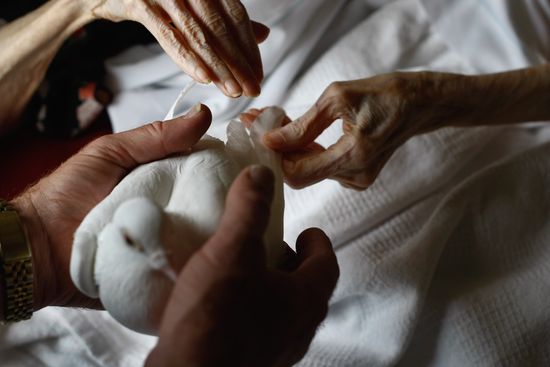
(Photo: Terminally ill patient Jackie Beattie, 83, touches a dove on October 7, 2009 while at the Hospice of Saint John in Lakewood, Colorado. The dove releases are part of an animal therapy program designed to increase happiness, decrease loneliness and calm terminally ill patients during the last stage of life. By John Moore/Getty Images)
 The Dish