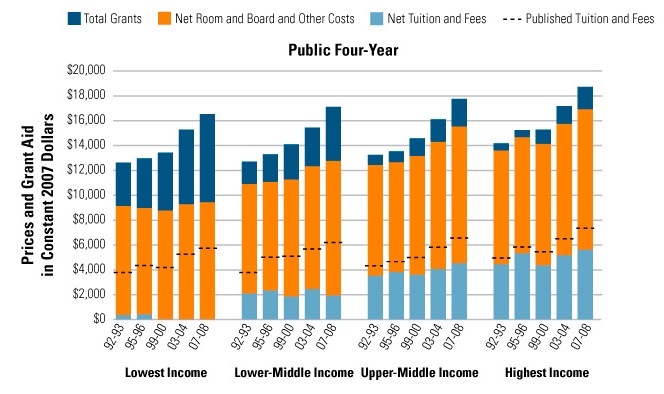
Evan Soltas argues that, overall, college costs haven't increased very much in the past 20 years. What has happened:
Wealthier families now pay more than ever to send their children to college. But for much of the middle class, the real net cost of college has not changed significantly; for much of the poor, the expansion of aid has increased the accessibility and affordability of a college education. Data from the College Board show effectively no change in real net tuition and fees for dependent students at four-year public or private universities whose families are in the lower-two income quartiles. There also have been some increases in the real cost of room and board, but for families with below-average income, the rise has been on the order of 20 percent over 20 years.
Kevin Carey has a different perspective:
[T]he odds of additional huge investments of federal money to offset future increases in college spending and state disinvestment are long indeed. Even the federal government doesn’t have enough money to bankroll the combination of constant college-spending increases and perpetual state-budget cuts forever. All of which means that net price will prove to be a temporary palliative to the college-affordability crisis. Structural changes in the industry’s underlying cost and revenue structures remain as needed as ever before.
 The Dish