
Googling Your Mind

Tom Simonite looks at Google's attempts to automatically provide information to users:

Contextual information provided by mobile devices—via GPS chips and other sensors—can provide clues about a person and his situation, allowing Google to guess what that person wants. "We’ve often said the perfect search engine will provide you with exactly what you need to know at exactly the right moment, potentially without you having to ask for it," says [Jon Wiley, lead user experience designer for Google search].

Google is already taking the first steps in this direction. Google Now offers unsolicited directions, weather forecasts, flight updates, and other information when it thinks you need them (see "Google’s Answer to Siri Thinks Ahead"). Google Glass—eyeglass frames with an integrated display (see "You Will Want Google’s Goggles")—could also provide an opportunity to preëmptively answer questions or provide useful information. "It’s the pinnacle of this hands-free experience, an entirely new class of device," Wiley says of Google Glass, and he expects his research to help shape this experience.

The Daily Wrap

GT NYCSANDYWORKER 20121127

Today on the Dish, Andrew took on Richard Cohen over the muscled modern man, joined Melik Kaylan in lamenting the Internet age's effect on privacy, joined readers in responding to ex-stoner Obama's silence on legal weed, supported Frederic Filloux's more sensible release schedules for TV shows and movies, and was awed by Einstein's brain and the "physical incarnation of human intelligence".

In political coverage, Chris Geidner examined this week's possible SCOTUS announcements regarding marriage equality, Massie broke down the civility gap between the US and UK, Hertzberg wanted to bust up the filibuster, Tom Ricks didn't apologize for calling Fox News a wing of the Republican Party, and we rounded up some responses to the left-leaning of Asian-Americans. Not forgetting the looming fiscal cliff, Stan Collender anticipated a nail-biter, while we also heard the ACA was already changing US healthcare for the better, aired more discussion about the demographic advantages of American immigrants, and explored Obama's possible kill-list hedge in the event of a Romney victory as well as contemplated the present state of America's autonomous killing machines.

In international coverage, we checked in on the massive anti-Morsi protests in Tahrir Square, readers thought through the logic of Israel's blockade of Gaza, the UK backed Palestinian statehood, and Marta Franco summed up the status of gay rights in India.

In assorted coverage, Tyler Cowen took apart Robert Solow, Phillip Cohen looked into the statistical relationship of violent crime to single motherhood, while Human Rights Watch disconnected violent crime from marijuana use, Allison Aubrey took us to war over nutmeg, John Quiggin deflated the importance of oil, and Emily Wilson noted the dangers of motherhood in ancient times. Also a reader suggested a Dick Morris Award for the sports world, McArdle and Yglesias mixed it up over the Walmart strike, Dolly Parton was mistaken for a drag queen, Ritwik Deo shared his perspective as a nimble-toed butler, and Jane Hu destroyed the myth of live-gerbil sex toys. We also wondered if 401(k)'s were just subsidizing the rich, learned not to expect electric brains outside of science fiction, saw Albanian pride on the FOTD, saw Winston-Salem through the VFYW, let readers zoom in on Chile in this week's VFYW contest, then watched as dogs and babies went at it in our MHB.

– C.D.

(Photo: A worker with the Department of Environmental Protection (DEP) works on the sewer system in the heavily damaged Rockaway neighborhood on November 27, 2012 in the Queens borough of New York City. The state of New York has said that Superstorm Sandy has cost upwards of $42 billion. This price, for which congressional leaders will make requests for federal disaster aid to help pay, includes $32 billion for repairs and restoration. By Spencer Platt/Getty Images)

Killing Machines

Last week, Human Rights Watch warned about "fully autonomous weapons, which would inherently lack human qualities that provide legal and non-legal checks on the killing of civilians." Spencer Ackerman sizes up the military's current technological limitations:

It’s reasonable to worry that advancements in robot autonomy are going to slowly push flesh-and-blood troops out of the role of deciding who to kill. To be sure, military autonomous systems aren’t nearly there yet. No Predator, for instance, can fire its Hellfire missile without a human directing it. But the military is wading its toe into murkier ethical and operational waters: The Navy’s experimental X-47B prototype will soon be able to land on an aircraft carrier with the barest of human directions. That’s still a long way from deciding on its own to release its weapons. But this is how a very deadly slope can slip.

Gary Marcus contemplates machine morality more generally:

An all-powerful computer that was programmed to maximize human pleasure, for example, might consign us all to an intravenous dopamine drip; an automated car that aimed to minimize harm would never leave the driveway. Almost any easy solution that one might imagine leads to some variation or another on the Sorceror’s Apprentice, a genie that’s given us what we’ve asked for, rather than what we truly desire. A tiny cadre of brave-hearted souls at OxfordYale, and the Berkeley California Singularity Institute are working on these problems, but the annual amount of money being spent on developing machine morality is tiny.

Fighting Back

A reader proposes a Dick Morris Award nomination:

I know that you are not much for talking about sports on the Dish, but an August 16 article by Rick Reilly, "Demoting Notre Dame," deserves a mention like no other this year. When I moved here from Ireland I figured that I should get into American sports and the obvious choice was Notre Dame. The last few years have been pretty grim with some horrible losses against poor teams and the Fighting Irish were generally written off. Reilly's piece was the most potent put-down of all:

If I told you about a team that had lost 10 of its last 12 bowl games, had dropped nine of its last 10 to USC, had led the nation only in disappointment, you'd figure that team would be halfway down the Mountain West standings. But Notre Dame still gets perks and love from the NCAA and BCS as though the year is 1946. Brian Kelly confers with one of his QB candidates, Everett Golson. I'm declaring an end to all that. In Europe, if you play too much bad soccer for too many years, you get "relegated" to a lower division, moved down, demoted. It just happened to the Blackburn Rovers. It needs to happen to Notre Dame football.

But how wrong can any one person be: an undefeated season, going to the national championship game and ranked number 1 in the nation. It has been an amazing ride and there is a definite sense of schadenfreude rereading articles such as Reilly's.

Update from a reader:

Your Notre Dame fan reader is getting a little ahead of himself.  

First, Notre Dame hasn't actually won anything yet, not even a conference championship since the school still fancies itself as some special-case above conference membership.  Second, Rick Reilly didn't actually say that Notre Dame wouldn't be relevant this year.  He says that IF they aren't relevant, they need to be relegated.  

Actual relegation is silly, but the situation in front of us is that Notre Dame has been relegated in all but the practical sense.  A whole generation of football fans looks quizzically at the phenomenon that is the perennial slurping of Notre Dame by fans, alums, and the media and probably wonders what the hell it's all about.  Before this year, they had not been practically relevant since the early '90s.  The closest thing they had to relevance was when a blowhard NFL offensive coordinator took over as coach and couldn't dig the program from the hole that it had made. 

The closest thing that Reilly said that's worthy of a Dick Morris Award is the comment about Notre Dame not being football royalty anymore, and in an era where Urban Meyer has won two championships in three years at Florida and Nick Saban did the same at Alabama (and could be competing for a third very soon), climbing back to #1 without actually having won anything yet does not put the crown back on your head.  

Which brings us to this year.  Notre Dame has played a decently hard schedule, but the team has hardly arrived at their perfect record by dominating its competition. Highlights include needing three overtimes to dispatch an unranked Pitt team and beating their rival USC when they were starting a freshman QB in his first game as a starter.  Not to mention that if they face Alabama in the title game, they'll probably be a considerable underdog.  As of a couple of weeks ago, Alabama was listed as a nine-point favorite over Notre Dame in a hypothetical matchup.  

If Notre Dame manages to repeat the kind of performance they had this year in the near future, then we can talk about them being football royalty again.  Otherwise, let's take it down a notch.

Oil Is Overrated?

John Quiggin argues that "oil is no more special or critical than coal, gas or metals—let alone food":

If oil is a commodity of modest importance, why does it loom so large in the thinking of U.S. policymakers and the general public? The answer, undoubtedly is the memory of the OPEC oil embargo imposed in retaliation for U.S. support of Israel during the Yom Kippur war of 1973. This shock was followed by months of queues and rationing, and by the double-digit inflation and high unemployment of the late 1970s.

Given this sequence of events, it was easy to conclude that control over oil exports is a powerful weapon in the hands of the OPEC states, and that shocks to the supply and price of oil represent a major cause of economic crises. Neither of these conclusions was correct at the time, and any validity they once had is long gone.

Walking Up To The Fiscal Cliff’s Edge

Stan Collender expects the fiscal cliff negotiations to go down to the wire:

Why is anyone surprised that no negotiating sessions on the fiscal cliff between the White House and Congress are scheduled this week? Why is anyone shocked that statements made about the cliff since Congress returned from the Thanksgiving recess seem to have gotten more strident rather than less? How is it possible that the two sides seem further apart now than they were a week or so ago?

The answer: It was both totally predictable and absolutely predicted. There will be no deal on the fiscal cliff before December 15 and from what I can see December 31 may be the better bet.

America Isn’t Filled To Capacity, Ctd

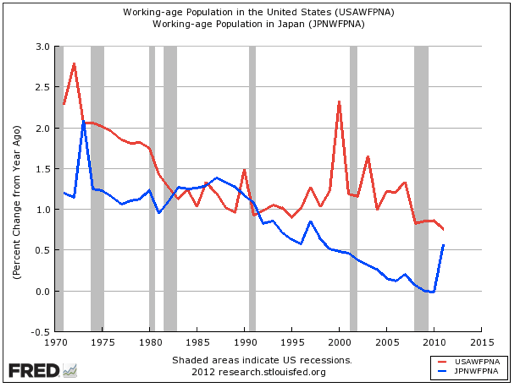
Japanvsusworkingagepop

Joe Wiesenthal compares US workforce demographics with Japan’s, finding that “Americans should be thankful” for a “demographic lift” that the latter country lacks. Alex Hern worries that America will lose this demographic advantage:

Japan’s demographic squeeze has been predicted and feared for a long time, but Weisenthal goes further by pinning a lot of hopes on America’s demographic health. Is he right? Time will tell, but one thing which is noting is that this demographic lift isn’t something which comes out of nowhere. In fact, it is something which, with the popular consensus around the need to limit immigration, is being actively fought by most US policymakers.

Pushing back on the bipartisan enthusiasm for attracting high-skilled immigrants, Noah Smith fears the implications for US higher-education costs:

Those immigrants will be great for the economy, but their kids are going to be competing with native-born kids for college spots. Unless we do something, that competition could cause a xenophobic backlash among the high-skilled native-born, as well as driving up tuition even further.

Reforming The Filibuster

Harry Reid reportedly wants to "diminish the power of Republicans to slow or stop legislation by putting limits on the filibuster." Hertzberg thinks we should kill it:

The filibuster is a bad idea when Democrats are nominally in charge, and it’s a bad idea when Republicans are in the supposed driver’s seat. Absent the filibuster, Congress would have passed meaningful climate-change and immigration reform, among other desiderata, by now. And, yes, President Reagan might have been able to abolish a federal agency or two back in the day. (He couldn’t even get rid of the tiny Legal Services Corporation.) Over time, the country will be better off if the parties can put their ideas into practice and be judged accordingly. As it is, neither side gets a fair shot, the voters never quite get what they voted for, and everybody complains about how politicians never keep their promises.