Shattering The Release Window

Driven to illegally downloading his new favorite show, "Homeland", Frederic Filloux wants to end release windows, or the amount of time between the airing of a TV show or movie and its availability online or through DVD:

Motion pictures should probably be granted a short headstart in the release process. But it should coincide with the theatrical lifetime of a production of about three to four weeks. Even better, it should be adjusted to the box office life – if a movie performs so well that people keep flocking to cinemas, DVDs should wait. On the contrary, if the movie bombs, it should be given a chance to resurrect online, quickly, sustained by a cheaper but better targeted marketing campaign mostly powered by social networks.

Similarly, movie releases should be simultaneous and global.

I see no reason why Apple or Microsoft are able to make their products available worldwide almost at the same time while a moviegoer has to wait three weeks here or two months there. As for the DVD release windows, it should go along with the complete availability of a movie for all possible audiences, worldwide and on every medium. Why? Because the release on DVD systematically opens piracy floodgates (but not for the legitimate purchase on Netflix, Amazon Prime or iTunes).

I've effectively stopped "going to" the movies, because TVs are as good, if not as giant, and because I don't like crowds, can stop the movie at home to take a pee or grab some munchies, and rewind parts I didn't quite catch.

And I think all the publicity and promotion for movies would be more productive if reviews came out and potential viewers could all watch it the same night. Movie theaters would go the way of books in a Tablet world. They'd be for purists, nostalgics and those who need the big movie event experience. But increasingly, with HD and 3D TVs competing, you need an Imax to really get the full benefits of physical scale.

I think a huge market exists for people who read a review on Friday morning and download it Friday night. Because they have to wait their attention wanders. Then the movie is out of theaters for a while. By the time it's available on your TV, all the marketing money is essentially useless. I'm sure movie-theaters want to resist the direct-to-viewer streaming and downloading. But so did Blockbuster.
Why Does Greater Israel Blockade Gaza’s Exports? Ctd

A reader writes:

My guess is that they are cracking down on exports to keep Hamas in theory from purchasing weapons with monies earned from basic capitalism. Never mind that the rockets and other weaponry are being smuggled in free of charge, but my guess is that you will get that answer from Israel if anyone bothered to ask.

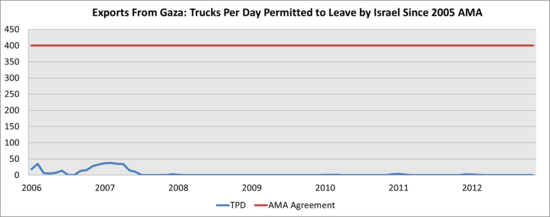
Yousef Munnayer cites the 2005 agreement that Israel signed agreeing to up to 400 trucks of exports a day by 2006. Here's what actually happened in graph form (the red line is the agreement; the blue ine is Israel's follow-through):

Gaza Exports

He concludes:

Note the total failure to meet the 150 TPD commitment by 31 December 2005, let alone the 400 TBD by end of 2006, or ever. Keep in mind, Israel's failure to keep this commitment regarding exports precedes Hamas' electoral victory on 26 January 2006 and their solidification of control in the strip in June 2007.

This isn't about Hamas, this isn't about security. This is about punishing the Palestinian people of Gaza by crippling their economy.

Another reader adds:

Isn't the FAR more interesting question: Why does EGYPT blockade Gaza at all? After all, if Egypt maintained no blockade, Israel could hardly enforce one. Why is all the pressure on Israel? We give a huge amount of aid to Egypt, too. Or am I completely missing something? I never, ever see this discussed – MSM or elsewhere. If Egypt is perfectly fine with the blockade, then why does Israel bear the sole blame for it?

Why Do Asian-Americans Increasingly Lean Left? Ctd

Income_Education_Demographics

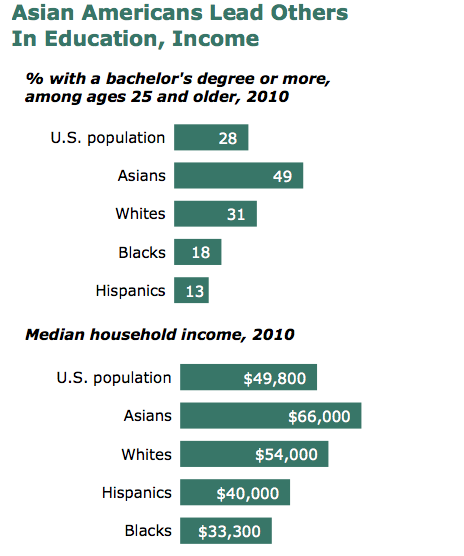
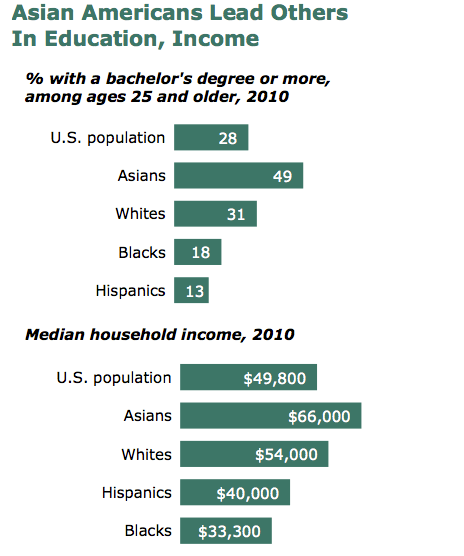
Charles Murray reframes the discussion:

It’s not just that the income, occupations, and marital status of Asians should push them toward the right. Everyday observation of Asians around the world reveal them to be conspicuously entrepreneurial, industrious, family-oriented, and self-reliant. If you’re looking for a natural Republican constituency, Asians should define “natural.”

Murray ultimately answers that Asians vote overwhelming for Democrats because they see Republicans as "as the party of Bible-thumping, anti-gay, anti-abortion creationists," a characterization he deems "ludicrously inaccurate." Weigel counters:

If I'm a non-Latino white conservative in West Virginia or Kentucky or Arkansas, it's clear that the GOP best reflects my social values. And so I voted for the party this month, powering it to big gains in my state. You could view the "why X group votes Y way" debate this way — why do whites vote for the party that best represents them on a range of issues? Instead, Murray treats whites as the logic-based control group, and asks why non-whites don't approach the vote quite as logically.

Richard Posner argues that culture is a key factor:

If voting is thought of in expressive terms, it becomes possible to understand why Asian Americans should have favored Obama so decisively…. [T]he strongest support for the Republican Party is now found in the southern states (a striking historical reversal), especially in suburban or rural areas, and it is easy to see how Asian Americans, who are concentrated on the East and West Coasts and in cities, might tend to find Southerners culturally alien. 

(Chart from (pdf) Pew)

The Walmart Strike, Ctd

McArdle argued that Walmart can't afford to increase worker wages significantly. Yglesias counters:

Wal-Mart's profit margins, though by no means enormous, are larger than those of its main competitors. Given the weak national labor market, Wal-Mart has no reason to cough up extra money to its workforce. But a strong labor union could coerce them into coughing up higher pay and bringing their margins in line with Costco and Macy's. As a result, each Wal-Mart employee might get a bit less than $3,000 more a year. Whether that's "life-changing" or not is an interesting question, but since we're talking about low-wage workers here, I think the intuitions of highly paid professionals may be a bit off. It seems very plausible that the marginal hedonic value of a thousand bucks or three to Wal-Mart's workforce would be very large.

McArdle goes another round:

Walmart is not just a poor man's Costco. They're very different businesses, with very different labor models, demographics, and revenue streams. And those things work together: the fact that Costco is doing great with a given labor model or profit margin does not therefore mean that Walmart could easily follow the same course. With depressing regularity, you see pundits and activists asking "Why can't Walmart be more like Costco", which is a little like asking why Malcolm Gladwell can't be more like Michael Jordan. I mean . . . um . . . where do I even start?

A Return To Tahrir?

GT TAHRIRSQUAREPROTEST 20121127

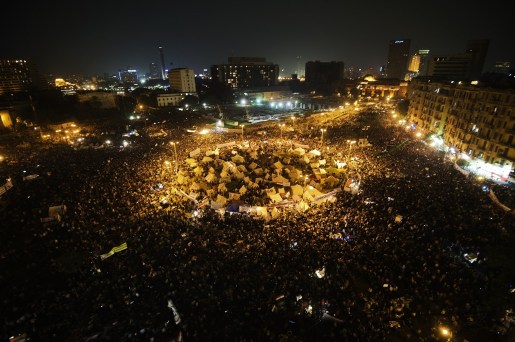
More than 100K protesters took to Tahrir Square today against President Morsi’s recent power grab. Video here. Abdel-Rahman Hussein reports from the scene:

[Many] marchers – who took to the streets in numbers similar to those that toppled Mubarak – called for Morsi not merely to rescind his decree but to step down from the presidency. The iconic chant of the 2011 revolution – “The people want to bring down the regime” – was echoed in other major Egyptian cities, including Alexandria and Suez. Police continuously fired tear gas not far from Tahrir Square, and fighting between police and protesters continued nearby even while people continued to mill in. 

Al Jazeera catches us up on yesterday’s developments:

On Monday, Morsi met with the nation’s top judges and tried to win their acceptance of his decrees. But the move was dismissed by many in the opposition and the judiciary as providing no real concessions. The senior judges that were in that meeting with Morsi on Monday night “are right now in an emergency session, trying to come up with one united stance – an answer to that meeting”, according to our correspondent. Presidential spokesperson Yasser Ali, said Morsi told the judges that he acted within his rights as the nation’s sole source of legislation, assuring them that the decrees were temporary and did not in any way infringe on the judiciary. He underlined repeatedly that the president had no plans to change or amend his decrees.

It appears that most of the country’s judges have gone on strike. Michael Wahid Hanna contends that “Morsi’s majoritarian mindset is not anti-democratic per se, but depends upon a distinctive conception of winner-takes-all politics and the denigration of political opposition.” He continues:

As opposed to mustering a more durable and broad-based consensus for change and reform, Morsi’s fateful step ensured that the divisions that have marred the post-Mubarak era will only be heightened and more irreconcilable. More broadly, this recurrent pattern raises fundamental questions about the Brotherhood’s commitment to an inclusive democratic process in which compromise and consensus are necessary ingredients. At root, the Muslim Brotherhood believes that it represents the authentic voice of Egyptian society and that its years of repression and its impressive electoral victories have invested it with the right to implement its agenda. As opposed to undertaking the arduous and difficult task of negotiating consensus outcomes, the Brotherhood now seems intent on eschewing the give and take of democratic politics and monopolizing political power. Egypt may step back from the brink yet again, but Morsi’s ill-conceived gambit will have poisoned the body politic and exacerbated the chronic and manifest flaws of the country’s transition. At a moment when a consensus outcome is most needed, that possibility will have been foreclosed.

Steven Cook expects the protests to continue:

No one doubted that there would be setbacks in Egypt’s transition, but Morsi and his Brothers have failed to grasp that after 60 years of suffering under strongmen, Egyptians will not tolerate authoritarian detours in the name of democracy. Wasn’t the State of Emergency temporary? Weren’t Mubarak and the National Democratic Party always employing authoritarian measures “to prepare the country for democracy”? For the Egyptians who have turned out into the streets to protest Morsi’s decree, it all seems depressingly familiar, right down to the violence the government has employed to suppress them.

The Guardian is live-blogging.

(Photo: Tens of thousands people take part in a mass rally against a decree by President Mohamed Morsi granting himself broad powers on November 27, 2012 at Egypt’s landmark Tahrir Square in Cairo. By Gianluigi Guercia/AFP/Getty Images)

Quote For The Day

“They had a bunch of Chers and Dollys [in the drag show] that year, so I just over-exaggerated — made my beauty mark bigger, the eyes bigger, the hair bigger, everything. So I just got in the line and I just walked across, and they just thought I was some little short gay guy…and I got the least applause! … It’s a good thing I was a girl or I’d be a drag queen,” – Dolly Parton.

Are 401(k)s “A Tax On The Unaware”?

Matthew O'Brien squares the findings of recent research on Danish tax-exempted retirement accounts with the $240 billion annually that the US government loses to 401(k) tax exemptions:

[O]ne penny's worth is exactly how much extra saving a dollar's worth of retirement subsidies produced in Denmark, according to [the study]. In other words, we might be spending $240 billion to get people to save $2.4 billion more.

But don't the trillions of dollars in 401(k) accounts tell a different story? Not necessarily…. Households save where the subsidy is, but don't save more because of the subsidy…. It's mostly the well-off, who have retirement savings to move around, who move their savings to where the subsidies are. The 401(k) doesn't do much if your goal is to get people who don't save much to save more, and it doesn't do this at quite the cost. 

Ray Fisman echoes this point:

In a recent conversation with me, [Romney economic adviser Glenn] Hubbard echoed the study’s sentiments that 401(k)s and IRAs are essentially subsidies to relatively wealthy households that are well-informed enough to take advantage of them. Or, in Hubbard’s words, these types of programs act as “a tax on the unaware.”

The implications for the current moment in fiscal negotiations:

[T]he biggest takeaway from this study may be that we don’t need across-the-board cuts in deductions or exemptions—they’re not all created equally. Some—like savings tax shelters—starve the government of tax revenue without doing much to encourage retirement savings or furthering other policy objectives. Distinguishing which well-meaning programs accomplish their objectives and which ones misfire is a delicate task. 

And a necessary one. The fiscal cliff is as much an opportunity as a crisis. Ridding the code of as many tax expenditures that have simply become encrusted tools of the privileged is a great place to start. Previous Dish coverage here, here and here.