Pot Smokers Aren’t Particularly Violent

Marijuana_Convictions

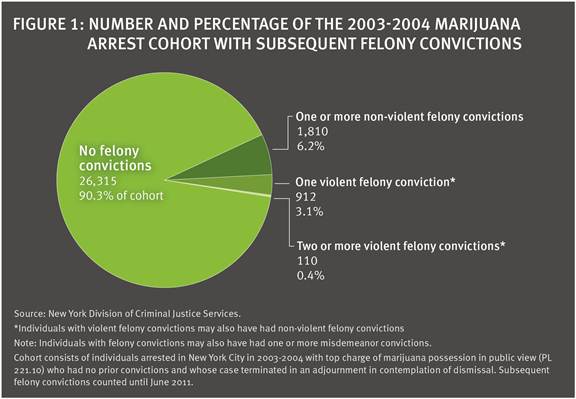
Human Rights Watch examined the recidivism rates of NYC residents arrested for possession of marijuana:

We tracked through mid-2011 the criminal records of nearly 30,000 people without prior criminal convictions who were arrested in 2003 and 2004 for marijuana possession. As shown in the figure [above], we found that 3.1 percent of them were subsequently convicted of one violent felony offense during the six-and-a-half to eight-and-a-half years that our research covers; 0.4 percent had two or more violent felony convictions. That is, 1,022 persons out of the nearly 30,000 we tracked had subsequent violent felony convictions. Ninety percent (26,315) had no subsequent felony convictions of any kind.

Furthermore:

There is no readily available data on the rates of felony or violent felony conviction for comparable demographic groups in New York City who do not enter the criminal justice system on marijuana charges. But the rate of felony and violent felony conviction among this group of first-time marijuana arrestees appears to be lower than the rate of felony conviction for the national population, taking into account age, gender, and race.

The Kink That Wasn’t There

Jane Hu separates fact from fiction in the non-history of gerbiling:

Not too long after the gay gerbiling rumor made its splashy early 80s debut, Doctors David B. Busch and James R. Starling published a surgical-stats report in Surgery titled "Rectal Foreign Bodies." This 1986 article, which gathered information from prior literature on Rectal Foreign Bodies (or RFOs), is the most frequently cited scientific document when it comes to gerbiling. Busch and Starling tabulated 182 cases by type and number of objects, among which included two whip handles, one plastic rod, one bottle with an attached rope, and one frozen pig's tail. No gerbils, though. Not even a tail.

Hu traces the myth's origin to the AIDS epidemic:

At the start of the 80s, gay men were already perceived as socially and sexually deviant. And if anything is not a secret, it's how especially openly homophobic American culture was throughout this decade. With the addition of AIDS and its attendant narrative of Gay Desires Being Punishable By Death, there seemed to be concerns in the mainstream that maybe gay people, already alienated, weren't being alienated quite enough. Toss interspecies sex with small dirty rat-like creatures into the mix, and you simply get a variation on a theme: gay sexuality as a realm plagued with abnormality, shame-inducing behaviors, and incomprehensible stupidity.

Chart Of The Day

Cohen singlemomchart2 thumb 615x590 106252

Philip Cohen interprets it:

Violent crime has fallen through the floor (or at least back to the rates of the 1970s) relative to the bad old days. And this is true not just for homicide but also for rape and other assaults. At the same time, the decline of marriage has continued apace. 

He adds:

I've written before about the assumption that the rise in single-parent families was responsible for the violent crime bonanza of the 1980s and 1990s. (Romney and Ryan returned to this theme….) By my reading of the research, it is true that children of single mothers are more likely to commit crimes. But other factors are more important. 

Nutty For Nutmeg

The colonial powers certainly were, explains Allison Aubrey, leading to many blood confrontations over control of the spice:

So, why was nutmeg so valuable? … It was fashionable among the wealthy. It was exotic and potent enough to induce hallucinations — or at least a nutmeg bender, as detailed in this account from The Atlantic. "Nutmeg really does have chemical constituents that make you feel good," explains culinary historian Kathleen Wall of the Plimoth Plantation.

How the nutmeg wars wound down:

In the 1600s, "the Dutch and the British were kind of shadowing each other all over the globe," explains Cornell historian Eric Tagliacozzo. They were competing for territory and control of the spice trade. In 1667, after years of battling, they sat down to hash out a treaty.

"Both had something that the other wanted," explains [culinary historian Michael] Krondl. The British wanted to hold onto Manhattan, which they'd managed to gain control of a few years earlier. And the Dutch wanted the last nutmeg-producing island that the British controlled, as well as territory in South America that produced sugar. "So they [the Dutch] traded Manhattan, which wasn't so important in those days, to get nutmeg and sugar."

Previous Dish on nutmeg as reacreational drug here.  

A Modern-Day Jeeves

Ritwik Deo describes his time as a butler:

[T]he art of the modern butler is altruism at its best. Butlers live a life of anticipation. Whether the silver-haired administrator butler at a large estate or a housekeeper butler at a dual-income middle-class home, he or she is marked by a remarkable devotion to service. Ever nimble-toed, the efficient manservant can scurry like a dormouse through a lounge full of broken crockery, scooping, clearing and dusting even as the guest rests undisturbed, couched in a chesterfield with the latest edition of the Esquire at his elbow and a tawny port by his side.

The Perils Of Ancient Motherhood

Emily Wilson reviews a spate of books on motherhood, among them Mothering and Motherhood in Ancient Greece and Rome:

Even male authors of antiquity were aware that motherhood was a very dangerous business, for women as well as for men and babies. Those who survived to adulthood must have been conscious that their mothers could have died giving birth to them; men must have been aware that fathering children on their wives could, and quite likely would, kill them. Orestes, who kills his mother in adulthood, is supposedly justified in his action, because he is avenging his father – and the Oresteia itself can be read as, among other things, an attempt to justify matricide and fatherhood (which are, revealingly, linked together). But the cultural background of the play includes the awareness that children very often "kill" their mothers, simply by being born; and husbands often "kill" their wives by making them pregnant.

Gay Equality In India

156921370

Marta Franco checks in on the pace of progress:

[A]fter more than a century of being spurned by their families, reviled in public and harassed by police, India’s gays and their supporters say [2009's] 377 ruling [decriminalizing homosexuality] is encouraging a gradual emergence from the shadows. "They’re not so open with their families yet, but they feel relatively more free now," said Anand Grover, lawyer and director of the Lawyers Collective HIV/AIDS Unit. While the situation remains difficult for many homosexuals, particularly in rural areas, Grover points to the new gay tourism market, the spread of queer parties at nightclubs, and the rising divorce rate among gay men who had previously been pressured to marry women.

And a cultural shift is gradually underway:

Gay-themed businesses are opening in areas where they once would not have dared to flaunt their sexuality. In 2011, the soap opera Maryada: Lekin Kab Tak? (Honor: But at What Cost?) became the first TV serial to feature an openly gay character. Gay protesters have jettisoned the masks they used to protect their identities during equal-rights marches. Talk shows feature questions about homosexuality and venues host events explicitly marketed for gays and lesbians.

Previous coverage on the emergence of gay publishing here.

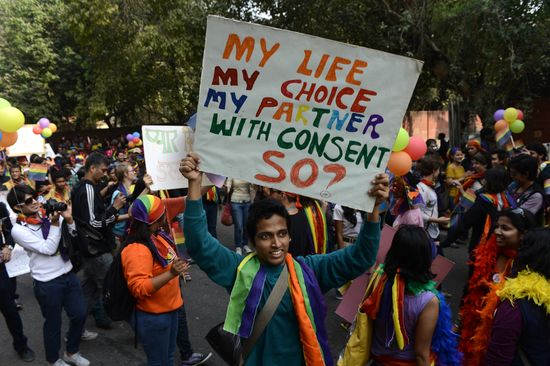
(Photo: Members of the lesbian, gay, bisexual, transgender (LGBT) community and supporters attend the 5th Delhi Queer Pride parade in New Delhi on November 25, 2012. Marching in solidarity and in celebration of their diversity, the LGBT community demanded equal legal, social and medical rights. By Sajjad Hussain/AFP/Getty Images)

An Electric Brain

Don't expect one any time soon:

At present, we still know too little about how individual neurons work to know how to put them together into viable networks. For more than twenty-five years, scientists have known the exact wiring diagram of the three hundred and two neurons in the C. Elegans roundworm, but in at least half a dozen attempts nobody has yet succeeded in building a computer simulation that can accurately capture the complexities of the simple worm’s nervous system. As the N.Y.U. neuroscientist Tony Movshon notes, "Merely knowing the connectional architecture of a nervous system is not enough to deduce its function." One also needs to know the signals flowing among the elements of neural circuits, because the same circuit can perform many different functions under different circumstances. By extension, building a device whose wiring diagram mimics the brain (e.g. Markram’s Blue Brain) does not guarantee that such a device can simulate the brain in any useful way.

The Daily Wrap

GT EGPYTFUNERALGABERSALAH 20121126

Today on the Dish, Andrew appreciated Bruce Bartlett's ballsy reason-following, warmed up a bit to New York City, reiterated the real-world incompatibility of Israeli settlements, and didn't buy Walter Russell Mead's dispassionateness about Gaza. In other Middle East coverage, Beinart grimaced at the Palestinian Authority's UN statehood bid, Sarah A. Topol reported on Gaza's many border tunnels, and we rounded up analysis of President Morsi's power grab in Egypt.

In political coverage, David Corn pointed out Obama's fiscal backbone, Eliza Gray let us see the GOP's Univision problem, Pareene did a postmortem on Campaign 2012's Twitter humor, and Rick Hertzberg did the math to unravel the House GOP's mandate claim. Meanwhile, readers shared the political views from their Thanksgivings, Surowiecki advocated for more infrastructure spending, Frum anticipated a changing Obama/GOP dynamic, and Mark Mazower took liberal intellectuals to task for ignoring controversial political theories. We also wondered about healthcare cost reductions via Obamacare, Lauren Sandler broke down the fertility divide between red and blue states, Rick Perlstein reflected on dishonest conservative leadership, and Bill McKibben highlighted the partial success of anti-coal environmentalism.

In assorted coverage, Benjamin Wallace-Wells thought through the ramifications of a possible end to the war on drugs, The Economist went over the dropping murder rate in Mexico, Mike Konczal worried about the high incarceration rates of black parents, and Radley Balko was encouraged by new police training on how to better handle pet dogs in the field. David P. Barash dug for the biological roots of homosexuality, William Langewiesche let us know what it was like to be in the French Foreign Legion, Daniel Siedell suggested the cause and effect of artists acting weird, and Randall Fuller championed the literary rebellion of Melville, Dickinson and others. Also, McArdle dismissed the Walmart strike, Rebecca Joines Schinsky took us to tumblr for some unhelpful Amazon product reviews, and Bilge Ebiri reality-checked the schemes of Bond-villains, while we looked forward to gamers becoming surgeons, traveled to Seville for the VFYW, watched a man's clothes drop in our MHB, and waited with our FOTD for a polluted-fish meal.

Extra-long Thanksgiving weekend wrap here.

– C.D.

(Photo: Egyptian Activists and April 6 movement members carry the coffin of Gaber Salah, a sixteen-year-old activist who died overnight after he was critically injured in clashes near Cairo's Tahrir Square last week, during his funeral at Tahrir square on November 26, 2012 in Cairo. Salah, a member of the April 6 movement known by his nickname 'Jika', was struck by birdshot in confrontations between police and protesters on Mohammed Mahmud street where he and others had been marking the first anniversary of previously deadly clashes. By Mahmud Khaled/AFP/Getty Images)
After The War

Benjamin Wallace-Wells imagines a possible end to the war on drugs:

The prohibition on drugs did not begin as neatly as the prohibition on alcohol once did, with a constitutional amendment, and it is unlikely to end neatly, with an act of a legislature or a new international treaty. Nor is the war on drugs likely to end with something that looks exactly like a victory. What is happening instead is more complicated and human: Without really acknowledging it, we are beginning to experiment with a negotiated surrender.

He predicts a complicated readjustment:

America’s prior experience with alcohol prohibition can tell us something about the economics of what might happen in Colorado and Washington. But alcohol was only briefly illegal, and so when prohibition was revoked, the culture and economy of legal consumption could return, almost as if they had always been there. There is no similar memory of the neighborhood marijuana café, no history of the harmless, corporatist transit of cocaine through Central America. In its long tenure behind the line—in the United States and beyond—the drug traffic has acquired its own culture, hierarchy, and distinct habits.