Face Of The Day

156977709

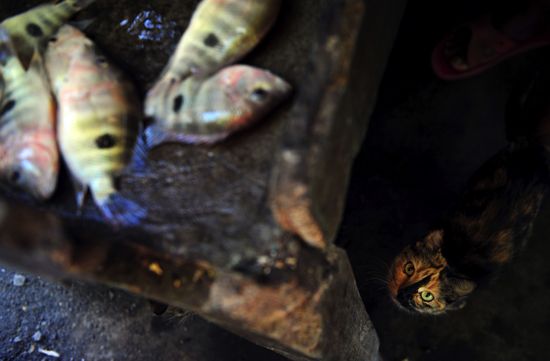
A cat waits while Nicaraguan Arturo Garcia cleans the fish given to him by fishermen at Xolotlan Lake, also known as Lake Managua, one of the biggest and most polluted in Nicaragua, in Tipitapa, some 20 km from the capital, on November 26, 2012. The administration of President Daniel Ortega three years ago obtained international funding to restore the lake back to health, where it is estimated that over a thousand fishermen fish. By Hector Retamal/AFP/Getty Images.

If The Economy Booms

Frum expects the political landscape to change:

1) President Obama will begin to claim more credit. In 2012, the word "stimulus" went unmentioned by Democrats. It was Republicans who tried to make political use of the $800 billion spent on job creation in 2009-2011. In 2013-2014, however, the shoe may suddenly rematerialize on the other foot.

2) Republicans will discover that their old "Obama isn't working" theme has become obsolete. By 2014, again assuming that Congress does not leap off the fiscal cliff, it will likely look as if Obama is working. What then? If negative messaging failed in 2012, it will fail bigger in 2014.

Chart Of The Day

Children_of_inmates

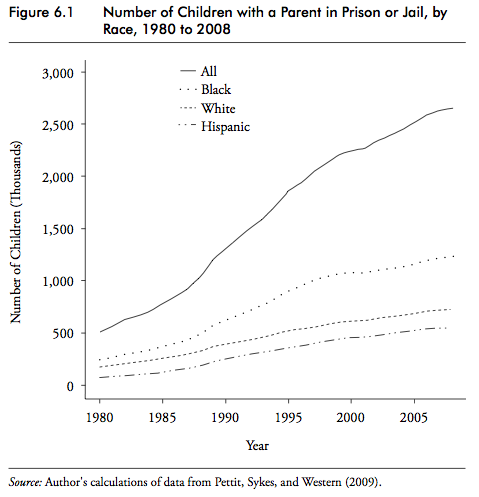
Mike Konczal points out that "24% of black children will have had a parent behind bars by age 17, an eightfold increase since 1980":

There aren't definitive answers for how incarceration changes family structure, though there is evidence that incarcerated fathers are less like to be cohabitating or marrying a year after their child's birth. And incarceration increases the liklihood of divorce. But we don't have full answers, in part because the incarcerated fall off the government's radar for data collection.

Preventing Puppycide

Two Texas police departments are training their officers to properly deal with dogs they encounter while on the job. Radley Balko welcomes the news:

Without training, the cop who fears dogs will continue to fear them, will continue to interpret benign gestures from dogs he encounters as a threat, will continue to shoot dogs, and will continue to be excused for it. With training, he gets over his fear, or at least learns how to deal with. He doesn't panic when a dog gets territorial, because he's been given instruction on how to recognize and distinguish that from aggression, and now has the know-how to deescalate the situation and put the dog ease.

Without training, the sadisitc or power-tripping cop can continue to kill dogs for whatever reasons might motivate a sadistic or power-tripping cop to do so. He'll continue to falsely claim he feared for his safety, and he'll continue to get away with it. With training, there's now some accountability. Now, the next time he kills a dog, he can be asked why he didn't resort to the other options he learned in his training. If it's a small or docile breed, he no longer has an excuse, and the police department no longer has an excuse not to discipline him. (Okay, so at least in theory.)

Balko's earlier coverage of puppycide is rounded-up here.

Is Mexico’s Crime Wave Ebbing?

Mexican_Violence

The Economist checks in on the situation:

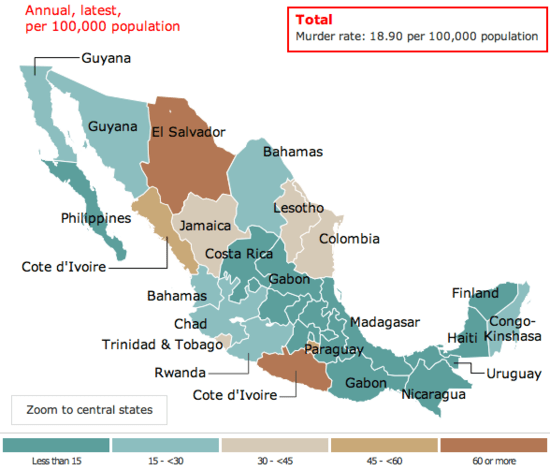
Many parts of Mexico, including its gigantic capital, are relatively peaceful, so the country’s overall murder rate is still no higher than Brazil’s and much lower than much of Central America’s. Yucatán, the quietest state, is statistically as safe as Finland. But very few places are unscathed by the trend: nearly all states saw more killings last year than five years earlier. Polls show that insecurity is Mexicans’ biggest worry.

Now, for the first time since murders began to soar in 2008, the rate is subsiding. In the first nine months of this year killings were 7% down on the same period in 2011. Twenty of Mexico’s 31 states recorded a decline. In Juárez Mr García’s mortuary is back to handling about 40 bodies a month, little more than during what juarenses still know as the “pre-war” years. Mr Calderón describes the past year as a “turning point” for the country, but cautions that it took Colombia many years to bring its murder rate under control. In Juárez people once again drive with their windows rolled down and eat their burritos on the pavement, but achieving the same results elsewhere will not be easy.

The above chart matches the murder rates in Mexico's states to the murder rates in various countries. Interactive version here.

Why Do Artists Behave So Strangely?

Daniel Siedell offers an answer:

A painting is a weak and vulnerable thing because it is just not necessary. Smelly oil paint smeared across a canvas cannot be justified in this conditional, transactional world. Yet vast, complex institutions and networks have emerged to do just that, whether through the auction house (art as priceless luxury item), the museum tour (education), or the local chamber of commerce (art as community service, cultural tourism, or urban revival). That art is ultimately gratuitous, that its existence is a gift to the world, creates anxiety and insecurity in the art world. Everyone involved, from art collectors and dealers to critics and curators have to justify their interest in this seemingly “useless” activity—and justify the money they make or spend on its behalf. Art simply cannot be justified.

He argues that, in response, "many artists cultivate a certain kind of behavior—craft a social role—that simultaneously justifies and protects their work, offering a marker for art collectors, curators, dealers, and critics, while releasing them of the burden to have to explain or defend each work they produce."

The Consequences Of Blockade

Gaza_Tunnel-Gt

Sarah A. Topol covers Gaza's tunnel industry:

“As long as we have any blockade, we have tunnels,” says Sameer Abumdallala, dean of the economics department at the Al Azhar University in Gaza, who has studied the tunnel sector. “In each war, they destroy some tunnels, and it affects specific workers, but it doesn’t change the industry.”

Abumdallala says there are now roughly 2,000 tunnels, up from 50 passageways that dealt mainly in weapons and drugs prior to the Israeli-led blockade in 2007. The industry employs between 12,000 to 15,000 Gazans, and most tunnels operate in two shifts, 24 hours a day, providing a much-needed lifeline in all kinds of goods—from food stuffs to building materials, like wood, metal, and cement.

Yglesias flags a paper on the blockade by Assaf Zimring. From the abstract:

This paper uses detailed household expenditure and firm production data to study the welfare consequences of the blockade on the Gaza Strip between 2007 and 2010. Using the West Bank as a counterfactual, I find that being removed from world markets reduced welfare by 17%-28% on average.

(Photo: A Palestinian man emerges from a smuggling tunnel along the Gaza-Egypt border in Rafah, in the southern Gaza Strip on November 25, 2012. Egypt's closure of scores of cross-border smuggling tunnels has affected the flow of goods into Gaza but has not dealt the knockout blow widely expected by traders and officials. By Said Khatib/AFP/Getty Images)
Unpopular By Design

Randall Fuller reviews Michael Kearns Writing for the Street, Writing in the Garret, which details the ways Herman Melville and Emily Dickinson turned "their backs on antebellum America’s burgeoning mass audience" and imagined "themselves as romantic artists governed solely by inspiration." How their example resonated in the literary efforts that would follow them:

Although Kearns focuses exclusively on Melville and Dickinson, his book is suggestive for the way in which both authors serve as forerunners to the twentieth and early twenty-first centuries. It was precisely their distaste for a mass audience—which they viewed as degraded by the yellow journalism of daily newspapers and magazines—that impelled modernist writers such as T. S. Eliot, Ezra Pound, Gertrude Stein, and others to produce difficult works meant to distance themselves from the democratic readers of their period. Their solution to the problem of producing art in a democratic society has sent generations of students through the thickets of footnotes and reference guides.

Liberal Triumphalism

Mark Mazower reviews Alan Ryan's On Politics, a wide-ranging survey of the history of Western political thought, and finds the effort emblematic of the genre's limitations:

To my mind, the merits of studying Plato, Aquinas or Hobbes are clear. What is less defensible, however, is the idea that a liberal tradition can survive that does not engage seriously with its challengers and does not at least acknowledge, in a changing world, the existence of parallel traditions that have tackled similar and often identical problems in strikingly different ways.

The basic intellectual problem is this: once you have defined the central issue of politics as the preservation of liberty within a political community, absolutism, fascism and religious fundamentalism can easily present themselves as phenomena of essentially negative interest. Yet fascism, for example, produced, in the writings of Carl Schmitt, a theorist of considerable power who provided a searing critique of parliamentary democracy. His definition of politics saw liberty as a distraction and revolved instead around the friend/foe distinction. One may disagree with this, but one has to take it seriously. Yet Ryan’s treatment of fascism and Nazism remains trapped within an older historiography that sees the most important thing about these movements as their irrationalism. Today most historians would regard their challenge to interwar liberalism as much more serious than this “irrationalism thesis” acknowledges. And as a result it seems downright odd to have a history of political thought that does not engage more fully with some of Schmitt’s ideas.