The Weekend Wrap

Wraptgiving

This weekend on the Dish, we explored the Thanksgiving holiday and its capitalist corollary, Black Friday, along with providing our usual literary and cultural coverage.

In Thanksgiving coverage, Mark Perry celebrated America's abundance of affordable food, Anna Spiegel outlined the process by which the turkey President Obama pardoned was chosen, Michaeleen Doucleff was impressed by an algorithm that predicts how successful a recipe will be, Tara Parker-Pope fact-checked diet food companies' claims about Thanksgiving caloric intake, and farm-bred turkeys turned out to be both threatened by climate change and subjected to cruelty on their way to your table. Stephen Marche urged us to ignore the foodies and indulge in Thanksgiving feasting, Elizabeth Gunnison explained how to salvage burned dishes, Rosecrans Baldwin deemed Thanksgiving a holiday for adults, and Shamus Khan provided a short history lesson on those who have to work on holidays. Hesham Hassaballa pondered God's gratitude, Akim Reinhardt debunked myths about Thanksgiving's origins, Rachel Shukert nominated Thanksgiving to replace Christmas as our biggest holiday a reader told a story of holiday political discussions, Madeleine Johnson investigated the dark history of cranberries, and Dana Gunder noted how much food we waste. Don't miss the Thanksgiving Hathos alert here and master storyteller Ed Gavagan's Thanksgiving tale here.

We also dissected the mania of Black Friday shopping. Farhad Manjoo declared that Black Friday is for suckers while Kevin Roose called it a behavioral economist's nightmare, Dorian Warren supported the Wal-Mart strike, The Week explored Black Friday's history and recent rebranding, and Rebecca Greenfield explicated why we delight in the frantic day of shopping. Josie Leavitt lamented that she no longer receives books as gifts as Reddit offered a lively thread on gifts that men are tired of getting.

In literary and culture news, Maria Popova noticed a fascinating episode in the ongoing relationship between food and literature, Dustin Kurtz reflected on reading Moby-Dick aloud, Yuga Igarashi couldn't escape the editing mindset, Adam Kirsch examined literature's connection to history, Robert Krulwich consulted Montaigne on what death feels like, Jessica Vivian Chiu ruminated on the nature of friendship, and Matthew Lee Anderson extolled intellectual empathy. Casey N. Cep considered the way poets eulogize one another, Matthew Bell speculated about the impact of Lincoln's barber, Bee Wilson learned about how the development of cutlery impacted the alignment of our jaws and teeth, Christopher Harding reflected on the role of psychology in religion, and Roger Forsgren profiled the Nazi architect Albert Speer. Charles Simic observed how places can trigger old memories, Megan Garber kept an eye on the Grim Reaper, John Horgan struggled with teaching evolution to students who believe in creationism, Linda Rodriguez McRobbie expounded on boredom's relationship to disgust, and Jason Wilson encouraged his students to stretch their tastebuds when tasting wine. Read Saturday's poem here and Sunday's here.

In assorted coverage, Michelle Andrews reported that cannabis co-pays don't exist, morning wood had its health benefits elucidated, Nell Lake set forth the risks that come with increased Cesarean section births, a new study suggested that music can result in an effect similar to runner's high, Nathan Heller noticed the Internet is getting nicer, and Matt Zoller Seitz reviewed Ken Burns' latest documentary about the Dust Bowl. Vaughan Bell highlighted time-sensitive sexual taboos, Marian Stamp Dawkins defined animal welfare, the Internet generated the rave's second wind, Violet Blue feared the introduction of facial-recognition software into porn, Jesse Gamble related how bears have coped with climate change, the universe proved to be past its prime in terms of making stars, and the charms of Sunday dinners with family were remembered. MHBs here, here, here, and here. FOTDs here, here, here, and here. VFYWs here, here, here, and here, and the latest window contest here.

– M.S.

(Rocio Fernandez greets her grandson Max Bazsn, 7, as families reunite at National Airport for Thanksgiving. By Bill O'Leary/The Washington Post via Getty Images.)

 

Snake Oil Politics

Rick Perlstein finds that many "conservative leaders treat their constituents like suckers":

Dishonesty is demanded by the alarmist fundraising appeal because the real world doesn’t work anything like this. The distance from observable reality is rhetorically required; indeed, that you haven’t quite seen anything resembling any of this in your everyday life is a kind of evidence all by itself. It just goes to show how diabolical the enemy has become. He is unseen; but the redeemer, the hero who tells you the tale, can see the innermost details of the most baleful conspiracies. Trust him. Send him your money. Surrender your will—and the monster shall be banished for good.

The Politics Of Fertility

A_3x-horizontal

Lauren Sandler unpacks them:

Stunningly, the postponement of marriage and parenting — the factors that shrink the birth rate — is the very best predictor of a person’s politics in the United States, over even income and education levels, a Belgian demographer named Ron Lesthaeghe has discovered. Larger family size in America correlates to early marriage and childbirth, lower women’s employment, and opposition to gay rights — all social factors that lead voters to see red.

Amanda Marcotte adds two cents.

(Map: Fertility rates: CDC, "Births: Preliminary Data for 2011" (pdf))

From Slackers To Surgeons

A new study suggests that playing video games might be helpful to the next generation of surgeons, who frequently use minimally invasive tools:

A group of physicians studying at UTMB—a world leader in robotic surgery—was put up against US high school and college students in a series of robotic surgery simulation tests. The study measured participants on 20 different skills, including how steady their grasping abilities were when performing surgical tasks such as passing a needle or lifting surgical instruments. There were 32 different teaching steps required to operate the robotic surgery simulator—a training tool with dual hand-operated controllers. Real-time surgical movements are displayed on its video monitor.

The surgical skills of the high school students (who played video games an average of two hours a day) and the college students (some of whom spent four hours a day gaming) were found to be equal to the UTMB physicians—and in some cases, even exceeded the skills of the residents. The UTMB physicians were able to save face when the same test groups were asked to perform non-robot-assisted laparoscopic surgery, the physicians unsurprisingly coming out on top.

Intellectual Empathy

Matthew Lee Anderson calls for it:

[Intellectual empathy] is, in a sense, an imaginative exercise that goes beyond the “willing suspension of disbelief” toward the granting of principles and premises that we may very well like to reject in order to see how the whole framework holds together—if the whole framework holds together.  Intellectual empathy is a form of seeing how.  As in, “Oh, I see how you could think that.  It’s wrong, but I can see how it might make sense.”  It is an act that is aimed, first and foremost, toward the good of understanding, a good that persuasion may flow from but can never precede.

Like all virtues, intellectual empathy needs some sharp edges to be of much use.  For just as ‘compassion’ can become a sort of loose affection disconnected from a normative order of goods, so too the intellectual good of empathizing and understanding can be disconnected from pursuit of both people’s good of discovering and affirming what is true.  Still, when the gap between outlooks is so wide, it is easy to skip the empathizing and move straight into the work of objecting and persuading.

A Poem For Sunday

Sunrise

"Hope says" by Antonio Machado:

Hope says: One day
you will see her, if you really wait.
Despair says:
She is only your bitterness.
Beat, heart. Not everything
Is swallowed by the earth.

(Translated by Willis Barnstone. From Border of a Dream: Selected Poems © 2004 by the heirs of Antonio Machado. Reprinted by kind permission of Copper Canyon Press. Photo by Flickr user brenmna)

The Big Sleep

Robert Krulwich consults Montaigne, Tolstoy, and the poet Mark Doty on what death might be like. Montaigne, who had a near-death experience after getting thrown from his horse, described it this way:

He was looking down from a higher, tranquil place from which he could, painlessly, slip away. "It seemed to me that my life was hanging only by the tip of my lips; I closed my eyes in order, it seemed to me, to help push [life] out, and took pleasure in growing languid and letting myself go." It was, he wrote, a "feeling that people have who let themselves slide into sleep."

He concluded:

If you don't know how to die, don't worry; Nature will tell you what to do on the spot, fully and adequately. She will do this job perfectly for you; don't bother your head about it.

Life Through Literary Eyes

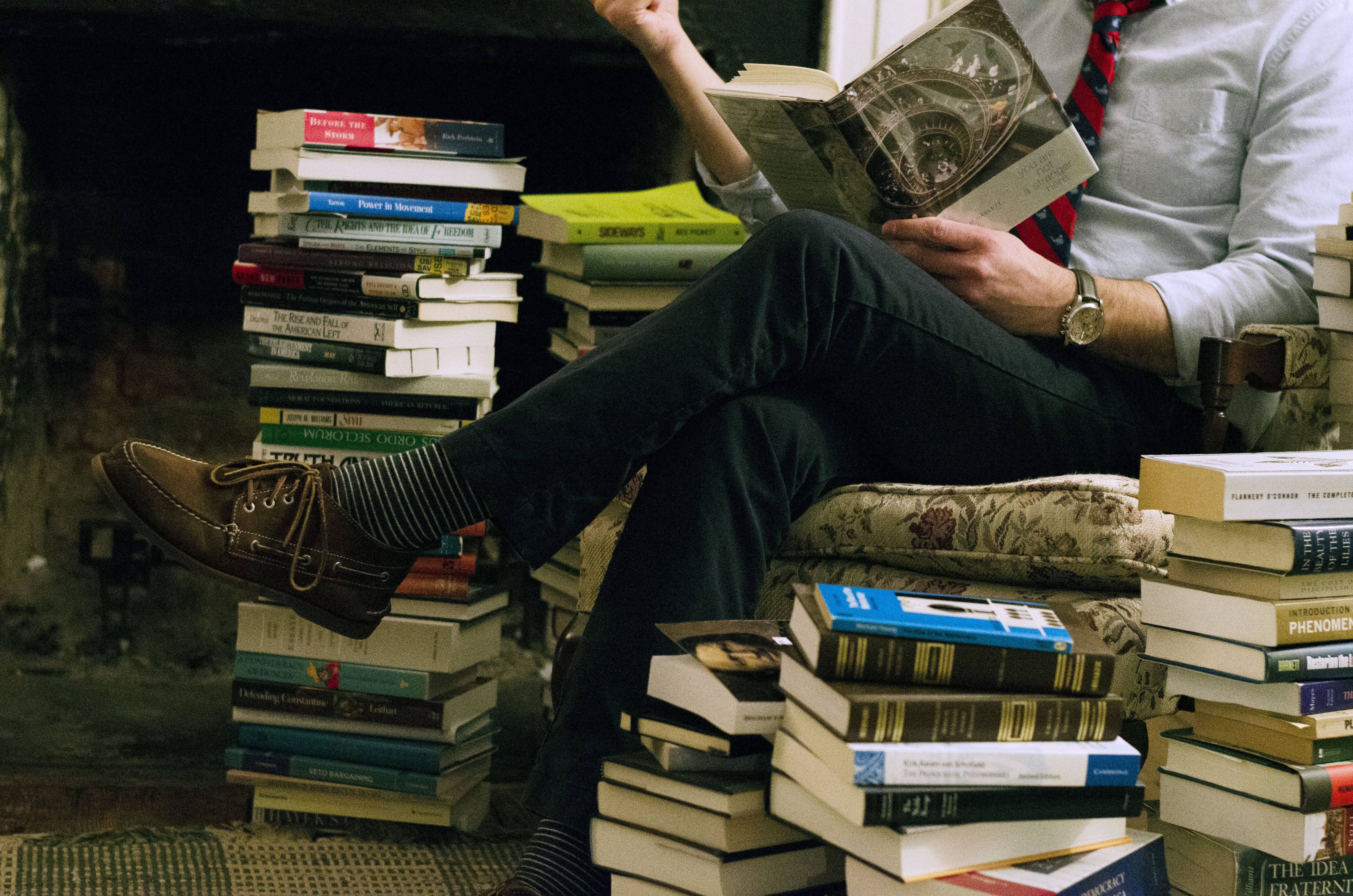
Book Piles

Adam Kirsch examines literature's connection to history:

Literature claims to be a record of human existence through time; it is the only way we have to understand what people used to be like. But this is a basic mistake, if not a fraud, since in fact it only reflects the experience of writers—and writers are innately unrepresentative, precisely because they see life through and for writing. Literature tells us nothing really about what most people’s lives are like or have ever been like. If it has a memorial purpose, it is more like that of an altar at which priests continue to light a fire, generation after generation, even though it gives no heat and very little light.

(Photo by Justin Ackerman, used with his permission.)

The Right Way To Teach Evolution

John Horgan struggles with students who believe in creationism:

I point out that some religion-bashing Darwinians exaggerate the power of evolutionary theory. For example, Richard Dawkins was wrong–egregiously wrong–when he claimed in his 1986 bestseller The Blind Watchmaker that life "is a mystery no longer because [Darwin] solved it." Even when bolstered by modern genetics, evolutionary theory does not explain why life emerged on Earth more than 3 billion years ago, or whether life was highly probable, even inevitable, or a once in a universe fluke. The theory doesn’t explain why life, after remaining single-celled for more than 2 billion years, suddenly spawned multi-cellular organisms, including one exceedingly strange mammal capable of pondering its own origins.

But he holds his ground:

I feel a bit queasy, I admit, challenging their faith, from which some of them derive great comfort. Part of me agrees with one student who wrote: "Each individual is entitled to his or her own religious beliefs… Authority figures teaching America’s youth should not be permitted to say certain things such as any religion being simply ‘wrong’ due to a certain scientific explanation." On the other hand, if I don’t prod these young people into questioning their most cherished beliefs, I’m not doing my job, am I?