The all-time biggest Youtube gets a mega mashup:
Month: November 2012
Will Cliff Diving Tank The Markets?
Daniel Gross hasn't a clue:
The conventional investing wisdom assumes that a deal – any deal – to avert the fiscal cliff will be good for stocks and the economy at large. That may be true. It may also not be true. In fact, I suspect that at the end of the day the people who are agitating most ardently for a big deal are going to be very disappointed. Compared with a few weeks ago, we are much less likely to have major entitlement reform and more likely to have large tax increases on the rich, with marginal rates rising, taxes on capital gains and dividends rising, and the rich losing some of their cherished deductions. The investor class has been begging for a resolution. The resolution they’re likely to get could be a sharp slap in the face.
Will that be good for stocks in 2013 and beyond? Who knows? In fact, hiking taxes significantly on investors may not influence the markets at all. My colleagues in the politico-financial industrial complex vastly, vastly overvalue the relation of government policy and marginal tax rates to asset prices in the stock market – especially my colleagues on the right side of the aisle.
Syria Goes Offline, Ctd
The Internet is still off in Syria. James Cowie of Renesys provides a chart showing which countries are capable of shutting down the internet:

Dashiell Bennett passes along video showing the methodical removal of Syria’s connectivity, noting that the Assad regime’s claims that “terrorists” were responsible for the outage are clearly BS:
[T]here are four actual physical cables that deliver connections from the global Internet to Syria. [As seen in this map via Renesys, t]hree of them are underwater, in the Mediterranean Sea. The other comes across the Turkish border. To completely stop the Internet in the manner observed, all four would have to be severed simultaneously, an unlikely logistical challenge for the rebels, and one that still wouldn’t fully explain the systematic shutdown observed by technology companies elsewhere.
Jillian C. York adds:
Unlike in Egypt, where the government had to force or coerce internet service providers (ISPs) into shutting down, the Syrian government only allows ISPs to operate within the network infrastructure of STE, the Syrian telecommunications establishment. What this means is that private ISPs cannot have their own international links, allowing STE – which is state-owned – to effectively control all traffic. A network shutdown is as easy as one switch.
Jon Tullett puts the outage in context:
Although states usually fail to control Internet communications (unless they have a true established dominance like in North Korea), this doesn’t stop them trying. In most cases, sudden Internet termination is one of the final steps of a failing regime. In the revolutions of the Arab Spring, which kicked into high gear in 2010, this was particularly apparent, and Syria’s blackout is following a now-familiar path.
Regarding the fighting underway during the blackout, which includes a severe limitation of mobile phone services, The Guardian’s live-blog highlights Phil Sand’s reporting from Damascus.
Is Cliff Diving The Least-Bad Option?
McArdle entertains the idea:
Unless something changes, we’re headed toward one of two uncomfortable places. Either we veer over the fiscal cliff and the economy crashes—or we keep going down the road we’ve been taking for more than a decade, delaying hard choices while assuring voters that no really hard choices need to be made. That road probably ends in an even nastier smashup. “Going over the fiscal cliff puts us into a horrible, self-created, and totally unnecessary recession, but then we come out of it,” says Marc Goldwein, senior policy director of the Committee for a Responsible Federal Budget. On the other hand, “if we keep racking up the debt, we don’t know when the crisis will hit. But historically, it will be fast, and we’ll have to go over a fiscal cliff anyway.” Only by then, the debt will be even larger, and we’ll have even less time to do anything about it.
So maybe the first cliff—the one coming in January—is the lesser of two evils. It just might achieve what white papers and impassioned pleas have so far failed to do: scare some sense into our legislators. Now all we have to do is hope that they pull out of the dive before we all hit bottom.
Letters From Millennial Voters
A reader writes:
I totally agree with what your Millennial reader wrote, and I want to add a few points. First, we have grown up in the most diverse America in history. My closest friends don't look like me, don't go to the same church, and some don't even speak English as their first language. We have more contact with immigrants, gays, the disabled, and multicultural families than any generation before us. So when a party tries to bemoan the loss of the "white establishment," even my white male friends – the supposed members of this establishment – are shocked and alienated. You can't try to win a demographic and think they won't notice that you are leaving behind their girlfriends, boyfriends, classmates and coworkers.
We are also the most educated generation yet. And while you can try to write off academia as a liberal indoctrination, what is really happening is that the anti-science, anti-evidence, anti-fact machine of the GOP can't stand up to people who know how to ask the right questions and have the Internet to find the answers. We are not going to take kindly to a party that would pass Medicare and start two wars without paying for any of it, blame the deficit on the next president, and then try to bill itself as the fiscally responsible party. The facts are out there, whether it's about climate change, birth control, or what you voted for on the House floor last year.
The Internet only strengthens both of those traits in our generation. O'Reilly can rant about Gangnam Style all he wants. [The above video] is perhaps the best example of how his party has lost a generation of supporters through willful ignorance.
Another writes:
I agree wholeheartedly with your reader on some of the big issues, but gay marriage support cannot be understated.
Eighty percent of millennial voters know someone personally who is gay. Unsurprisingly, there's a 20% difference in marriage support amongst those who know someone that is gay. These are our family members, our friends, our co-workers. We not only know them, but we see the love they have in their hearts for their partners. And it's starting to work on our baby-boomer parents, too. My mother was a lifelong Republican voter. But since 2008, she has become close, personal friends with a gay man. She and her fiance have him and his partner over to dinner just as they would any other couple. In two weeks, they are standing up with her at her wedding. My mom voted for the President this year almost solely on that issue alone.
You have always written that marriage equality moves forward because it's virtually normal. That it doesn't have to be won in court cases or by demanding it. Marriage equality is being won because gays are no longer an enigma being defined by the Christian Right. We know gays and lesbians. We're friends with gays and lesbians. We share our lunch table at work and our dinner table at home. And more troubling for Republican Party, we're starting to have our own children. Children that are growing up in households with parents who support marriage equality, who are going to daycare with children of same-sex couples. And to them, it won't even be virtually normal. It will just be normal.
The Ke$ha Of Philosophy
Dish punching bag Slavoj Žižek gets a tumblr full of GIFs. Dish fave after the jump:

A Historic Moment For SCOTUS
Tom Goldstein calls the same-sex marriage cases being considered today "the most significant cases these nine Justices have ever considered, and probably that they will ever decide":
I have never before seen cases that I believed would be discussed two hundred years from now. Bush v. Gore and Obamacare were relative pipsqueaks. The government’s assertion of the power to prohibit a loving couple to marry, or to refuse to recognize such a marriage, is profound. So is the opposite claim that five Justices can read the federal Constitution to strip the people of the power to enact the laws governing such a foundational social institution.
SCOTUS could announce which cases it is taking this afternoon or on Monday morning.
The Roid Age, Ctd
More readers vent their frustrations and personal preferences:
Wow, just digging yourself in deeper there: "gay men cannot resist the siren call of big chests or an ass you can rest a jäger shot on." Did it ever occur to you to say "I" or use a qualifier such as "many/some" gay men? My best friend is a gay man who loves skeletally thin men and finds big chests and asses to be repulsive. While an attraction to skeletally thin might not be widespread, there is more diversity in physical attraction than is dreamt of in your barren roid philosophy. Your particular turn ons do not speak to all gay men's turn ons.
As an additional dissent, it becomes tiresome to keep reading posts about either marijuana or steroid use without the qualifier that, due to your HIV status, you have significantly less risky access – either from a legal (medical marijuana) or safety (doctor prescribed steroids) perspective – than most of the population.
Sure: I shouldn't have said all men or all gay men. Many. As for my unusual status as someone under medically supervised testosterone replacement therapy, I have often referred to it. Another reader:
Are you familiar with twinks? Have you forgotten they exist? Not all gay men are into muscle worship and the professional wrestler look. You're trying to hard to universalize your erections.
I thought both pecs and an ass would cover the ground. Twinks can have great asses too. Another reader:
I'm a 41-year-old bear. My partner of almost 9 years is a slender guy. Your blog is the last place I thought I'd read the same kind of childish, muscle-worshipping stereotype that repels me from gay bars – especially bear bars. I've had bears in these bars look at my partner and say, "What are you doing here?" then say to me, "What are we, not good enough for you?" Please. These people need to get some therapy.
Perhaps you think this is obvious but someone has to say it: different strokes for different folks, Andrew.
Not all straight men like big boobs or slender women and not all gay men are drawn to the "siren call of big chests". I'm certainly not. To me, those aren't sirens; they're warning bells of someone who's in love with their looks and will spend more time at the gym than by my side. They'll likely be dreadful, shallow insecure messes as their bodies inevitably age. Comments like yours serve to only reinforce the completely false stereotypes that the gay community is a shallow sex-starved group of sweaty men.
I was unaware that gay men were viewed as "sex-starved". But of course I understand that sexual and emotional attraction varies enormously and is complex. But the allure of the V-shape of healthy masculinity is, in my view, buried in our genes. Steroids just take that one step further – for good and ill. Another reader:
Speaking as a straight man, a hot body alone is unlikely going to get you laid. Women simply don't operate with visual stimuli like men. Gay men, yes – I can get it. As a straight man, a highly visually stimulating women creates an immediate physical and primal response. Involuntary. But it is my civil nature, how I was brought up, and my general repulsiveness to being someone I am not that draws a line between pursuit and passivity.
Women simply won't go to bed with a meathead. While casual sex is on the increase, it is still not the norm and sexual activity is typically confined to an emotional bond. And for women sexual attractiveness, while important, is just one of many factors – and not nearly as important traits such as confidence and sense of humor. A guy who can tell a joke or turn a phrase has a WAY better chance at getting laid than any roided-up jackass.
Another:
Yes, many of us of women find tights butts and bulging biceps a turn-on, but to a point (straight potential steroid-users take note). I'm pretty sure most women are are repulsed by the look of the ultra-pumped up body builder physique, perhaps in the same way some men find bleached, breast-implanted, botoxed, lip-injected, excessively made-up women unappealing.
Secondly, you are making a big, and I think, incorrect, assumption by concluding gay men universally lust after the physical characteristics that you find personally attractive, or that all straight guys are wild about big boobs. Fortunately for athletic, small-breasted women such as myself, there is a definite "market" for the skinny, small-boobed girl. There are also guys who specifically dig wobbly overweight girls, scarily tall girls, and female body-builders.
Yes, guys like boobs, but not all guys like really big boobs. Some are more interested in other body parts (curvy butts for example). Same goes for women; while I go for guys who look fit (but not ripped), some like bodybuilders, some go for big hairy longhaired biker-looking guys, and some prefer a cleancut ultra-lean runners physique. I imagine it is pretty much the same with gay men (there are a number of gay looks/types, are there not?). You overlook that there is this great diversity in what individuals of any gender or sexual orientation consider attractive (despite what Hollywood would have us think).
To read the full discussion thread, go here.
Is British Free Speech Under Attack?
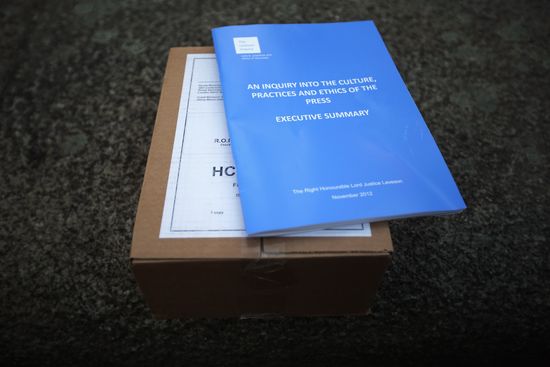
The Leveson report, a response to the British phone-hacking scandal and the other sins of Fleet Street, was released yesterday. Anthony Lane sizes it up:
Leveson proposes to scrap, or radically to remake, the Press Complaints Commission, about which, until now, the press itself has had amusingly few complaints. What should replace it, he suggests, will be a “new independent self-regulatory body,” which sounds the sort of thing that we can all approve of, especially those of us who eat enough fiber. This healthy body, moreover, should be reinforced by another body—a statutory one, backed by new legislation. And so the bodies mount up, to the evident alarm of those in the media who peer ahead and foresee a dark time when the press finds itself denuded of its traditional freedoms. Are they right to worry? Will British newspapers in five years’ time look and sound markedly different, in Leveson’s uncertain wake? A more pressing question might be whether half of them will even exist in five years’ time, at least in print editions, but my suspicion is that, as so often occurs in Britain, far less will change than is feared—(or, if you have been a victim of press intrusion, than you have fervently hoped for)—and that what changes are enforced will arrive at the pace of molasses.
Shafer suggests that the British public should share some of the blame for the press's misdeeds:
Perhaps the biggest problem in the UK is not unethical publishers and unethical reporters but contemptible readers who sanction criminality and privacy invasion every other time they buy a disreputable copy at the newsstand. Of course you can’t establish a voluntary, self-regulatory body of readers, funded by them with investigative powers to peer into their own dismal tastes in journalism. But if you could, I’m certain Lord Justice Leveson would take a stab at it. Every block could have a tribunal of its own, and every reader’s reading habit could be judged, and the worst of them fined or put in stocks and pelted with eggs.
Massie adds:
[O]ne cannot help but wonder if Britain's unusually uncorrupt public life will really be improved by anything Leveson has recommended. But that is not something Lord Justice Leveson has paused to consider. In 2,000 pages of thumb-sucking, ponderous reflection and recommendation he devotes just a single page to the internet. If this is the end of one era that merely means it is the opening of another. The game is still the game.
(Photo: A box containing a copy of the Leveson Inquiry outside the Queen Elizabeth II conference centre on November 29, 2012 in London, England. By Oli Scarff/Getty Images)
Yglesias Award Nominee
"You go back in time, you've got radiocarbon dating. You got all these things, and you've got the carcasses of dinosaurs frozen in time out in the Dakotas. They're out there. So, there was a time when these giant reptiles were on the Earth, and it was before the time of the Bible. So, don't try and cover it up and make like everything was 6,000 years. That's not the Bible. … If you fight science, you are going to lose your children, and I believe in telling them the way it was," – Pat Robertson.
 The Dish
