Evil’s Architect

Hitler_Architect

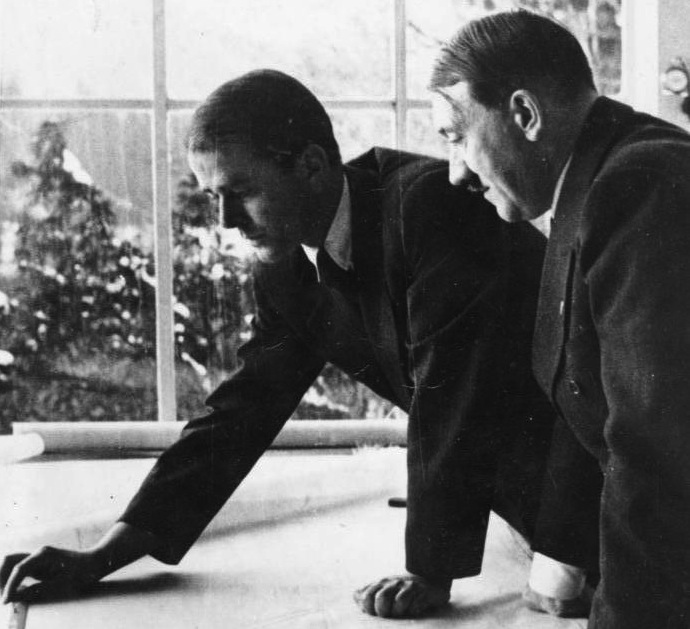
Roger Forsgren has a fascinating meditation on the life of Albert Speer, the Nazi architect and engineer who used "his brilliant technical expertise and talents to enable the war efforts of the most evil regime in history." Forsgren ponders the lessons Speer contains for all who work to increase the power at man's disposal:

Albert Speer’s life is a warning to all engineers that their creative powers to design and build are capable also of unleashing tremendous harm and destruction. In a sense, there were perhaps few more dangerous men in the twentieth century than Albert Speer — all the more so because he did not fully realize what he was doing. It was almost too late in his life, and certainly too late for the world and the lives lost, when Speer finally understood his horrific personal failures.

It might be said that Speer exemplifies what happens when a technical person becomes too absorbed in his work. Speer claimed at his trial that he was simply doing what nearly any other architect would have done; he was too busy “studying far into the night” to even discuss the political world exploding all around him, too lacking in the ability to think discriminately and critically, and so he found himself “unable to deal with the arguments” of his cohorts, and instead just went along. Perhaps it is the inherent nature of the technical disciplines that brings their practitioners to view the world with a practical eye, to possess a preoccupation with efficiency and order — even to the point of ignoring the humane values of dignity and justice. These are characteristics that will surely sound familiar, to some extent, to those who have worked with engineers, even if in far less sinister contexts.

(Photo: Albert Speer with Adolf Hitler, from the German Federal Archive, via Wikimedia Commons)

Worshipping At Freud’s Altar

Christopher Harding considers the role of psychology in religion:

[P]sychologically naive spirituality can be destructive in its own way. Buddhism’s ‘no-self’ insight, like the contrast between ‘false’ and ‘true’ selves sometimes found in Christian teaching, can give the impression that, with enough meditation or prayer, mental health problems will simply go away. Very often the reverse is true. Meditation in particular can show you things that you really ought to take to a psychotherapist or psychiatrist, or perhaps work through, painfully and embarrassingly, with your family.

That brings us to what might be the most useful role for psychology in religion. It offers perspective that stands outside religion’s enticing, evocative conceptual networks: it can show us when our talk of humility, surrender and dismantling the ego are really masking, perhaps even facilitating, their polar opposites — despite our best intentions.

A Poem For Saturday

Starnight

"At Night" by Jimmy Santiago Baca:

I lie in bed
and hear the soft throb of water
surging through the ditch,
from extreme to extreme water bounds,
clumsy country boy,
stumbling over fallen water logs and rubber tires
to meet a lover
who awaits in her parents’ house, window open.

As I used to for love.

Now gray-black hair,
vigorous cheeks, weathered brow, chapped lips,
dismal thoughtful eyes,
I float in brown melancholy on the lazy currents
of memory, studying my reflection
on the water this night,
with distant devotion,
a swimmer who has forgotten how to swim.

(From Black Mesa Poems © 1989 by Jimmy Santiago Baca. Reprinted by permission of New Directions Publishing Corp. Photo by Flickr user Sweet Chi)

Personalizing Your Porn

Violet Blue fears what the introduction of facial-recognition software into porn will do to privacy:

SexFaceFinder positions its service as a way for users to find a performer that looks like a specific person. Or to find performers that look like the user's favorite type of model, in an effort to engage the user with a service that closes the marketing gap between a user and their fantasy. Another company, Naughty America, openly solicits users to upload images of girls found on Instagram and other internet destinations in an effort to find the photo's subjects in porn – or find celebrity look-alikes, girlfriend and ex-girlfriend look-alikes, or similar/specific porn performers.

The Rave’s Second Wind

Gideon Lewis-Kraus is thrilled:

Somehow the thing that everybody had predicted circa 1995—that electronic dance music (hereafter: EDM) would take over pop—had been delayed a mere seventeen years. In 2012, a gentleman named Skrillex, whose music sounds like a computerized raccoon fight, took home three Grammys, sweeping the electronic categories, and was the first EDM act to be nominated for Best New Artist. Deadmau5 appeared on the front page of The New York Times in his signature mouse head. Forbes estimated that Tiësto was averaging $83,000 an hour for his DJ sets. No corner deli went unthrobbed by a Calvin Harris beat.

The reason? The Internet:

Because what's important now is not where or how you heard a track first; it's that it's heard repeatedly and by as many people as possible. It's the opposite of hipsterism. Where hipsterism is about being part of the few in the know, the EDC scene is about being a part of the many. Insofar as it's a scene at all, it's one geared toward the universal coalescence that the focus group of the Internet makes possible. This is a youth phenomenon that has submitted to the fact that access to knowledge—the secret location, say, of a warehouse party—no longer sets one particular group off as a special vanguard.

Time For Sex

From a selection of sexual taboos from the Encyclopedia of Sex and Gender, excerpted by Vaughan Bell:

In some societies, sexual activity is prohibited during certain times of day. The Cuna of Panama approve of sexual relations only at night in accordance with the laws of God. The Semang of Malaysia believe that sex during the day will cause thunderstorms and deadly lightening, leading to drowning of not only the offending couple but also of other innocent people. And the West African Bambara believe that a couple who engage in sex during the day will have an albino child. … The Ganda of Uganda forbid sexual intercourse the night before battle if the fighting is likely to be protracted. The Lepcha prohibit sex for three months after a bear trap has been set. If the taboo is broken, no animals will be caught.

Learning To Love The Weird

In teaching a course called "The Geography of Wine", Jason Wilson encourages students to stretch their tastebuds:

But if there has been one stumbling block, it is when we leave the comforting aromas and flavors of fruits and flowers and herbs and enter into more challenging tasting territory: Minerality. Chalk. Tar. Tobacco. Animal. Farmyard. Petrol.

"Why would we want to drink a wine that tastes like these things?" my students want to know. It’s a reasonable and valid question.

Look, I tell them, if you’re happy and content with fruity, pleasurable red wines redolent of berries and cherries and plums or zippy, easy-to-drink whites with tangy citrus and orchards full of apples and pears… well, then that’s what you should drink without feeling any need to move beyond that. Wine should be, foremost, about pleasure — and pleasure is personal. There’s a reason that romantic comedies with happy endings, sunny, catchy pop music, mac n’ cheese, whipped cream vodka, and wearing Ugg boots with pajama pants remain popular.

But if we think more deeply about pleasure, we realize it isn’t always so straightforward or even comfortable. After all, why do so many of us love sad poems, disturbing horror films, or intense, subtitled psychological dramas.  … With the arts, we inherently understand that without the darker, more confounding elements, there can be no light. Wine is no different.

Life, Unedited

A charming anecdote from Yuka Igarashi, after wrapping up copy-edits for the new issue of Granta:

I looked down at the sandwich menu: kiln smoked salmon and horseradish chive creme fraiche in toasted wholemeal bread. ‘Kiln smoked’ probably should be hyphenated, I thought – it’s acting as an adjective modifying smoked salmon – and ‘creme’ needs the accent. Also, does ‘in’ make sense here? Wouldn’t it be better if it was ‘on’? Was this some kind of innovative sandwich that involved salmon being placed inside the bread?

‘Why don’t we share some appetizers to start?’ one of us suggested.

‘Redundant,’ I muttered to myself. Appetizers are starters; either cut ‘to start’ or change ‘appetizers’ to ‘plates’. Then again, in some cases, people order only appetizers, and don’t go on to have a main course. So was it actually essential to say ‘to start’, to clarify that, in this instance, everyone should feel free to order more food after the first sharing course? I wasn’t sure.

The lesson she draws:

There is a danger to copy-editing. You start to read in a different way. You start to see the sentence as machinery. You focus on the gears and levers that connect words to one another; you hunt for the wayward semicolon, the unintentionally ambiguous phrase, the clunky repeated word. You even hope they appear, so you can kill them. You see them when they’re not even there, because you relish slashing your pen across the paper. It gets a little twisted.

Face Of The Day

Twomey_Ann 3.jpg.CROP.article920-large

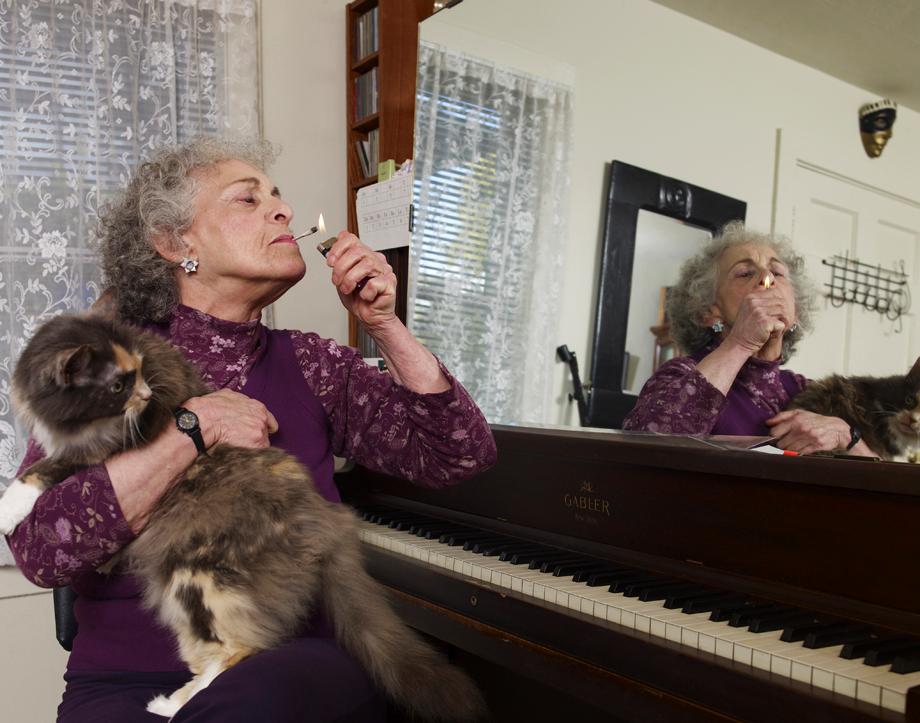
Alyssa Coppelman spotlights the work of Robyn Twomey, who began documenting medical marijuana smokers in late 2009:

Ann (pictured at top with her cat) received a prescription for medical marijuana as soon as it was available. She uses it to treat chronic back and neck pain resulting from a childhood accident that fractured her spine. When it healed, her spine became misaligned and has given her increasing trouble as she ages. She believes more elderly people could benefit from the use of cannabis should it be legalized and destigmatized.

(Photo by Twomey, courtesy of Patricia Sweetow Gallery)