This past weekend marked the inaugural Moby Dick Marathon in New York. Dustin Kurtz, one of the 160 readers, reflects:
What do we gain from reading the book out loud? If it is only the excuse to say "harponeer" fifteen times in a minute, that would surely be enough. But there is more here. First, the work benefits. Melville is a storyteller, and as I’ve said, his writing, at least in the seafaring stories, has a rhythm to it that is only highlighted when eyes are chained to tongue and the reader is forced to speak the man’s silly dialogues, his grandiose heights of descriptive prose, and more than anything, his somber exaltations of humanity.
More broadly, the readership benefits. We were not critiquing the book, or even discussing it. We didn’t perform it. We were not there to buy it. We had just come together as a readership to do only that: to read the thing, together. That’s a rare and proudly contrary instinct when it comes to books, if a happy one.
For those not in NYC, Cassandra Neace recommends the website Moby Dick Big Read, "a read-a-long, or, rather, a listen-a-long version of what they refer to as the 'great unread American novel.'" Recent Dish on how to read Moby Dick like a scientist here. Previous Dish on the intimacy of reading aloud here.
Matt Zoller Seitz reviews Ken Burns' latest documentary and how it relates to today's climate change crisis:
More than anything else, The Dust Bowl is about a certain self-destructive strain in the American character that prizes individual will over collective responsibility, stigmatizes real or perceived failure, and stubbornly refuses to learn from mistakes for fear of being thought weak. … There are appalling accounts of farmers continuing to use equipment that pulverized topsoil rather than return to more difficult but responsible methods — even after repeated expert warnings that they were destroying the land — because doing so would have been less "efficient," and because they didn’t like academic pointy-heads telling them their business.
"We always had hope that next year was gonna be better," says survivor Wayne Lewis. "We learned slowly, and what didn’t work, you tried it harder the next time. You didn’t try something different. You just tried harder, the same thing that didn’t work."
Alyssa Rosenberg interviewed Burns and his producer Dayton Duncan:
Duncan: So to me, what’s interesting about it is that this catastrophe that occurred and the manmadeness of it, there wasn’t a single – there is no conspiracy single bad person that you can say "It all goes on them." It’s us.
This is what we are capable of doing if we delude ourselves with an arrogance that we don’t have to pay much attention to what the climate, and what the land, and the environment is trying to tell us. We can look at these plants that grow that far from the ground and send roots five feet down and say, "We can turn these over and plant wheat and everything will be fine." Well, it doesn’t work that way. It just doesn’t. And you’re gonna get caught up and somebody’s gonna pull your undies at some point on it, on the Great Plains particularly.
Burns: The dialectic of journalism requires that there are opposites, but in fact Dayton is right: we have met the enemy and he is us. And I think the advantage of art—as opposed to the dialectic of journalism—is that it permits us to tolerate the undertow within our own selves. You’ve met characters who went in both of these directions, and sometimes a third direction, meaning out of the state. And we wanted to have a humanity that embraced the complexity without having to parse out the sort of villainy, the victimhood, the responsibility. This is a collective human tragedy, and it is also an enduring, hopeful story of human perseverance.
Models agree that with the global warming in store absent dramatic cuts in greenhouse gas emissions, much of the western United States—from Kansas to California—could enter into a long-term state of dryness, what physicist Joseph Romm has termed "dust-bowlification."
With soil conservation measures in place, when drought revisited the Plains in the 1950s, the mid-1970s, the early 2000s, and again in 2011-2012—when Texas and Oklahoma baked in their hottest summers on record—a full-blown Dust Bowl did not develop. But will the ground hold forever? The United States is by far the world’s leading grain exporter; thus the fate of the nation’s "breadbasket" matters for food prices, and food security, around the globe.
According to Linda Rodriguez McRobbie, boredom may be "the evolutionary cousin to disgust":
In [Dr. Peter] Toohey’s Boredom: A Living History, the author notes that when writers as far back as Seneca talk about boredom, they often describe it was a kind of nausea or sickness. The title of famous 20th century existentialist writer Jean-Paul Sartre’s novel about existential boredom was, after all, Nausea. Even now, if someone is bored of something, they’re "sick of it" or "fed up". So if disgust is a mechanism by which humans avoid harmful things, then boredom is an evolutionary response to harmful social situations or even their own descent into depression.
"Emotions are there to help us react to, register and regulate our response to stimulus from our environment," he says. Boredom, therefore, can be a kind of early warning system. "We don’t usually take it as a warning – but children do, they badger you to get you out of the situation."
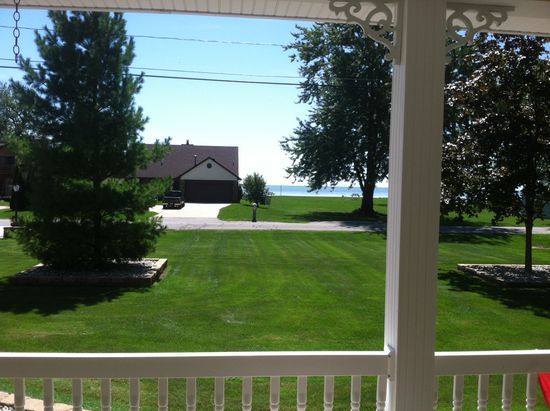
You have until noon on Tuesday to guess it. City and/or state first, then country. Please put the location in the subject heading, along with any description within the email. If no one guesses the exact location, proximity counts. Be sure to email entries to VFYWcontest@gmail.com. Winner gets a free The View From Your Window book. Have at it.
Nathan Heller notices a change in Internet culture:
These days, life online has become friendly, well mannered, oversweet. Everyone is on his or her very best behavior—and if they’re not, they tend to be quickly iced out of the conversation. The sweet camaraderie that flourished during Sandy isn’t just for terror and crisis anymore; it has become the way the Internet lives now.
And it’s made converts of even the most truculent cases. In mid-October, Perez Hilton, the famously snide online ogler of celebrities, decided to turn over a new leaf, and delivered the message in song. “I resolved I must be kind!” he sang onstage at a 42nd Street theater, the New York Times reported, part of a recent public shift he’s tried to make toward a friendlier, gentler approach to celebrity culture. (It meant a lot to publicists.) Gawker, once considered the reigning champion of snark, has similarly moved away from its claws-out mission and toward more earnest investigative efforts—often with the aim of making the world a better place. Among the site’s most notable stories this fall was the outing and shaming of Reddit’s ViolentAcrez, one of the Internet’s most notorious trolls. (Gawker and Hilton’s site are surely catering to the market in some sense, but the market itself may be changing: For years, it was their meanness, not their generosity, that earned them page views.)
His big fear:
If anything, these days, we risk regarding the web as too much of a cultural mirror or, at least, a mirror pointed in the wrong direction: Good faith has become indistinguishable from good speech, and agreeable words risk outweighing the actions that push them toward fruition. In truth, crucial decisions are never quite as simple as an exclamation-filled post of support. We’ve just emerged from a bitter election season through which many of us moved forward fueled by like-minded applause, seeing only what we wished to see. Yet what comes next isn’t a cuddle; it’s a struggle.
A new study suggests that singing, dancing and drumming can result in an effect similar to runner’s high:
[University of Oxford psychologist Robin Dunbar] and his colleagues report people who have just been playing music have a higher tolerance for pain—an indication their bodies are producing endorphins, which are sometimes referred to as natural opiates. In their experiments, simply listening to music did not produce this positive effect. “We conclude that it is the active performance of music that generates the endorphin high, not the music itself,” the researchers write in the online journal Evolutionary Psychology.
Dunbar argues that music evolved, at least in part, as a way of strengthening societal bonds. As a 2010 study of preschoolers found, people who sing or move in rhythmic unison tend to work together more cooperatively afterwards. This explains the presence of music in church services and military ceremonies. But what’s the trigger of this spirit of community? This new research suggests it may be the release of endorphins.
One-third of American babies are now born by Cesarean section, versus 5 percent in 1970. Nell Lake explores the reasons and risks involved:
Demographic changes and shifts in maternal health may have contributed to the rise in the use of C-sections in recent decades. Pregnant women, overall, have become older and heavier, and older, heavier women undergo more C-sections. But such factors don’t account for all the differences shown in Ecker’s study, which sought to control for them by looking only at pregnancies that had progressed well: in which fetuses had reached full term, were normal weights, and in which labor had begun spontaneously (i.e., doctors had found no reason to induce labor early). Even among these cases, hospitals varied significantly in the frequency of C-sections. Such disparities matter because cesareans are expensive—on average, a cesarean costs about $20,000, a vaginal birth about $11,500—and also carry significant risks.
The main reason for the rise:
In a dynamic that is repeated in other medical care, doctors perform cesareans, in part, because they aren’t trained to favor or perform less-invasive techniques. With inadequate training and experience, liabilities and patients’ risk increase.
Medical marijuana is now legal in 18 states and the District of Columbia, but health insurance doesn't cover it and patients often scramble to cover the cost. "It's an expensive medication, no doubt about it," says Kris Hermes, a spokesman for Americans for Safe Access, a patient advocacy group. "Patients are struggling to afford it, regardless of whether it's available in their state." Hermes estimates that patients pay $20 to $60 for an eighth of an ounce, enough to make about three joints.
The problem is that marijuana remains classified as a Schedule 1 substance, "meaning it has no medical use and a high potential for abuse" – a classification completely detached from reality, of course:
In October, consumer advocates presented oral arguments before the U.S. Court of Appeals for the D.C. Circuit to remove marijuana from that list. Reclassification would make it easier to conduct research on therapeutic uses for marijuana, say advocates, and ultimately make the drug more accessible to patients. Last year, the Drug Enforcement Administration denied a request to reclassify the drug, following an evaluation by the Department of Health and Human Services.


 The Dish