
Squirrel Island, Maine, 10.30 am
Squirrel Island, Maine, 10.30 am
A team led by Lada Adamic, a computer scientist at the University of Michigan and Facebook, created an algorithm (pdf) to predict how successful a recipe will be. Michaeleen Doucleff is impressed:
It predicts with nearly 80 percent accuracy how many stars your mother's cranberry recipe will receive on allrecipes.com. Plus, it can recommend ingredient replacements to make your pie crust and potatoes more healthful. She and her team took nearly 50,000 recipes and 2 million reviews from allrecipes.com and then hacked up an algorithm to extract out all the ingredients, cooking methods and nutritional profiles. With just these items, her algorithm could predict the recipe's rating with an accuracy of about 70 percent.
But the magic happened when Adamic built a "social network" for the ingredients. She looked at how often two ingredients appear in the same recipes. Those that frequently show up together — milk and butter, nutmeg and cinnamon, basil and rosemary — sit close to each other in the network, but those that rarely appear in the same dish, such as coconut and parsley, are far from each other. … Adamic's network analysis boosted the accuracy of her recipe recommendations by about 10 percent.
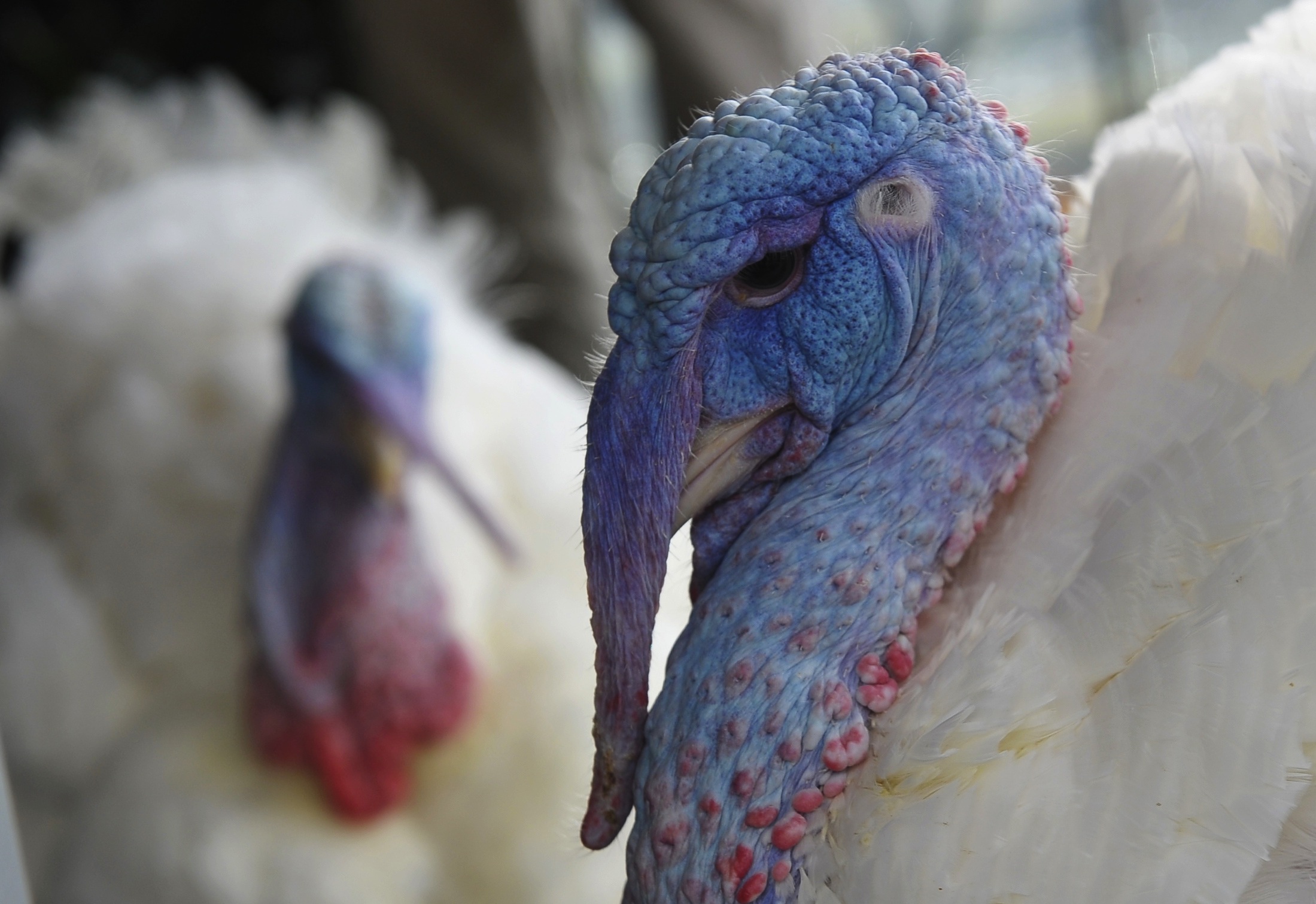
Anna Spiegel outlines the process by which the pardoned turkey was chosen:
The selection process began in June with a whole rafter, or flock, of turkeys. National Turkey Federation chairman Steve Willardsen chose a farm he owns in Rockingham County, Virginia, as the birthplace. Forty eggs were selected and incubated together. Once hatched, the poults moved to their own barn. Turkeys are naturally skittish, but the select group was trained to be what the National Turkey Federation describes as "media-savvy." Handlers familiarized the turkeys with human contact and played music around the clock so the turkeys got used to loud noises and human voices.
The final bird, and its alternate, were picked "based on the birds’ ease with handling, physical health, and superior looks."
(Photo: The National Thanksgiving turkey and its alternate are seen during a press conference November 20, 2012 at the W Hotel in Washington, DC. By Mandel Ngan/AFP/Getty Images)
Mark Perry flags something to be thankful for:
The fact that the average American family can celebrate Thanksgiving with a classic turkey feast for ten people for less than $50 and at a "time cost" of only 2.1 hours of work for one person (and only 1.56 hours for Walmart shoppers) means that we really have a lot to be thankful for on Thanksgiving: an abundance of cheap, affordable food. Relative to our income, food has been more affordable in recent years than at any time in history.
Even our voracious debt is getting under control:
For the quarter-century leading up to the great recession at the start of 2008, Americans accumulated ever-larger piles of debt, both in absolute terms and relative to the size of the economy. Home mortgages were the largest portion of that, but it also included credit cards, auto loans, and student loan debt.
The good news is that in the past three years, Americans have made remarkable progress cleaning up their balance sheets and paying down those debts. After peaking at nearly 98 percent of economic output at the start of 2009, the household debt was down to 83 percent of GDP in the spring of 2012. That represents debt reduction of $636 billion, or more than $2,000 for every man, woman and child.
The surgical team in alShifaa hospital in #Gaza, who a midst the continuous bombings continued their work. twitter.com/MariamBarghout…
— Mariam Barghouti (@MariamBarghouti) November 21, 2012
Today on the Dish, Andrew took apart Joe Scarborough over his anti-math hackery, then believed in the therapeutic potential of MDMA, and applauded Ken Mehlman’s attempt to course-correct Republicans on same-sex marriage.
In continuing coverage of the crisis in Gaza, while last night’s cease fire fell apart, today it finally arrived and we rounded up reactions. Also, more readers joined the exasperated fray over perpetual Israeli-Palestinian unrest, while Greg Scoblete imagined the fruition of Walter Russell Mead’s Shermanesque plan for Israel, The Economist offered a numerical take on the ongoing violence, Beinart pointed out that the “real” Obama still supports Israel, and Gaza started running out of drinking water. Elsewhere internationally, we wondered if Nate Silver-like models could predict world events, Massie reminded us that Europe needs America’s help with Syria, and Seema Shah took a look at the upcoming Kenyan elections.
In political coverage, Michelle Cottle offered some helpful advice for avoiding Thanksgiving’s conversational minefield, Chait highlighted JPod’s toxicity, Larison anticipated future GOP moderation, and Daniel Gross professed his desire to Thelma-&-Louis off the fiscal cliff. Also, John McCain won’t make an apology tour, but he did finally acknowledge reality with regards to Susan Rice, while Adam Ozimek wanted more immigrants in our melting pot, and Bill McKibben told us it might be too late to stop global warming, but not too late to make it a lot less worse.
In assorted coverage, the wonderful reader thread about America’s over-medaled servicemembers went another round. We also met the cross-dressing grandfather-model of the year, learned six new ways to hack open a beer bottle, and Charles Kenny killed us with the stress of security theater, even after Air Canada gave up its seats to the obese. Rod Dreher’s son connected with yesterday’s remarkable video defining Aspergers, Virginia Hughes made sense of how dogs smell, Maria Konnikova celebrated the logical empathy of Sherlock Holmes, and turkeys got bigger and bigger, but according to Tom Jacobs they might not be as tasty as guilt. We also tried to diagnose the strawberry-haggling wackiness of Mary Todd Lincoln, Andrew P. Smiler shattered the stereotype of sex-crazy men, and Jonathan Rauch warned us to never give up being offensive. An obliviously-lucky turkey heard Obama joke around in our FOTD, we saw San Fran in the VFYW, and SNL took us home for the holidays in our MHB.
– C.D.
The scene tonight in Gaza:
Beinart admits that Israel’s military operation achieved some goals:
[I]n the short-term, destroying Hamas missiles and killing some of its leaders, can win Israelis some respite from rocket fire. It did for a time after Cast-Lead. And any government—most certainly including our own—would be hard-pressed to ignore that benefit.
Max Fisher agrees but also puts Hamas on his winner list:
The cease-fire agreement hints that Israel, which maintains a near-blockade of the impoverished Palestinian territory, might loosen border restrictions. That would certainly be good news for Gazans, 40 percent of whom are unemployed and 38 percent of whom are below the poverty line. Hamas’ popularity among Palestinians had reportedly been declining, so this significant concession could help its stature in Gaza. The high-profile negotiations with world leaders didn’t hurt, either.
Brent Sasley believes most of the players lost, including Israel:
As I’ve argued before, Israel has no long term strategy regarding Gaza. Its victory in a limited military campaign will only strengthen the perception that its tactical-military emphasis works and doesn’t need to be changed. This means it’ll be harder for Israel to accept a new formula for maintaining security and achieving peace. It also means we’re likely to see a repeat of November’s events again.
Meanwhile, Tony Karon notes Egypt’s new role:
[W]hile Egypt seeks a cease-fire that ends Palestinian rocket fire from Gaza and Israeli air strikes on the territory, Cairo’s mediation also offers Hamas a pathway out of the blockade that has choked off Gaza’s economy for the past five years. Even Israeli leaders have praised the response from Cairo, notwithstanding Egypt’s unprecedented public acts of solidarity with Hamas.
Daniel Brumberg adds:
[I]n the coming months [Morsi] must clearly signal that a democratic Egypt will now take the lead in pushing all key regional parties towards making an enduring peace. This will be very hard pill for Egypt’s Muslim Brotherhood to swallow. But if the idea of Egyptian-Israeli peace as a bridge to Palestinian-Israeli peace once seemed little more than a bad joke, it does not have to remain so.
And Ali Gharib gives America some credit:
[T]he chief mediator—Egypt’s Muslim Brother president Mohammed Morsi—and the Israeli government both value their ties to the U.S., and both acted like it in the face of apparent American requests. In his announcement on Twitter, Benjamin Netanyahu was explicit that he “accepted [Obama’s] recommendation to give [the] Egyptian proposal for a ceasefire a chance.” Those of us who called for public pressure should take heed: JTA‘s Ron Kampeas noted on Twitter that Obama apparently “extracted Israeli concessions [without] an ounce of public pressure.” Nonetheless, there was pressure and, for the moment, it seems to have accomplished something. Like everyone else, we’ll wait to see if that accomplishment will bear tangible fruits…
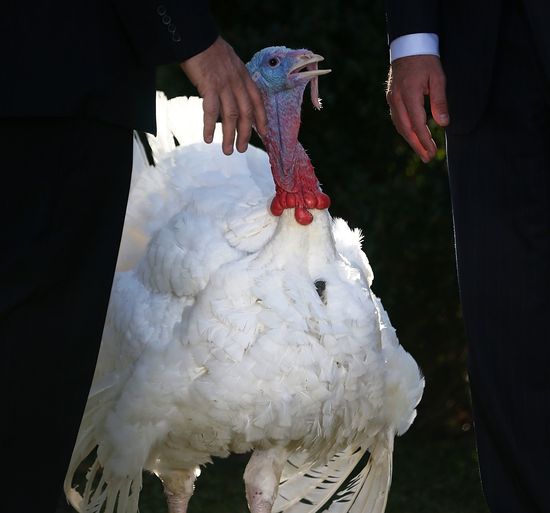
Cobbler, the 2012 National Thanksgiving Turkey, is seen during a Rose Garden turkey pardon event November 21, 2012 at the White House in Washington, DC. After pardoned by President Barack Obama, Cobbler and its companion Gobbler will spend the rest of their lives at George Washington's Mount Vernon Estate and Gardens in Virginia. By Alex Wong/Getty Images.
Charles Kenny argues that, if "Americans really care about saving lives this Thanksgiving travel season, for goodness’ sake, don’t beef up airport security any further":
There is lethal collateral damage associated with all this spending on airline security—namely, the inconvenience of air travel is pushing more people onto the roads. Compare the dangers of air travel to those of driving. To make flying as dangerous as using a car, a four-plane disaster on the scale of 9/11 would have to occur every month, according to analysis published in the American Scientist. Researchers at Cornell University suggest that people switching from air to road transportation in the aftermath of the 9/11 attacks led to an increase of 242 driving fatalities per month—which means that a lot more people died on the roads as an indirect result of 9/11 than died from being on the planes that terrible day. They also suggest that enhanced domestic baggage screening alone reduced passenger volume by about 5 percent in the five years after 9/11, and the substitution of driving for flying by those seeking to avoid security hassles over that period resulted in more than 100 road fatalities.
Spurred by Spielberg's new film, Jeffrey Bloomer reviews the conventional wisdom that Mary Todd Lincoln was crazy:
After President Lincoln’s assassination in 1865 and the loss of a third son in 1871—two others died in 1850 and 1862—Lincoln’s emotional state deteriorated until, after some erratic behavior, the two police officers showed up at her door. She was institutionalized, released months later, and lived out most of her remaining years overseas. After her death in 1882, historians—all of them initially male—began to mine her legacy, advancing a questionable theory of lifelong mental illness that remains hotly debated today. … Early portrayals of Mrs. Lincoln as unhinged and volatile were followed by claims that she suffered from bipolar disorder, a diagnosis which, of course, did not exist in her lifetime.
Michelle Dean dives deeper into the First Lady's quirky behavior:
She was reputed, before she arrived in Washington, to be a woman who haggled over every purchase, strawberries particularly. And Baker claims that Lincoln’s estate was only the size it was because Mary sought out every available source of funding for official matters other than the President’s own pocket. The obsession with money led to that disastrous sale of fancy clothing and to the act of sewing her entire inheritance of fifty-six thousand dollars, just before her commitment, into her skirts. You can read that as parsimony or greediness, but what it boils down to is control….
There is evidence that even before the Presidency Mary was prone to shopping binges, when there was money for it. Some historians think this further evidence that she was bipolar, with a mania that expressed itself as acquisitiveness. It is hard to say if they are right. There are certainly people in this world who could testify to the satisfaction of impulse buying, and to its fleetingness, without falling under psychiatric scrutiny.
Tom Jacobs flags a study on them:
According to newly published research, the guilt we feel may make that decadent treat taste even more delicious than it otherwise would. When succumbing to temptation, “people who are primed with guilt subsequently experience greater pleasure than people who are not,” reports a research team led by Kelly Goldsmith of Northwestern University’s Kellogg School of Management. “People lack awareness of this automatic process.”
Jacobs advises:
[D]on’t beat yourself up over eating those candied yams: it may only increase your craving for seconds. It turns out that forbidden fruit really does taste the sweetest.
 The Dish
