A reader sends the above image:
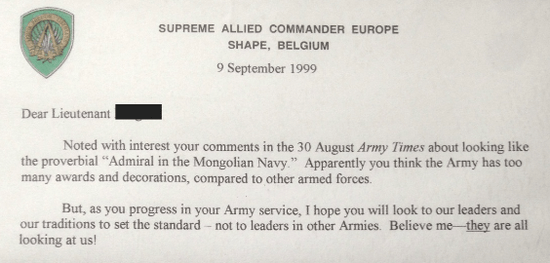
I know I'm late to this party, but I thought I'd share a personal experience with the debate over medals. In the Army in 1999, we had the same debate during operations in Kosovo. On March 31, 1999, three GIs were captured by Serb forces and held for a month. Upon their release, they were awarded Purple Hearts and Prisoner-of-War Medals, sparking a heated debate in the pages of the Army Times over the leniency of the Army award policy.
Then a First Lieutenant, I added my two cents' worth by suggesting the answer was obvious to anyone who watched television. It wasn't just the medals; it was the staff assignment badges, special skill badges, coats-of-arms for regimental affiliations – the American uniform is, if you will, highly accessorized. I pointed out that in televised NATO press conferences, the British and German officers appeared in uniforms adorned by a half-dozen or so ribbons, making General Wesley Clark, the NATO Commander, "look like the proverbial Admiral in the Mongolian Navy."
This caught Clark's attention, because several days later a rather sternly worded – and personal – response from the Supreme Allied Commander, Europe, arrived in my mailbox. The irony is that, looking at it now, Clark's uniform was nearly naked compared to Petraeus's.
Another:
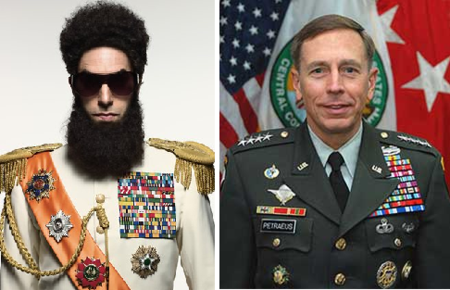
I noticed your image highlighting the glaring disparity between Eisenhower's and Patraeus' uniforms. And then I realised something; I've seen this officer before, but in a much more satirical format:
Another reader:
I find that the full-chest mode of some of our generals to be so "Soviet", as others have said. Speaking as a Vietnam-era vet, I think the most I ever saw on a general during my time (four years), was two, perhaps three rows. Many of the readers commented on the fact that many medals are awarded for "doing their job". Well, the ONLY one I ever got was for MY contribution to a war effort. Here's my story:
I was in the Army signal intelligence branch in Vietnam. I was assigned to a particularly hot area, but we were on a base and there had to be over 200 other men in my unit. Now this wasn't combat, and I know that, but our unit was attacked several times. We overlooked jungle at one edge of our compound.
In early 1968, the enemy radio units that I was monitoring started to be very active. Large volume of messages were being passed up and down the chain of command. This was an unusual event to be sure. It started on my shift and I was responsible for making some sense out of it. Clearly something was up. I stayed with this for several days. I can't recall all the details of my work, but it was an intense period and I put in very long hours over several days. My reports were sent to a central command and it turns out they were one of many that were a predictor for the Tet Offensive. This lead to command doing a wide spread warning of impending attack just hours before Tet began. This early warning might have saved lives.
When I got back from Vietnam, I was assigned to a base in California. One day, I was told to show up in dress uniform at HQ. I wasn't sure what this was all about. Turns out I was being awarded the Army Commendation Medal. No, it was not a Bronze Star, which is a fairly low level medal they usually reserve for combat infantry, but it was an acknowledgment of my contribution to a major combat event. It was the only medal I ever got for my work and even though its been 40 years, I still feel proud that I got it. No one else in my unit, as far as I know, got one for that time period. To this day, I am not sure why I was singled out, many others worked hard during that time and I always thought it was a unit contribution.
In my branch of the Army, there weren't many who were awarded medals, so the ones we got, we wore with pride. In today's military, there might be a tendency to over reward effort. I guess part of that has to do with the fact that we have a volunteer army and the too many tours of duty in Iraq and Afghanistan. I can understand that many would disparage those awards, but for us who did serve in another time, and able to get rewarded was something special.
To this day, I still have that medal and the commendation that went with it. It reminds me of that time and the men I served with and what we were able to contribute to the war effort.
On that note:
When I was in the Army we became increasingly bemedalled, with rows of what we derisively termed "liquoice allsorts". Then one parade an old soldier appeared. The old soldier wore only one small ribbon. But it was for conspicuous gallantry in WWII. We all felt deeply embarrassed, and removed these ridiculous ribbons from our chests very quickly. Decorations for anything other than gallantry in action is insulting.
On the other hand:
I spent nine years in the Navy, and I knew a Mess Specialist (otherwise known as a cook) who was awarded a Navy Achievement Medal for his quick thinking in putting out a fire in a deep-fat fryer by tripping the grease hood's fire suppression system. The kicker? He had started the fire himself, by being an idiot and turning the fryer up too high. Yeah. He got a medal for putting out a fire he himself started through dumbassery.
Another reader:
I have to say it is beyond annoying to read someone compare the "participation" trophies in children's soccer to the ribbons on soldiers' uniforms. First of all, if one has a problem with the proliferation of ribbons, blame the various congresses and presidents for creating many of them, particularly the time-in-service and campaign ribbons. The regulations requiring the wearing of those particular ribbons are an occasional annoyance to soldiers, since they have to keep up with all of those ribbons in the correct order of merit every time they wear them. Every time a similar ribbon is added, the others don't go away. The proliferation of military actions has created a proliferation of ribbons.
The number of ribbons that can be used for non-combat recognition, however, has not increased in years. Among them, the Commendation Medal (which can also recognize valorous actions) has been around since 1941, the Achievement Medal since 1961, and the Meritorious Service Medals in some capacity since the 1960's. Most of hemedals for heroism in combat or gallantry from the Bronze Star up have existed since WW2, and some from well before (the Medal of Honor being established in the Civil War).
Since this present controversy begins with Petraeus, keep in mind that as a general the rules are literally different. By DOD and service regulations, generals can pretty much wear what they want. For enlisted soldiers, there are greater limits on the ribbons worn and medals earned. I am personally against the wearing of foreign awards of any kind, as many others are, but it will take an actual act of congress to change that.
Still, I have to say, so what? When I was an NCO, the ability to put in good soldiers for meritorious awards was a great leadership and motivational tool. Awards are not handed out easily, and there is a paperwork trail a mile long for many of them. Soldiers also depend on those ribbons for the points they add toward being eligible for promotion. Why should soldiers give up any of their salad just to make cantankerous, judgmental civilians who never served, don't know anyone who served, and certainly wouldn't ask their own children to do their duty, feel better about some pictures they occasionally see in the media?
To read the entire "The Medals They Carried" thread, go here.
 The Dish