How A Dog Smells So Well

Nasal-flow

With some help from a 2010 engineering study, Virginia Hughes reveals the secrets of the canine olfactory system:

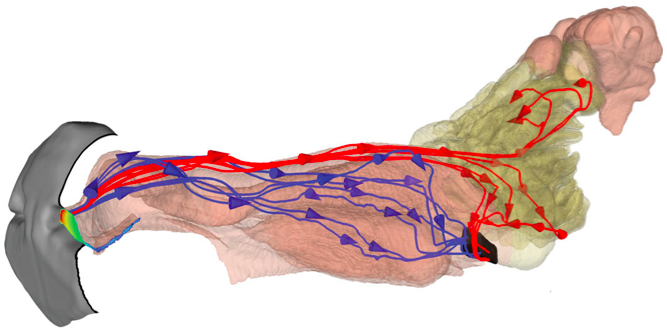
Human noses aren’t built to take in much from that pungent world. When we’re trying our damnedest to smell something, we inhale deeply. But as soon as we exhale, we lose the scent. The airflow patterns of the dog nose are strikingly different: They have one air passage for breathing and another for smelling. …

The dog’s nostrils are in gray on the left; the rest shows the inside of the nose. The brownish area on the right is where all of the smelling, or olfaction, happens — all those receptors sensing different types of odor molecules. The red lines represent the airflow paths when the dog is smelling, whereas the blue lines show the paths during breathing.

You can see that because of the nose anatomy, a dog can quickly move odor molecules to the back, letting them linger atop olfactory receptors. The front area, meanwhile, stays clear for continued breathing. Our olfactory receptors, in contrast, sit at the top of our nasal cavity, easily perturbed as we breathe out.

The biology explains all the dog snorting too, which " helps capture new scents below it and pushes them backwards into the nostril."

Modeling The World’s Future

Michael Ward and Nils Metternich imagine a future in which we can predict major world events based on models like Nate Silver's:

Today, there are several dozen ongoing, public projects that aim to in one way or another forecast the kinds of things foreign policymakers desperately want to be able to predict: various forms of state failure, famines, mass atrocities, coups d'état, interstate and civil war, and ethnic and religious conflict. So while U.S. elections might occupy the front page of the New York Times, the ability to predict instances of extreme violence and upheaval represent the holy grail of statistical forecasting — and researchers are now getting close to doing just that. In 2010 scholars from the Political Instability Task Force published a report that demonstrated the ability to correctly predict onsets of instability two years in advance in 18 of 21 instances (about 85%), including the prediction of instability in Iran in 2004 and Côte d'Ivoire in 2002, for example.

The Daily Wrap

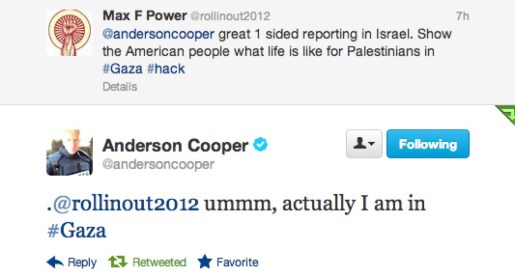
Andersoncooper tweet

Today on the Dish, Andrew shared his thoughts on the evolutionary shift of world values, enjoyed the success of the conservative case for marriage equality, and "totally absorbed" Obama's pot-headedness. In continuing coverage of the conflict in Gaza, Andrew noted the divide between those who wield war as power and those who try to remain just, Beinart hoped Israel would engage Fatah, Michael Koplow wondered if Pillar Of Defense was previewing an Israeli strike on Iran, Amy Davidson shattered the illusion of a "surgical war", and a reader threw up their hands over yet another Israeli-Palestinian crisis. Also, Harry Enten went over the numbers regarding Americans' support for Israel (a country Turkish PM Tayyip Erdogan tagged as a terrorist), while Sharon Udasin stepped in it over Israeli pet trauma and Wasseem El Sarraj identified the strange and horrifying sounds of a Gaza under siege. Elsewhere internationally, we debated the complicated legacy of Kofi Annan.

In political coverage, Andrew joined Michael Brendan Dougherty in respecting Pat Buchanan, Matthew Dickinson examined the uniquely modern advantage of incumbent presidents, David Simon got his Edmund Burke on, Michael Moynihan debunked Oliver Stone's new history book, and Dean Chambers checked himself into the "psychological ward for denial." We also anticipated gubernatorial insurgence over Obamacare, Rand Paul suggested exchanging military spending for entitlements and welfare, Seth Masket correlated political moderateness to time spent out of power, and Alex Knapp took Marco Rubio to school on the Earth's age. Speaking of our planet, Bill McKibben told us how we should talk to climate change skeptics, while Brian Ries explained how Obama's election-night pic ruled the Internet – though the president was not impressed.

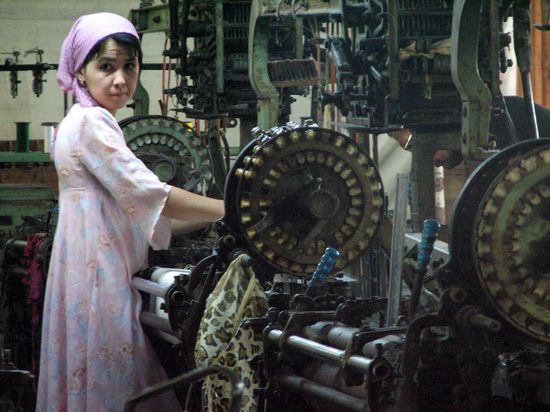
In assorted coverage, readers offered yet more thoughts on the America's military medal inflation, we stared into the money pit of streaming-but-selfish music services, Yolanda Spivey and others exposed the racism of the job market, Mat Honan declared the end of the password, Claudia Hammond used more than 10% of our brains, and Michael Clarke considered a vinyl-like resurgence for hardcover books (as had Nick Carr). James Balog explained the idea behind the new global warming film "Chasing Ice", Rachel Cohen-Rottenberg shared the sensory overload of Aspergers, Jack Gilbert reflected on loss in our Poem For Tuesday, which we better appreciated after rap music opened the creative gate of our minds. Matthew Crawford pondered the often flexible standards that define a job well done, readers zoomed in on Sendai in this week's VFYW contest, Ross Marquand impressed us with his impressions in our MHB, we saw a Cambridge parking lot in the VFYW, and spotted a FOTD in an Uzbek factory.

Lastly, we asked you to tell us about the interesting political conversations you have with your red, purple and blue family members while home for Thanksgiving this week.

– C.D.

(Image: One of the several examples from Buzzfeed's "In The Midst Of Conflict, Anderson Cooper Is Owning People On Twitter" collection.)

Pets Under Fire

Sharon Udasin wrote a story for the Jerusalem Post about the impact of rocket attacks and air raid sirens on Israeli pets. Even while she was still researching the story on Twitter, the outrage was swift:

Tweet

From the inevitable IDFSpokesPet parody Twitter account:

More responses here. Dashiell Bennett defends Udasin:

Animal stories are part of her beat and this particular story also ties into the biggest story in her country right now. (According to her personal website, Udasin is not Israeli, but was born in America and moved to Israel after graduating from Columbia's journalism school.) And reporting on pets during a larger human crisis would not make her unique or heartless. Almost every major U.S. news outlet has run a story about pets lost and displaced by Hurricane Sandy (or any natural disaster) and one of the most popular war stories of recent memory was about the dogs who fight alongside SEAL teams.

Fighting Obamacare Every Step Of The Way

James Capretta and Yuval Levin explain how state governors that refuse to set up insurance exchanges could thwart implementation of Obamacare:

By declining to build exchanges, the states would pass the burden and costs of the exchanges to the administration that sought this law. And it is far from clear that the administration could operate the exchanges on its own. Congress didn't allocate money for administering federal exchanges, and the law as written seems to prohibit federally run exchanges from providing subsidies to individuals.

The administration insists that it can provide those subsidies anyway. But if the courts read the plain words of the statute, then federal exchanges couldn't really function. Thus states that refuse to create their own exchanges would effectively be repealing a large part of the law.

So far, this approach has been embraced by Louisiana's Bobby Jindal, Wisconsin's Scott Walker, Ohio's John Kasich, Maine's Paul LePage and, as of yesterday, Oklahoma's Mary Fallin. Jonathan Cohn considers the consequences:

Obamacare critics believe that, by blocking the subsidies, they’ll undermine the law’s effectiveness and eventually erode support to the point that people clamor for a conservative alternative. It’s the same rationale they cite when they urge states to take advantage of the Supreme Court ruling and reject the expansion of Medicaid. The real world effect of both moves, if successful, would be to deprive residents of these states of financial assistance and access to affordable insurance. And most of these people desperately need the help. Whether poor or middle class, insurance is too expensive or simply unavailable to them, because of their age, work status, or medical condition. Keep in mind that, as the (heterodox) conservative economist Josh Barro wrote recently in his Bloomberg column, the “alternatives” that conservatives and libertarians propose inevitably do little for the uninsured.

Jonathan Bernstein sees this sort of obstruction as unusual:

This effort to undermine the law by undermining implementation may be unprecedented. Can anyone think of a similar historical example? This is different from typical opposition. It’s as if Democrats who opposed missile defense had actively campaigned for contracts to go to the contractors they believed were most likely to produce duds, just so they could eliminate the program after “proving” that it didn’t work.

Rap Your Head Around This

Nic Halverson reports on the discovery of unusual brain activity that occurs when rappers freestyle, as opposed to rehearsed rhyming:

[F]reestylers enter a "flow" state, which researchers described as a "complete immersion in creative activity, typified by focused self-motivation, positive emotional valence and loss of self-consciousness." Their creative gate is wide open.

"It's the absence of attention," said [study co-author Dr. Allen] Braun. "When the attention system is partially offline, you can just let things fly and let things come without critiquing, monitoring or judging them."

Daniel Cressey points to similar research that explains the trance-like state that artists sometimes feel they enter while creating:

Rex Jung, a clinical neuropsychologist at the University of New Mexico in Albuquerque, has also studied the link between brain structures and creativity, finding an inverse relationship between the volume of some frontal lobe structures and creativity…. [This suggests] an explanation for why new music might seem to the artist to be created of its own accord. With less involvement by the lateral prefrontal regions of the brain, the performance could seem to its creator to have "occurred outside of conscious awareness", the authors write.

In related news, scientists in China recently translated brain and physiological activity into music, which could ultimately be used to help patients learn to consciously control brain activity. 

The Recovery In Black And White

Yolanda Spivey, an African-American woman who works in the insurance industry, recounts what happened after she applied for jobs as both herself and a white candidate named Bianca White:

At the end of my little experiment, (which lasted a week), Bianca White had received nine phone calls—I received none. Bianca had received a total of seven emails, while I’d only received two, which again happen to have been the same emails Bianca received. Let me also point out that one of the emails that contacted Bianca for a job wanted her to relocate to a different state, all expenses paid, should she be willing to make that commitment. In the end, a total of twenty-four employers looked at Bianca’s resume while only ten looked at [mine]. 

Mychal Denzel Smith points out that, by the end of 2011, black women had lost more jobs during the recovery than they had during the recession:

Around 40% of the public sector jobs lost have been in local government education, where teachers, librarians, guidance counselors, administrators, and more have seen their jobs vanish. This is field dominated by women, and has been a safe bet for black women seeking employment.

How Spivey's story fits into this trend:

It's no accident that during September of this year, when the public sector actually added 10,000 jobs, all of the job gains that were made by black people belonged to black women. Left solely to the private sector, more black women, contending with racism and sexism in hiring, would likely report stories like Spivey's. The public sector has offered, not full equality, but a reprieve from despair.

Meanwhile, Kevin Roose ruminates on a Bloomberg story comparing the fates of a 64-year-old black female veteran forced to foreclose on her dream house and a white former head of the Bear Stearns' division that bet on mortgage-backed securities and emerged okay:

[It's] a necessary and useful device, because it connects a Wall Street executive to a real-life casualty of the housing bubble and its eased underwriting standards. It undoes the many layers of disintermediation between [former homeowner Rebecca] Black's mortgage and [former Bear Stearns exec Thomas] Marano's bonus, and presents it as a pat (perhaps a little too pat) story about asymmetric losses in times of economic crisis.

Of course, you didn't need the housing collapse to figure out that a Columbia-educated white guy would accumulate more social and economic capital than a working-class black woman, or that the white guy would have a much larger safety net to rely on in times of hardship. But it's humbling to see just how stark the differences in opportunity and recovery time can be.

A Poem For Tuesday

Frig

"Married" by Jack Gilbert:

I came back from the funeral and crawled
around the apartment, crying hard,
searching for my wife’s hair.
For two months got them from the drain,
from the vacuum cleaner, under the refrigerator,
and off the clothes in the closet.
But after other Japanese women came,
there was no way to be sure which were
hers, and I stopped. A year later,
Repotting Michiko’s avocado, I find
a long black hair in the dirt.

More Gilbert poems featured on the Dish here and here.

(Reprinted from Collected Poems © 2012 by Jack Gilbert. Used by permission of Alfred A. Knopf, a division of Random House. Photo by Flickr user ndanger)

The Age Of The Earth Matters

Contra Marco Rubio, Alex Knapp argues that "the age of the universe has a lot to do with how our economy is going to grow." For example:

[S]cientists currently believe that the Earth is about 4.54 billion years old because radioactive substances decay at generally stable rates.  Accordingly, by observing how much of a radioactive substance has decayed, scientists are able to determine how old that substance is. However, if the Earth is only 9,000 years old, then radioactive decay rates are unstable and subject to rapid acceleration under completely unknown circumstances. This poses an enormous danger to the country’s nuclear power plants, which could undergo an unanticipated meltdown at any time due to currently unpredictable circumstances. Likewise, accelerated decay could lead to the detonation of our nuclear weapons, and cause injuries and death to people undergoing radioactive treatments in hospitals. Any of these circumstances would obviously have a large economic impact.