Cambridge, Massachusetts, 11 am
Cambridge, Massachusetts, 11 am
Beinart wishes that Israel would get tough on Hamas by negotiating with Fatah:
So why doesn’t Israel do more to weaken Hamas and boost its rivals? Contrary to the conspiracy theories you sometimes hear in pro-Palestinian circles, it’s not because Israel prefers Hamas. It’s because the Israeli right doesn’t see Abbas and Hamas as fundamentally different. For Israeli and American Jewish hawks, it is taken for granted that Abbas, like Hamas, is not a real partner for peace. Why? Because he won’t recognize Israel as a Jewish state, renounce refugee return, negotiate without a settlement freeze or an agreement on the 1967 parameters, or accept an indefinite Israeli troop presence in the Jordan Valley. What those Israeli and American Jewish hawks don’t usually acknowledge is that many of these litmus tests are new. Egypt and Jordan didn’t accept Israel as a “Jewish state” when they made peace. Ehud Olmert agreed to some limited return of original Palestinian refugees. He negotiated within the 1967 parameters and conceded that the Jordan Valley would be patrolled by international rather than Israeli troops. But by moving the goalposts, Netanyahu and other allies can insist that Abbas hasn’t truly embraced the two-state solution, even though Olmert, who intensively negotiated with Abbas for two years, insists that he has.
Wasseem El Sarraj reports from his home in Gaza:
In our house we have become military experts, specializing in the sounds of Israeli and Palestinian weapons. We can distinguish with ease the sound of Apaches, F-16 missiles, drones, and the Fajr rockets used by Hamas. When Israeli ships shell the coast, it’s a distinct and repetitive thud, marked by a one-second delay between the launch and the impact. The F-16s swoop in like they are tearing open the sky, lock onto their target and with devastating precision destroy entire apartment blocks. Drones: in Gaza, they are called zananas, meaning a bee’s buzz. They are the incessant, irritating creatures. They are not always the harbingers of destruction; instead they remain omnipresent, like patrolling prison guards. Fajr rockets are absolutely terrifying because they sound like incoming rockets. You hear them rarely in Gaza City and thus we often confuse them for low-flying F-16s. It all creates a terrifying soundscape, and at night we lie in our beds hoping that the bombs do not drop on our houses, that glass does not shatter onto our children’s beds. Sometimes, we move from room to room in an attempt to feel some sense of safety. The reality is that there is no escape, neither inside the house nor from the confines of Gaza.
YouTube above from "rosaingaza," who writes, "17 November 2012 I spent the night at an house near Gaza seaport and I put my camera outside the window while the Israeli navy was bombing Gaza."
Noting that Pandora and Spotify are running annual losses in the tens of millions, Galaxie 500's Damon Krukowski wonders why they're in business at all:
The answer is capital, which is what Pandora and Spotify have and what they generate. These aren't record companies– they don't make records, or anything else; apparently not even income. They exist to attract speculative capital. And for those who have a claim to ownership of that capital, they are earning millions– in 2012, Pandora's executives sold $63 million of personal stock in the company. Or as Spotify's CEO Daniel Ek has put it, "The question of when we'll be profitable actually feels irrelevant. Our focus is all on growth. That is priority one, two, three, four and five."
He goes on to write that he has "stopped looking to these business models to do anything for me financially as a musician. " Eliot Van Buskirk has a different view:
Damon claims that Spotify co-founder and CEO Daniel Ek mainly wants it to grow because that way, he can sell his shares — in other words, that Spotify is more of a finance play than a music play. But as the head of indie label consortium Merlin told Evolver.fm in an exclusive interview, he thinks it’s worthwhile for indie bands and labels to put their music on Spotify in part because it’s growing — as is the number of users who choose to pay for it, which is ultimately the number that determines how much musicians, labels, songwriters, and publishers are paid for the music streamed there.
If all of the music fans who listen to free online radio and buy five or so downloads per year were to suddenly start paying $120 per year for Spotify, Rdio, or any other streaming service, that would not only grow those services; it would also represent a significant uptick in money spent on recorded music in general. It’s not happening suddenly, but many argue that it is happening.
A reader sums up the frustration and ennui of many about the latest Israeli-Arab conflict:
Fuck ‘em both. I’m 50 years old, and we’ve been doing this dance for as long as I can remember reading newspapers, and it never changes much. Israel might give Sinai back to Egypt, or Gaza and the West Bank might get some form of Palestinian political control. And then. . . the same old shit. Terrorist attacks on Israel, reprisals by Israel, a cease-fire. Repeat. Repeat. Repeat. Illegal settlements spread, American politicians protest, Israeli politicians waffle a bit or stand their ground, nothing changes. Repeat. PLO or Hamas or Hezbollah, whichever Israeli PM, each accuses the other of being the impediment to “lasting peace.” Repeat. The details shift, but the fundamentals do not change. It just goes on and on.
So most Americans who are not Millennialist Christians or hard-core Zionists really do just tune it out. Speeds up reading the paper every day, as I can just skip the details about the latest iteration of the same old shit. On my most extreme days, I shamefully hope for some kind of nuclear catastrophe, and we’ll deal with the environmental catastrophe entailed by such a thing. But at least we’ll be done with this endless fight, which you recently pointed out is insoluble: religion plus politics plus territory cannot be negotiated.
I know that this sort of feeling is deeply flawed, but I honestly have felt this way since the late 1980s. And I feel it more strongly now, and many people I know express similar emotions. Here We Go Again. Why Bother?
That's why it's called the audacity of hope, I guess.
Four more years. twitter.com/BarackObama/st… — Barack Obama (@BarackObama) November 7, 2012
Brian Ries tells the story behind the iconic tweet seen above:
That photo, taken by a campaign photographer [Scout Tufankjian] just a few days into the job in mid-August, has broken all sorts of Internet records. With more than 816,000 retweets as of Sunday, it’s the most shared picture in the history of Twitter, beating out entries from Justin Bieber and the fast-food chain Wendy’s. It’s also the most-liked photograph ever to be shared on Facebook, amassing almost 4.5 million “likes” since Election Day. And it’s sure to be the photo most everyone with an Internet connection will remember seeing as they heard that Barack Obama – for better or for worse – would reside for four more years at 1600 Pennsylvania Avenue. …
But, perhaps surprisingly for a campaign with a deep love for data, where even the subject lines of emails were formulated based on intense rounds of numbers-backed analysis, the selection of the “four more years” photograph was a decision made on the fly. It was chosen by a 31-year-old digital operative [Laura Olin] who had been up since 4 in the morning. She was completely exhausted.
Continued here. Slate has an interview with Olin. Below is further proof that Obama is the president of the Internet:
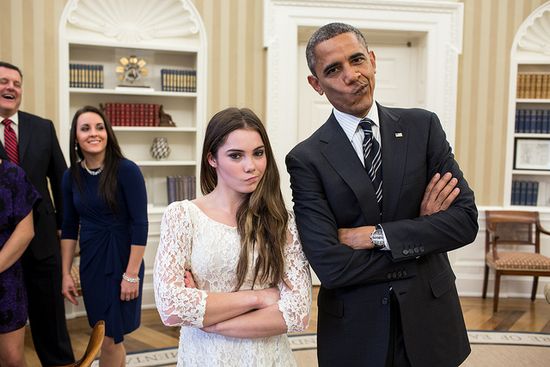
By Pete Souza. Meme explanation here.
More servicemembers respond to our popular thread:
Promotion to sergeant and to staff sergeant is based on a points system. One of the categories is Awards and Decorations, for which a soldier will earn a certain number of points for each award or badge that he or she wears. This system encourages leaders to find a reason to recommend someone for an award, when a reason may not be obvious (and if it's not obvious, is it really awards-worthy?).
When I was enlisted, I was awarded five Army Achievement Medals, one Army Commendation Medal and one Meritorious Service Medal. All of that in a six-year enlistment, without a deployment. Why? Because my superiors wanted to see me get promoted. But as a result, I have a number of relatively meaningless awards.
In a refreshing break from the norm, some soldiers have elected NOT to wear all of the awards and decorations that they're authorized. For example, look at this photo of Chairmen of the Joint Chiefs GEN Martin Dempsey, wearing just two rows of ribbons on his uniform.
Another:
I was deployed on the USS TRUMAN in 2010, working for an F/A-18 squadron. One of the pilots from my squadron was flying around the ship at night and spotted a ship on fire. He reported it and a helicopter was dispatched, resulting in nine Iranian fishermen being rescued. It was a a great thing to do, no doubt about it. But then every single person who was involved with the rescue, from the Hornet pilot, the helo crew, the medical personnel who took care of the fishermen, the translators and even the cooks who cooked for the fishermen got a Navy and Marine Corps Achievement Medal (NAM). Every single one. We joked that the Hornet pilot got a medal for seeing a fire at night in the middle of the ocean.
I've been in the Navy for about five years and have recieved more than my share of medals. I already have two NAMs, but only one of which I'm proud (ie I did something worth mentioning). My first NAM was for not getting fired at my first job, basically, and when I leave my current command, I'm going to get another for the same reason.
My grandfather served as a radio technician in the Air Force in the '50s. While staitioned in Alaska, he was the only person to hear a faint distress call from a town whose generator had broken and who was running out of food and water. He reported it and the town was saved. In today's military, he would have gotten a big award for just doing his job. Back then, they offered him the equivalent of a certificate saying "Good job!" and he turned it down, as he was just doing his job.
Another:
I agree that there seems to be an over-abundance of medals and awards, and yes, they can be awarded for something that happens off-duty. I share a few of the ones worn on General Patraeus' chest, having served two tours in the Middle East. However, I will say this; most don't boast. And they aren't really for the public anyway. We don't wear these for you. We wear these for our brothers and sisters-in-arms.
Think of this way; at your job, if you meet performance expectations, and/or exceed them, you receive a bonus, be it monetary or otherwise. We have similar expectations, but unlike you, cannot be awarded any such gift for this or even a heroic act. You get a set of golf-clubs for 10 years at your job, I get a ribbon. I care what that ribbon means, like you would be proud of your golf clubs mean. What some people call boastfulness is a snapshot of our career on our chest.
Another:
I'm a civilian, and for a long time, my concept of the medals on a soldier's chest was that the soldier earned them in combat by going above and beyond. Then I started writing a short story and needed some detail about a ribbon on a soldier's uniform. It was a bit of a revelation.
The one that stuck with me was the Antarctica service medal. You get it for being in Antarctica. If you spend a winter there, you get a device to pin to it. Two or three winters and the color of the little pin changes.
No doubt, Antarctica is a tough assignment. But it's not a war zone and might not require any braver action than surviving the cold. My suspicion is that it mostly involves ferrying supplies to scientific outposts. It's very important and probably dangerous, but it's dangerous because of the weather, primarily, not because there's terrorists in Antarctica.
I suspect most civilians assume, like I did, that all those medals mean tremendous acts of bravery. A lot of them, like your Marine reader points out, are for showing up. It's like a soldier's service record in ribbon form. A soldier's superiors need to know he was in Antarctica. It probably helps them figure out who has the necessary experience for some assignment. Likewise, knowing that a soldier was in a combat area is important for health care providers should he need mental health care down the road.
But most of us in the civilian world don't know what all those little colorful things mean, and we make assumptions. We don't know that one of those is for not getting in trouble for a certain number of years, so we assume it's for doing something awesome.
The worst of it is, I suspect Petraeus and generals like him know that those of us outside the military don't have a clue what all those things mean, and they know we look at them and assume they must be amazing soldiers. And they may be, but not all those medals really tell that story.

There really is a conflict, it seems to me, between those of us who have come to see conservatism and nonviolence as intertwined and those who see war as itself as a tool of raw power; between those of us who cling to just war theory as a model for preserving civilization even in times of necessary conflict, and those who have never had much time for just war theory at all. There is a long way from Aquinas to Machiavelli. So the Israeli model of "mowing the lawn" by using superior arms and technology to constantly wage war on neighbors who refuse to accept its legitimacy has left just war theory in the desert sands. Daniel Larison gives us an excellent example of the distinction:
According to the Catechism of the Catholic Church, the requirement of proportionality in just war theory is that “the use of arms must not produce evils and disorders graver than the evil to be eliminated.” By any reckoning, the current operation in Gaza has already done this, and the harm will be compounded if the Israeli government decides to launch a ground invasion. The fact that it is not yet as disproportionate as Operation Cast Lead or the second Lebanon war doesn’t make it all right. There are several other tests required in just war theory that Mead simply ignores, including whether there are “serious prospects of success,” which assumes that a given military operation has definable, obtainable objectives. Those objectives seem somewhat unclear in this case, so it’s difficult to argue that there are serious prospects of reaching them.
Between Hamas's evil targeting of civilians to Israel's massively disproportionate power over a crowded refugee ghetto, it's a bleak moral scene – and getting bleaker. And one cannot help but think that the Israeli view of counter-terrorism – an abandonment of just war theory in favor of pre-emptive war against eternal foes – came, in the Bush-Cheney administration, to infect America.
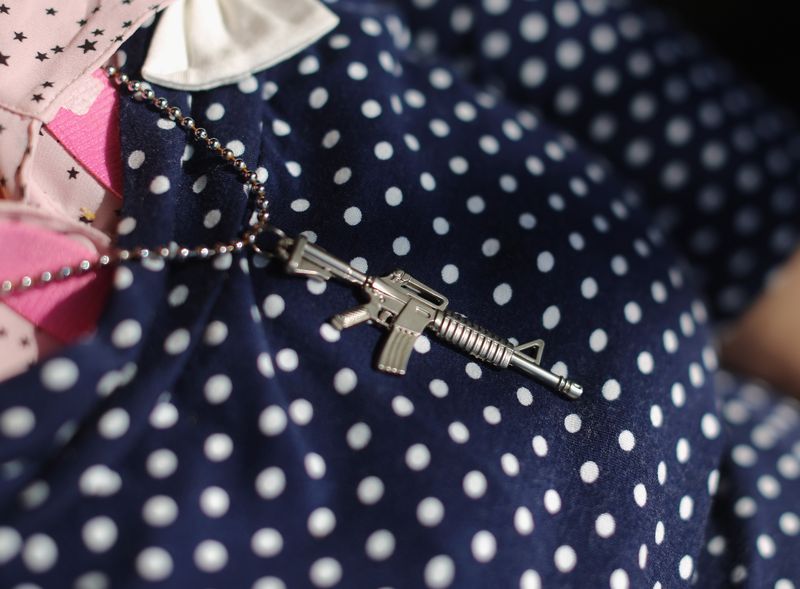
(Photo: An Israeli woman wears a trinket in the shape of an M16 rifle as she sits in a cafe on November 20, 2012 close to Israel's border with the Gaza Strip near Ashkelon, Israel. By Christopher Furlong/Getty Images)
So declares Mat Honan, whose online identity was famously hacked this summer:
Access to our data can no longer hinge on secrets—a string of characters, 10 strings of characters, the answers to 50 questions—that only we’re supposed to know. The Internet doesn’t do secrets. Everyone is a few clicks away from knowing everything. Instead, our new system will need to hinge on who we are and what we do: where we go and when, what we have with us, how we act when we’re there. And each vital account will need to cue off many such pieces of information—not just two, and definitely not just one.
 The Dish