Marriage Equality Update

Equality_Map

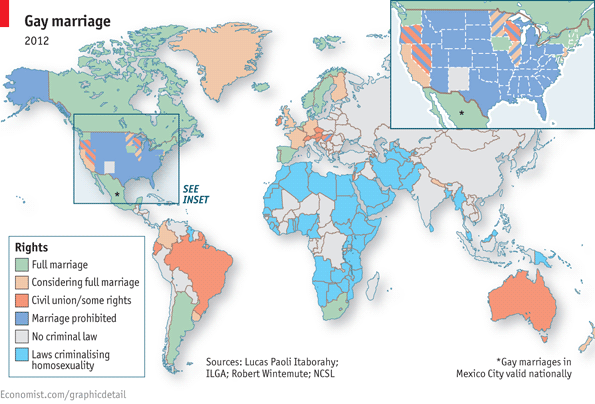
The Economist maps global marriage laws:

Same-sex marriage is now legal nationwide in 11 countries, including Argentina and South Africa, as well as in parts of a further two. In Mexico it is allowed in the capital. In America nine states and the District of Columbia have legalised it, including three which, for the first time, did so by popular vote on November 6th, ending a succession of electoral defeats for the measure in 32 states. In Catholic France the new Socialist government has just approved a bill to permit same-sex marriage. That said, in 78 countries—mostly in the Muslim world, Africa and other developing states—gay sex is still a crime, punishable by long prison terms and even death.

One more striking development in the US: Michigan residents now favor marriage equality by a double digit margin in new polling.

Sometimes I think the whole world is really a version of America's red and blue – but with the red much redder elsewhere (think Pakistan) and much bluer too (think Paris or Barcelona). Globally, we are witnessing an evolutionary shift about sex and marriage, men and women, gays and straights, blacks and whites and all the nuances in between. In the past, such shifts occurred gradually, as tradition reinvented itself in coherent societies. Today, with new media and a global economy, the conflicts and shifts that might be resolved gradually and peacefully in various societies at various stages of evolution, are unmissable and graphic everywhere at once. So you have both Victorian homophobia in Africa alongside the emergence of a gay rights movement in that continent. You have the web uniting the teens of Iran and Tunisia – but polarizing their own societies into modernists and fundamentalists (where the fundamentalists have the majority).

In some ways, this last election settled the red-blue issue in America, by rendering it a bluer shade of purple in several states. Here, we now know the fundamentalists, even when allied with others, are, in fact, a minority. And so the next phase of integration can begin. Elsewhere? The wars will rage on – prematurely on the ground, and far too late on the web. It's this aspect of the web that is often over-looked; it can break societal mores very easily; but it does not yet have the resources or reach in more traditional areas to rebuild them.

Do Americans Stand With Israel?

Harry Enten digs into polling on the subject:

[T]here is a relatively wide difference between how Democrats and Republicans view Israel. Per the CNN/ORC poll, which mirrors other recent data, 51% of Democrats sympathize mostly with the Israelis, and 16% with the Palestinians, in the conflict at large. This compares to an 80% v 5% split between Israelis and Palestinians respectively among Republicans.

You might be wondering how there could be a 29-point split between Democrats and Republicans on pro-Israel sympathy, in contrast to only an 11-point difference between Democrats and Republicans on pro-Palestinian sympathy. That is chiefly because Democrats are far more likely to say their sympathies are with both Israelis and Palestinians (6%) or neither (14%). Put another way, Democrats aren't really any more sympathetic to the Palestinians than Republicans are, so much as they sympathize with both sides or don't care much for either.

Geo-Politics And Dead Babies, Ctd

GT GAZACRATERAL DALLUFAMILY 20121120

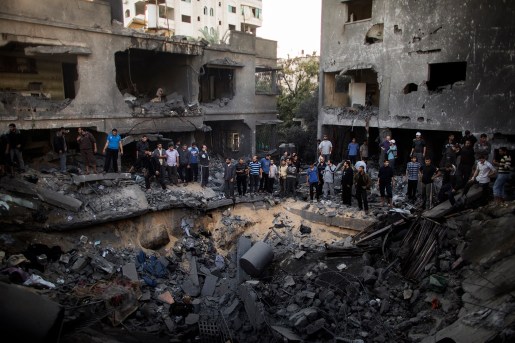
Amy Davidson responds to an IDF airstrike that unintentionally wiped out nearly an entire family in Gaza, including four children. She worries that Israel and the United States have bought into the "illusion of surgical war":

This was not some little bomb slipped in between the windows; according to the L.A. Times, “the force of the blast blew out windows blocks away and sent a charred mattress flying into the street.” (See Wasseem El Sarraj on the sounds of the bombs.) It is hard to see how, even if the bomb found who it was looking for, indiscriminancy wasn’t built in. The replies are that Hamas’s rockets don’t discriminate either, that war is always messy, and that the problem and the blame is with men who fire rockets and choose to live among children. But attempting to construct equivalencies is no way to feel better about the death of children; and the point about messiness is why one gets angry at wars, not why one shrugs at them. And it should be all the more jarring, given that the messaging of this war—at times boastingly via Twitter, and in stories about drones taking out motorcycle riders—has been about its supposed precision.

(Photo: Palestinian men gather around a crater caused by an Israeli air strike on the al-Dallu family's home in Gaza City on November 18, 2012. By Marco Longari /AFP/Getty Images)

A Conservative Of The Heart

Michael Brendan Dougherty profiles the irascible, iconoclastic pundit and former politician Pat Buchanan, who describes himself as "a right-wing troublemaker from Northwest [DC] that likes poetry." The thing about Buchanan is that, unlike so many in Washington, he's actually intellectually sincere and internally coherent. Which became a problem:

Buchanan never signed up to be in the conservative klatsch. The movement frankly bored him even as he was trying to bring it into the Nixon fold. “I was never in that,” he says now, recalling all the little organizations like Young Americans for Freedom or the Liberty Society. "In the conservative movement there is all this talking and meeting. I viewed a lot of it as just a waste of time. I learn more when I’m reading.”

He liked many of National Review’s writers, to be sure. But when Garry Wills asked him if they had any influence, he could recall none. "I was going to say Burnham, but when I read Suicide of the West I already agreed with it," Buchanan says before quoting Jacques-Bénigne Bossuet, “The heart has reasons that reason does not understand.” Years later he would tell the 1992 Republican convention that the party needed to reconnect with people who don’t read Adam Smith or Edmund Burke, but who remain "conservatives of the heart." He could have been referring to a less tutored version of himself.

My defense of Buchanan, after he was fired from MSNBC, here. Reader responses here and here.

The View From Your Window Contest: Winner #129

Vfyw_11-17

A reader writes:

The boxy architecture and the blue mesh-protected construction site remind me of northern Asia, though the house in the center looks more western.  Since the taxi looks kinda like a Russian taxi and the SUV and vans have markings kinda like Russian police vehicles, lets say Russia. The upper flag on the pole appears to have a green triangle on a white field, and the closest match I could find is that of Khabarovsk Krai in the Russian far east. So let's go with its capital: Khabarovsk.

Another:

This is a view of Sochi, Russia, from a Dish reader who is helping get the city ready for the Winter Olympics.  

Another:

Maybe this is in an older section of Hagatna, capital of Guam?  Guam has the same land area as the Alaskan island where I live, but is otherwise a mysterious place that seems to surface only during the 4-year cycles of summer Olympics and political conventions.

Another:

Hi – the geography teacher here again. This week’s guess is the result of input from members of both my class and my department. My initial reaction was that this was somewhere in the Balkans, but one of my students insisted that it resembled parts of Japan that she had seen, while a colleague said it reminded her of her recent trip to Seoul. I am going to go with somewhere in South Korea, for the following reasons: the architecture, specifically the roof tops, the mountains in the background, the vertical sign in the background that looks like it has a cross on top of it, and the cars. The gray vehicle in the foreground looks like a Chevy Beat, which is produced by GM South Korea. One of my students pointed out that it looks like one of the cars is not parked, but is driving – on the left side of the road; that would suggest Japan, but it seems to me that there are too many other indicators of South Korea. But not Seoul. I think somewhere closer to the Chiaksan National Park, so I am going with Wonju. Plus, maybe you posted a photo of South Korea in honor of Psy’s appearance on the American Music Awards on Saturday.

Another gets on the right track:

Oohhhh, I just know this is Japan.

From the scenery it's not the middle of Tokyo, but I can't narrow it down much further than that. (Couldn't there at least have been a convenience store logo?) I'll take a stab at Sapporo because it reminds me of my visit to lovely Hokkaido in 2010 and because that'll keep me away from any of the Tokyo-centric guesses. Thanks for the contest!

Japan it is. Another:

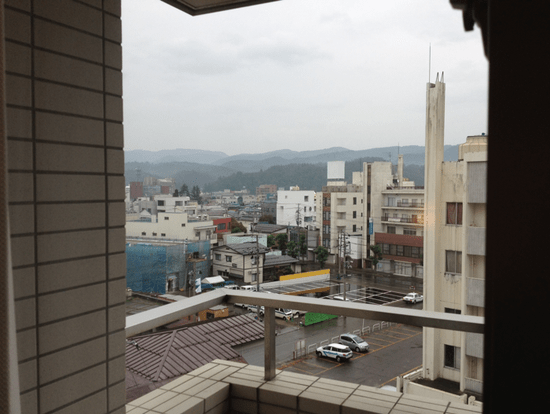
This view is obviously in Japan. The sterile brickwork on the building we are looking from is the first strong clue, followed by the poured concrete construction of some of the buildings in the center and to the right, the squat water tank on one of their roofs, the giant temporary screens around the houses under renovation or construction, and even the abundance of above-ground utility wires – to say nothing of the "traditional" looking roof on the building in the lower foreground, which is probably made of sheet metal. These are things that anyone in Japan sees many times a day.

And that's where things get tricky. Such details are so common that it could be almost anywhere in Japan. The mountains in the background narrow it down a little, but very little. There are some industrial-looking buildings in the distance to the left – if only I could make out what they were.

But since I have to take a stab at the city, I'm going to say Tokyo – specifically its western reaches. Many people associate the word "Tokyo" with gleaming skyscrapers near Tokyo Bay, but the borders of the metropolis extend far west into the moutains, with the buildings getting smaller and smaller (but remaining just as dense) until there is nowhere left to put them. This photo could be from one of the areas where the city finally runs out of flat space.

So that's my guess. Western Tokyo, Japan.

Another:

This photograph is,
Unmistakably Japan;
Could it be Ota?

Another:

A couple of things about this photo give it away as Japan to me, including the shape of the white railings next to the parking spaces (not to mention the car backed into the space – Japanese are very particular about proper parking), the style of the blue sheeting material around the building under construction on the left, and even the tiling of the apartment block from where the photo is taken.

Unfortunately, this photo provides few clues that might help narrow down a specific location. Japan has hundreds of small, nondescript regional cities and is mountainous nearly everywhere, so the hills don't help. Still, based on the cloudy weather and the empty streets I'm going to make the most educated guess I can and go with Ichinoseki, Iwate Prefecture in the northeastern Tohoku region. I lived there for a week while volunteering in nearby communities hit by the tsunami and the scenery on my walk every evening from the apartment to the public path was very similar to this. This is the first time I've felt I have a short at VFYW so I'm crossing my fingers that I'll at least be close!

Another gets closer:

I've worked in commercial real estate here in Japan for over a decade and I've traveled all over the country inspecting properties even in rural locations.  Depressingly, most Japanese cities look very similar.  So in trying to think of a rural location without recognizable landmarks that might turn up in the VFYW contest, I'm going with Fukushima, somewhere near the station looking East.

Closer still:

I lived in Japan for seven years. I am not 100% positive, but the VFYW picture looks an awful lot like Sendai.

Sendai was the most proximate guess among all the entries, so that reader is the winner this week. Update: Doh – Ichinoseki is actually a tad closer, so the third entry from the end is the winner. The exact location is revealed by the photo's owner:

Yokote is not exactly on the main tourist route.  The photo is from the Hotel Plaza Annex Yokote.  For the life of me I can't remember which room we were in – it might have been 625. On a trip around Töhoku we stopped off for one night in order to visit my husband's best friend from college (Tokyo University of Agriculture, popularly known as "Nodai"), who lives in that general area. Töhoku means literally the "north-east" and is the whole northern section of the Honshu, the main island.  Most people probably heard the term because the earthquake and tsunami affected the east coast part of the region.  But Yokote is inland, in Akita-ken, which is especially known for growing rice and making sake.

(Archive)
Quote For The Day II

“How about another compromise? Republicans who think military spending, myself, who think national defense is important, should compromise and say, you know what, not every dollar spent on the military’s sacred, we can reduce the military spending, that’s a compromise. Democrats should compromise also — entitlements and welfare, the spending can come,” – Rand Paul to Jon Karl.

The Silent Stoner President

Back in 2004, Obama didn't laugh off questions about marijuana:

Mike Riggs notes that Obama "has yet to acknowledge that a massive shift in drug policy happened on the same day he was reelected":

This isn't going away. Legislators in Rhode Island and Maine–states that already have medical marijuana–are introducing legalization bills in 2013. The 2014 election will likely see more marijuana-related ballot initiatives. If a more nuanced response is in the works, Obama should not only say so, he should be the one to deliver it.

And Obama has a story to tell that's worth telling, if he wanted to:

The group — "decent students and athletes who went on to become successful and productive lawyers, writers, and businessmen" — dubbed itself the Choom Gang. A favorite hangout was a lush hideaway called Pumping Stations, where they parked their cars, turned up Blue Oyster Cult on their stereos, "lit up some 'sweet-sticky Hawaiian buds,' and washed it down with 'green bottle beer.'" Once stoned, Maraniss alleges, the gang was often seen slipping past the "keep out" signs at the gorgeous Manoa Stream and standing under a rock where water rushed overhead.

What Maraniss reveals is that Obama wasn't just a passive peer-pressure stoner; he was a hard-core pothead. He even regulated the inhalation of others by coining the term "total absorption" and was always bogarting the joint. Then there are the real origins of "leading from behind":

One of the favorite words in their subculture revealed their democratic nature. The word was veto. Whenever an idea was broached, someone could hold up his hand in the V sign (a backward peace sign of that era) and indicate that the motion wash not approved. They later shortened the process so that you could just shout "V" to get the point across. In the Choom Gang, all V's were created equal.