Well, someone had to do it … and who better than Michael Moynihan?
Month: November 2012
The View From Your Thanksgiving
This year, we have that quadrennial favorite: the post-election get-together. In a campaign in which it sometimes seemed as if one half of the country was talking past the other half, we thought it might be interesting to ask readers to email us if they had any political discussions with family members that added more light than heat. Special props for red-blue family reconciliation – or otherwise. It’s been a fascinating cultural year and Americans now get to discuss it at their own dinner table.
Let us know how it goes; and we’ll tell everyone else.
Ask McKibben Anything: How To Talk To Climate Skeptics?
Our feature returns at last:
Bill McKibben is one of the world’s leading environmentalists and writers:
In 2009, he led the organization of 350.org, which organized what Foreign Policy magazine called “the largest ever global coordinated rally of any kind,” with 5,200 simultaneous demonstrations in 181 countries. The magazine named him to its inaugural list of the 100 most important global thinkers, and MSN named him one of the dozen most influential men of 2009.
Our first video with Bill is here. Read some of his Sandy coverage featured on the Dish here, here and here.
Is Pillar A Prelude?
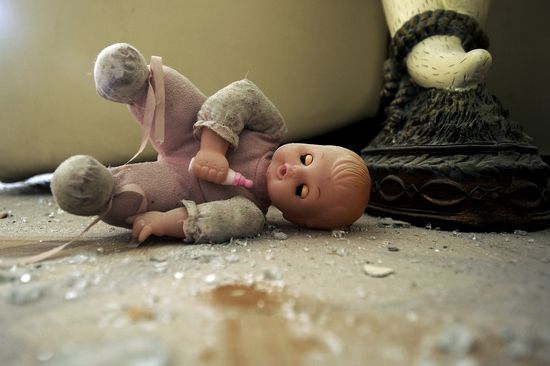
Michael Koplow explores the possibility that Pillar Of Defense will make an Israeli strike on Iran more likely:
If Iran is giving Fajr-5 missiles to Hamas, many Israelis are going to ask themselves whether the assumption that Iran would never supply Hamas with a nuclear missile is perhaps wishful thinking. It was much easier to not feel it necessary to launch a preemptive strike on Iran when there weren’t Iranian missiles being launched at Israeli cities, and my hunch is that the Iranian component to this is going to make Israelis more hawkish on the subject and think about how crowding in stairwells and bomb shelters is one thing for poorly made rockets and a whole different can of worms for Iranian nuclear missiles.
Oh great. Tom Ricks is on the same page, posting an e-mail wondering whether Israel is prepping for an attack on Iran:
If Israel is on the cusp of preempting Iran, it would be a very smart thing to crush Iran's surrogates on the border and neutralize prepositioned weapons that might be brought to bear when the gloves come off with the Farsi folks. At least, this is what I would do in advance of an attack on Iran. Tick-tock, tick-tock.
Previous coverage on the possible connection of Pillar Of Defense to Iran here.
(Photo: A doll lies in a damaged house after a rocket fired by Palestinian militants from the Gaza Strip landed in the southern Israeli city of Ashdod on November 17, 2012. By David Biumovitch/AFP/Getty.)
The Conservative Case For Marriage Equality
I guess I was onto something all those years ago. In the four marriage equality successes this November, the following themes were the most potent:
A shift away from talk of "rights" to a focus on committed relationships; a decision to address "values" directly as being learned at home …
What some have yet to understand is that marriage equality is not an "attack" on "morality". It's a way to affirm the already existing commitment to one another that a gay couple can achieve, to create a stable home where none existed before, to affirm values of mutual responsibility and care that are conservative, in as much as they protect the family from the acid of homophobia. It's homophobia that tears families apart, not same-sex orientation. And it's marriage that brings families together – including, at last, the gay members within it.
In many organic social changes right now, what appears to be de-moralizing is actually a form of re-moralizing, devising ways to channel already existing behavior into new and more productive and more responsible forms. That's what the marriage equality movement has in common with the fight against marijuana prohibition. It admits reality – loads of people are gay and even more people smoke weed – and makes the best of it, in true Burkean fashion. It offers civil marriage to gay people and a perfectly marketable, legal product to marijuana-enthusiasts – giving states revenues, parents' more security, and millions of people a reason to watch HD TV. It folds people into middle class society, rather than marginalizing them outside.
And that's a good thing, as Martha Stewart would say.
Quote For The Day
"Change is a motherfucker when you run from it. And right now, the conservative movement in America is fleeing from dramatic change that is certain and immutable. A man of color is president for  the second time, and this happened despite a struggling economic climate and a national spirit of general discontent. He has been returned to office over the specific objections of the mass of white men. He has instead been re-elected by women, by people of color, by homosexuals, by people of varying religions or no religion whatsoever. Behold the New Jerusalem. Not that there’s anything wrong with being a white man, of course. There’s nothing wrong with being anything. That’s the point.
This election marks a moment in which the racial and social hierarchy of America is upended forever. No longer will it mean more politically to be a white male than to be anything else. Evolve, or don’t. Swallow your resentments, or don’t. But the votes are going to be counted, more of them with each election. Arizona will soon be in play. And in a few cycles, even Texas. And those wishing to hold national office in these United States will find it increasingly useless to argue for normal, to attempt to play one minority against the next, to turn pluralities against the feared “other” of gays, or blacks, or immigrants, or, incredibly in this election cycle, our very wives and lovers and daughters, fellow citizens who demand to control their own bodies," – David Simon, channeling Edmund Burke.
Waiting For An Eisenhower
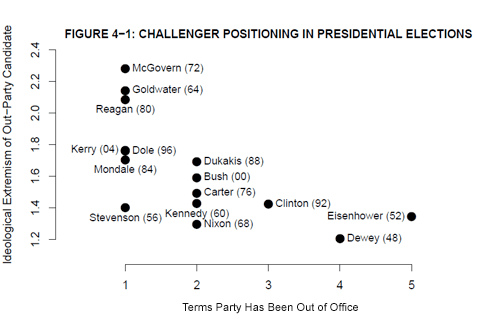
Seth Masket posts the above chart from The Party Decides:
[T]he longer a party is deprived control of the White House, the more moderate its presidential nominees become. One term out of office may be a fluke, but two terms is serious, and three is catastrophic. Parties take this seriously and tend to nominate considerably more centrist people, sacrificing a significant chunk of their governing agenda for a chance of actually governing.
That assumes a party hasn’t jumped the shark and become a populist-religious movement more concerned with purity than power. But maybe that’s just part of a transitory phase as well. But here’s hoping we have a credible GOP by the time the Obama wave subsides. A country needs two sane parties, not just one.
Maximizing The Mind
Claudia Hammond busts the myth that we only use 10% of our brains:
Nine-tenths of the cells in the brain are so-called glial cells. These are the support cells, the white matter, which provide physical and nutritional help for the other 10% of cells, the neurons, which make up the grey matter than does the thinking. So perhaps people heard that only 10% of the cells do the hard graft and assumed that we could harness the glial cells too. But these are different kind of cells entirely. There is no way that they could suddenly transform themselves into neurons, giving us extra brain power.
Debating Annan’s Legacy

Reviewing Kofi Annan's memoir, Interventions: A Life in War and Peace, Rory Stewart is skeptical about the accomplishments of the former UN Secretary General:
The idea of Annan as a heroic world-changer continues to be very useful to many institutions…. But in fact, Annan and the other "global leaders" at his level are unlikely to deliver the kinds of change our institutions require.
Truly transformational change relies on exactly the reverse of Annan's worldview. It requires optimism about local capacity, and scepticism about the role of the international community. It is more likely to emerge from immersion in the history, the desires, the strengths, and the imagination of a particular culture. In short, change, like politics, is local. Gandhi or Mandela did not forge their reputation and legacy by moving between four continents, a dozen conflicts and fifty conferences, but by staying home.
As Michael Ignatieff sees it:
The essential paradox of Annan’s career is that through a period in which the UN’s prestige declined in the 1990s, crippled by moral promises it failed to keep, his prestige emerged unscathed.
However, Ignatieff sees judgment of Annan's record as more complicated than Stewart's view:
Annan’s story is a cautionary tale about the fragility of moral prestige in a world still stubbornly ruled by state interest. He can be seen as an entrepreneur of moral standards, promoting new ideas of collective behavior, sovereign responsibility, and international criminal accountability for a world that briefly believed that globalization might bring us together. He put his own prestige on the line to bring peace to war zones from Bosnia to East Timor. He will talk to tyrants if there is a chance for peace.
To achieve these goals, he was prepared—this was the essence of his job—to live with the narrow nationalism of the state interests he served and the cowardice of the UN bureaucracy that made him who he was. No one ever came closer to being the voice of "we the peoples" and no one paid a higher price for it. The world still needs such a voice, but the next person who tries to fill that role will want to reflect long and hard on the lessons of this candid, courageous, and unsparing memoir.
(Photo: UN-Arab League envoy Kofi Annan looks on before a meeting at his office at the United Nations Offices in Geneva on July 20, 2012. Annan is 'disappointed' at the UN Security Council's failure to press for an end of the Syria conflict, his spokesman said after Russia and China vetoed a resolution proposing sanctions against the government. By Fabrice Coffrini/AFP/Getty Images)
The Incumbent Advantage
Matthew Dickinson ponders it:
Why is it so difficult to defeat an incumbent president in the modern era? One likely reason is that the office is much more visible, so that presidents simply by virtue of carrying out their duties in a non-partisan way, such as providing disaster relief, can score political points. It may also be the case that in an era of nuclear weapons and other WMD’s, the presidents’ foreign policy role enhances their political standing. That is, as national security issues loom larger in voters’ calculations, the incumbent president’s foreign policy role is magnified. Moreover, despite the criticisms his comments entailed, Romney was right when noted – albeit perhaps not in the most diplomatic manner – that Presidents are relatively well situated to influence policies in ways that reward key voting blocs. All this is somewhat speculative, of course, but I am persuaded, in the absence of countervailing evidence, that modern incumbents generally run for reelection with advantages that their premodern forebears did not possess.
 The Dish